




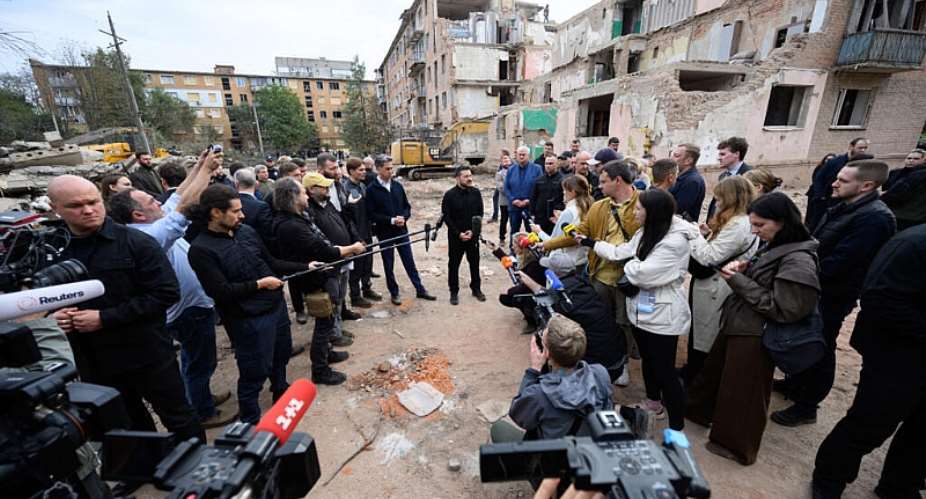
As Russian bombs rain down on Kyiv, explosive revelations about corruption, scandal and misuse of public funds also regularly rock the city.
For Sofia Troshchuk, a journalist and presenter on news channel 24, it is impossible to ignore these issues.
"Of course, corruption is a painful issue for any democratic and civilised country, and for Ukraine, which is in the throes of a bloody war, even more so. Because all that stolen money literally represents the lives of Ukrainians, including my own," she explains.
"This issue affects me not only professionally, but also as a citizen – because my life and those of my loved ones depend on how Ukraine manages this money."
It is a dilemma faced by any journalist investigating their own country, but one that is undoubtedly exacerbated in times of conflict: having to report on controversial issues, even though this may tarnish the country's image – not only in the eyes of the public, but of international partners the country is depending on.
But for Troshchuk, investigating abuses of power does not mean weakening Ukraine – on the contrary.
"The question of whether or not to cover this topic does not even arise in any Ukrainian media outlet worthy of the name," she says.
"And I love these stories, because they show Ukrainians and the whole world just how democratic their country remains and how much it aspires to a better life. Because when people see that the state is doing something unjust, they protest and fight for their rights, even in times of war."
Russia accuses France of 'silencing dissent' over journalist expulsion
Numerous scandals
There is no shortage of cases to cover. In late 2025, anti-corruption agencies uncovered the "Midas affair" – a sprawling case of money laundering and embezzlement in the energy sector.
A network with close ties to the government – including businessman Tymyr Mindich, a close associate of President Volodymyr Zelensky, as well as the former minister for energy and justice, Herman Haluschchenko – is alleged to have demanded bribes of between 10 and 15 percent on certain contracts, laundering nearly $100 million.
Following the revelations, several senior officials were arrested and Andriy Yermak, head of the presidential office, was forced to resign. The scandal undermined the credibility of the Ukrainian government and raised questions about the use of public funds in the midst of a war.
Corruption scandal exposes 'absolute impunity' in Ukraine's energy sector
Media outlet Ukrainska Pravda played a crucial role in revealing the extent of the scandal.
Its investigative team, led by journalist Mykhailo Tkach, revealed the identities of some of the key figures, as well as the fact that Mindich had fled to Israel, where Tkach confronted him on camera.
Ukrainska Pravda's coverage prompted a parliamentary committee to summon the individuals identified in its recordings.
Last month Operation Carthage, also carried out by anti-corruption agencies, indirectly implicated former prosecutor general Ruslan Kravchenko and one of his close associates in connection with an alleged network protecting fraudulent call centres.
Although he has not been charged, Kravchenko has left Ukraine and, according to revelations by Tkach in Ukrainska Prava, settled in Vienna with his wife, with the aim of applying for political asylum there.
While investigating Kravchenko, on 8 October Tkach was arrested in Vienna and questioned for more than 12 hours.
Public support
At a time when Ukraine needs the support of its European allies more than ever, and is hoping to join the European Union, these investigations are a source of embarrassment for Ukrainian authorities.
But they have the backing of the public. In the summer of 2025, thousands of Ukrainians took to the streets in protest following an attempt by the government to muzzle anti-corruption agencies – a move which was widely reported in the press.
This summer, the controversial dismissal of former defence minister Mykhailo Fedorov also sparked protests, with the public demanding that their government explain the decision.
Faced with the scale of the movement, which was covered by local and international media, the unpopular commander in chief of the army, Oleksandr Syrskyi, was dismissed.
Ukraine's wartime unity put to the test by protests over military leadership
A report published by the Kyiv International Institute of Sociology following the protests in the summer of 2025 showed that such revelations have been largely welcomed by Ukrainians, who regard their country as being committed to the fight against corruption.
In contrast, by the end of 2025 only a third of the population said it trusted the media as a whole – even though more than 90 percent believed it should still be possible to criticise those in power, even in times of war.
Troshchuk is not surprised by this attitude. She sees it as a national trait: "I sometimes feel that putting things right in a difficult but fair way is in the nature of Ukrainians."
This article has been adapted from a report in French by RFI's correspondent in Kyiv, Emmanuelle Chaze.


 Mahama Defends Gold Export Restrictions, Signals Ban on Raw Mineral Exports by 2...
 Judicial Secretary Urges JUSAG to Suspend Planned Strike
 Education Ministry Orders Probe into Alleged Assault at Techiman SHS
 Chief Inspectors’ Amnesty Promotion: Supreme Court grants Police Administration ...
 Police deploy officers and cameras nationwide as TraffiTech-GH enforcement begin...
 Govt to fund travel expenses of mother of murdered Ghanaian teenager to US funer...
 Stop labelling menopausal women as witches – Public told
 Ghana woos investors for US$100million vaccine manufacturing project
 Eight killed, 21 rescued in bus collision on Elubo–Takoradi Highway
 NPP asks US Embassy to suspend recognition of Ghanaian diplomatic and service pa...


