




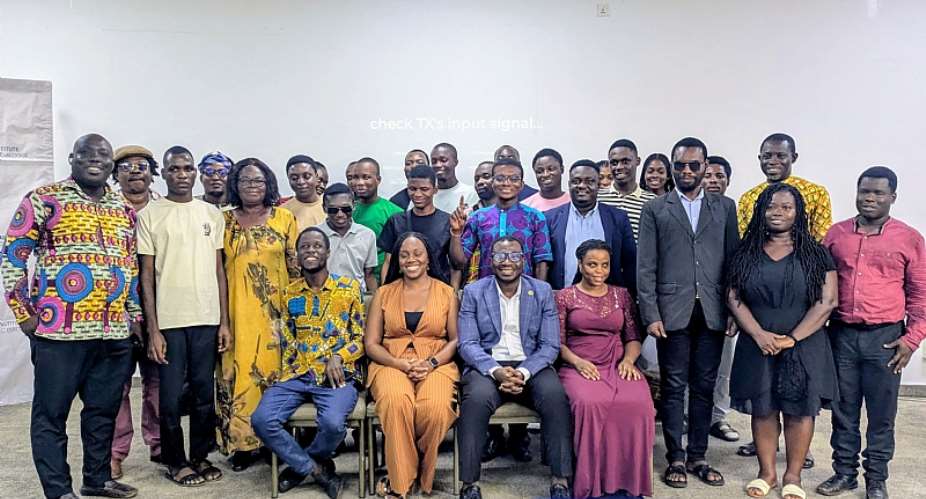
Economic and policy experts have called on Ghana to strengthen local industries, diversify its exports and improve the implementation of national development policies to protect its economic prosperity amid growing global competition for strategic resources.
The call was made at the fifth Nyansa Dialogue, organised by the Nyansa Institute for Strategic Dialogue in Accra on Friday, October 30.
The dialogue, held under the theme “How does Ghana protect its economic prosperity in an age of strategic competition?”, brought together economist Emmanuel Amoah-Darkwah and policy strategist and researcher Marie-Noelle Nwokolo to examine how Ghana can secure greater benefits from international trade, foreign investment and its natural resources.
In a speech read on his behalf, the Institute’s Executive Director and Founder, Samuel Koranteng Adjei, said Ghana must engage global powers strategically and ensure that international partnerships serve its long-term national interests.
“Economic prosperity must mean more than growth figures; it must mean jobs, competitive local businesses, stronger industries, improved living standards, and an economy that can withstand external shocks,” he said.
Trade deals must support local industries and value addition
Speaking during the panel discussion, Mr Amoah-Darkwah said Ghana must negotiate trade agreements that promote local production and ensure that the country retains more value from its natural resources.
He noted that although China had introduced tariff-free access for African goods from May 2026, Ghana must consider whether its trade arrangements are producing favourable outcomes.
He said Ghana and several African countries continue to record trade deficits because they largely exported raw materials while importing finished products.
He urged the country to move beyond exporting raw commodities and develop the capacity to process them into higher-value products.
Mr Amoah-Darkwah cited bauxite and manganese as examples of resources Ghana had mined for decades without sufficiently developing their downstream industries.
He also called for the protection of industries with the potential to create jobs, including pharmaceuticals, textiles, poultry and automobile manufacturing.
“It's not enough to have a trade deal between China and Ghana. What are we exporting to China in terms of the value chain? Are they raw commodities or are they value-added?” he asked.
Ghana needs stronger institutions and policy continuity
For her part, Ms Nwokolo identified weak institutional coordination, short-term political considerations and inadequate infrastructure as major obstacles to Ghana's economic transformation.
She said the country had developed several policies and institutions to address its development challenges but continued to struggle with implementation.
She cited unemployment as an example, arguing that several government institutions had overlapping mandates but lacked effective coordination.
She said the creation of more institutions would not necessarily produce results unless they worked together towards clearly defined national objectives.
Ms Nwokolo also called for policy continuity, arguing that frequent changes in development priorities after changes in government undermined long-term planning.
She urged political parties and other stakeholders to agree on a common national development plan that would guide successive governments over the next 20 to 50 years.
“There's a lot that we have on paper. There's a lot we've written. There's a lot we've committed to. Ghana is one of those countries that, on paper, not a lot of people can match us,” she said.
Economic policies must reflect citizens' needs
The policy strategist said Ghana must place the needs of ordinary citizens at the centre of its economic decisions.
She argued that improvements in economic indicators would have limited meaning if they did not translate into better living conditions for citizens.
She said policymakers must pay attention to the issues citizens consider most important.
Referring to Afrobarometer data, Ms Marie-Noelle identified healthcare and employment as key areas requiring attention.
She also cautioned against treating every development challenge as an immediate priority, saying government must make deliberate choices about what to address and how to sequence its interventions.
More data needed for critical minerals negotiations
In his concluding remarks, Mr Amoah-Darkwah said Ghana must invest in geological exploration and data to strengthen its position in negotiations over critical minerals.
He noted that global demand for critical minerals is increasing as countries pursued cleaner energy sources.
However, he said Ghana needs reliable information about its mineral resources to negotiate investment agreements from a position of strength.
The dialogue formed part of the Nyansa Institute for Strategic Dialogue's efforts to provide a platform for policymakers, researchers, business leaders and citizens to examine issues affecting Ghana's development.


 Mahama Defends Gold Export Restrictions, Signals Ban on Raw Mineral Exports by 2...
 Judicial Secretary Urges JUSAG to Suspend Planned Strike
 Education Ministry Orders Probe into Alleged Assault at Techiman SHS
 Chief Inspectors’ Amnesty Promotion: Supreme Court grants Police Administration ...
 Police deploy officers and cameras nationwide as TraffiTech-GH enforcement begin...
 Govt to fund travel expenses of mother of murdered Ghanaian teenager to US funer...
 Stop labelling menopausal women as witches – Public told
 Ghana woos investors for US$100million vaccine manufacturing project
 Eight killed, 21 rescued in bus collision on Elubo–Takoradi Highway
 NPP asks US Embassy to suspend recognition of Ghanaian diplomatic and service pa...


