




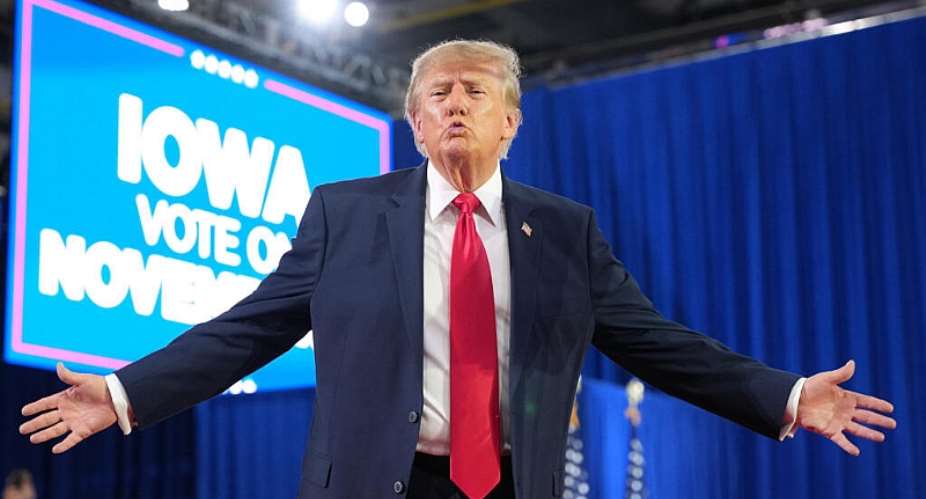
Trump has a history of challenging unfavorable election results, notably falsely blaming his 2020 defeat by former president Joe Biden on widespread voting fraud.
"The Trump administration has tried to insert the federal government into almost every aspect of the election process” in the lead-up to the 2026 vote, said Jonathan Diaz, director for voting advocacy and partnerships at the Campaign Legal Center.
Read more Georgia on Democrats' minds: Powering up the Black vote to counter Trump's meddling
“The long-term risks I think are very significant, but for these midterms in particular – even if he hasn't been successful in changing the rules or in coercing state and local election officials to do what he wants – it's created an atmosphere of fear and uncertainty,” Diaz added.
In a new poll by the Associated Press-NORC Center for Public Affairs, only 55 percent of Democrats said they are confident the final count after the midterm will be accurate, compared to 38 percent of Republicans.
The following are some examples of how the Trump administration has tried – and in many cases, failed – to interfere in the midterm vote.
The SAVE Act
Trump has repeatedly claimed that large numbers of noncitizens are voting in US elections, despite the actual numbers showing that this is exceedingly rare. Voting in US elections is reserved for citizens and already requires an ID; any non-citizens who attempt to vote can face stiff penalties including fines, prison or deportation.
Even think tanks that support Trump's voting restrictions have failed to find evidence of widespread fraud.
“The Heritage Foundation's database of documented cases of voter fraud includes 100 cases of noncitizens voting from 1982 to 2025. That is about 0.000008 percent of more than 1.3 billion votes cast in presidential elections during that time,” the New York Times reported in April.
Nevertheless, Trump has been pushing lawmakers to pass the Safeguard American Voter Eligibility (SAVE) Act, which would require people to present “documentary proof of United States citizenship” to vote.
The United States does not issue a national identity card to its citizens, and under the SAVE Act a driver's license or other official form of identification would not be sufficient for voting if it does not indicate a place of birth.
Acceptable forms of ID would include a valid US passport, a military ID card, a valid government-issued photo ID showing the person was born in the United States, or a birth certificate – but only if it matches the person's current name exactly, which could pose a problem for the 69 million women who changed their names after getting married and the trans community.
According to the Campaign Legal Center, more than 21 million Americans, or nearly 10 percent of voting-age Americans, lack access to documentary proof of citizenship, notably young people, those in lower income brackets and people of color. A 2024 report by the Center for Democracy and Civic Engagement found that 3 percent of people of color lack proof of US citizenship like a birth certificate, passport or naturalization documents.
By comparison, only 1 percent of white Americans have no such documentation.
A GOP amendment to the legislation also aimed to curtail the ability to vote by mail or online by overhauling these systems to comply with the stricter ID measures.
The legislation passed the US House of Representatives in February before languishing in the Senate due to a lack of support. Trump allies are still looking to get it passed through the budget reconciliation process.
Controversial database
Last year the Trump administration expanded a controversial federal database, the Systematic Alien Verification for Entitlements (also known as SAVE), which exists to verify whether someone is a citizen and thus qualifies for government benefits. But the expansion allowed states to use it to verify whether someone is eligible to vote.
At least 25 states opted into the voluntary system, and it scanned 67 million registrations before a US district judge blocked it in June over privacy concerns and fears it could remove thousands of eligible voters.
Because SAVE uses historical immigration data its records are often out of date, which results in flagging people who have since become naturalized citizens. In Travis County, Texas, 97 people flagged as noncitizens – 10 percent of them, and possibly up to 21 percent – were actually US nationals, the AP reported.
But the US Supreme Court lifted the judge's block in a September ruling, allowing use of the database to go ahead.
The effects of that ruling on the midterms could be limited, however, as states cannot purge people from electoral rolls less than 90 days before an election.
“SAVE is incredibly unreliable when it comes to verifying the citizenship status of an individual person,” Diaz said, adding that this is especially true for naturalized citizens.
Read more US Supreme Court allows Trump to use controversial voter 'verification' system Homeland Security Investigations officers leave a home after arresting a suspect accused of illegally registering to vote during a federal operation in Commerce, California, on October 19, 2026.
Charges and arrests
The Trump administration has also used the courts to pursue noncitizen voters. The Justice Department said in mid-October it had charged 113 people across 20 states with either voting or registration offenses in the past seven weeks. It earlier said it had charged some 90 people for election misconduct in 2026, including 50 who are suspected of having voted as noncitizens.
Jose Antonio Banuelos-Diaz, 42, has been living in the United States for 40 years. He was accused of trying to register to vote in 2007, around the time when he applied for a driver's license. California residents are prompted to register to vote at the same time they get their license.
“I have never voted because I know I can't vote,” he told AP after his arrest, denying he tried to register. “If there was a mistake, they should have called me out right away, not 20 years later.” He has since been released but faces five years in prison if convicted.
The Trump administration also sued California election officials to try to prevent the state from counting some 20,000 mail-in ballots it says were sent by noncitizens. But a federal judge ruled the count should go ahead, saying the administration's request "violates longstanding constitutional principles mandating that states have control over their elections".
Diaz of the Campaign Legal Center said the list was inaccurate. "California looked at the list and said, well, half of these people were born in the United States, so they are citizens," he said. For the other half, "we don't have enough data in this set that you've given us to identify these people, much less verify ... what we're using".
Trump's Department of Justice sent letters to nearly all 50 states demanding unredacted copies of their voter registration rolls. At least 30 states and the District of Columbia were later sued to obtain their voter registration lists; 26 of those lawsuits were subsequently dismissed.
At least 16 states willingly handed over, or promised to provide, their lists.
Restricting mail-in voting
Trump has also been “irrationally” suspicious of mail-in voting, Diaz said, adding that one reason is that many people relied on mail-in voting in 2020 – when he lost the last election – because of Covid-19.
In March, Trump signed an executive order that created new regulations for the US postal system, the USPS, that would have imposed new standards on voter-specific data and ballot envelopes.
The US Supreme Court then blocked the measure in September.
But if it had gone through, this order could have prevented thousands from voting, disproportionately affecting Democrats, who are slightly more likely to use mail-in ballots. According to a report by the MIT Election Data & Science Lab, 37 percent of Democrats reported voting by mail in 2024, compared with 24 percent of Republicans.
Elections in the United States are held on Tuesdays, and many people choose to use mail-in voting instead of going to the polls in person to avoid missing a day of work.
While the Trump administration has appealed the Supreme Court's decision, the court is unlikely to reinstate it ahead of the midterms.
According to Diaz, he will “certainly continue to try to make mail-in voting more difficult and to add new restrictions to it. I don't think he has much chance of success, but he will keep trying”.
Gerrymandering
The US congressional map looks very different in 2026 than it did in the 2024 election after Trump urged Republicans to redraw dozens of US House of Representatives districts to favor the party, notably in Texas.
This form of political redistricting, known as gerrymandering, has been used to disadvantage voters along class or race lines. Republicans sometimes seek to split up areas with a large Black population to lower their collective voting power since they are statistically more likely to vote Democrat.
“Redistricting is a problem much bigger than these midterm elections,” Diaz said. “It is bad for the long-term health of democracy when a majority of American voters do not have a meaningful choice in who represents them in Congress.”
After Texas lawmakers adopted a new electoral map that would give Republicans five more US House seats in the midterm elections, California held a referendum in which voters overwhelmingly approved a new congressional map that would give Democrats five more seats.
Republicans in Southern states have rushed to follow Texas's lead.
And in a boost for GOP efforts, the Supreme Court voted in April to narrow the legal grounds for challenging maps that may be racially discriminatory under the Voting Rights Act, potentially opening the door to future redistricting.
Republicans gained an advantage in 16 districts because of this push. But a recentReuters analysis suggests that nine of them are either too close to call or expected to go to the Democrats on November 3, largely due to Trump's low approval ratings over the rising cost of living and the unpopular Iran war.
"The thing with gerrymandering is that you're always drawing maps based on data from the last election,” Diaz said. "So if voters change their preferences, the maps that you draw may not be as successful in securing support for your party as you thought.”


 'Atmosphere of fear': Trump moves to curtail voting rights ahead of the midterms
 Flavio Bolsonaro posts video, says he fled Brazil due to ‘persecution’
 Uncle and niece shot dead over alleged GH¢500,000 debt; woman arrested
 Minister spotlights emerging security threats in Bono region
 NDC must accept same scrutiny demanded under Akufo-Addo — Afenyo-Markin
 Military commended for preparedness exhibited at Land Combat and Firepower Demon...
 Police arrest man with 91 parcels of suspected Indian hemp at Circle bus termina...
 How the record-breaking $6.3 billion heist in crypto history unfolded
 NPP's new parliamentary aspirant selection process designed to favour Bawumia lo...
 ECOWAS steps up regional efforts to address climate-induced migration


