




HBCUs are the soul of higher education, and when HBCUs have issues, America has issues!
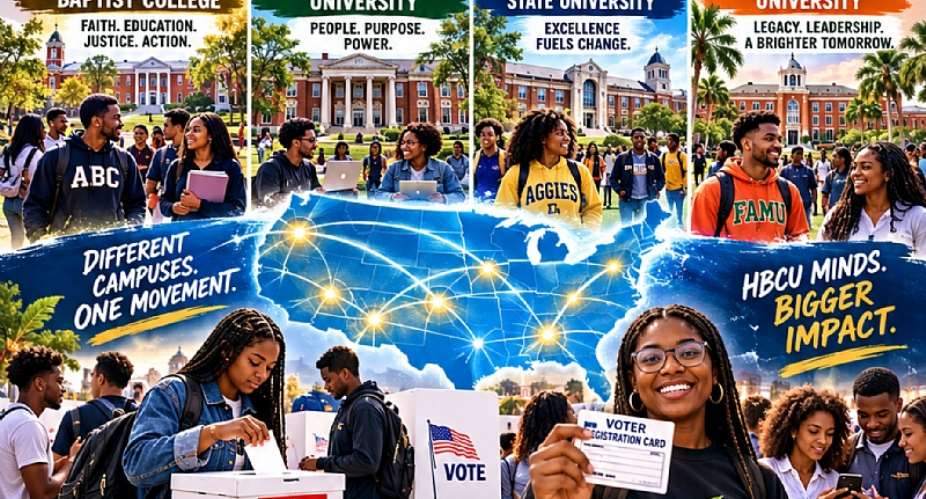
Across the United States, something extraordinary is happening. A wave of young college students is leaving classrooms, residence halls, and campus convocations to participate in the democratic process. From Arkansas Baptist College to North Carolina A&T State University, students are demonstrating that civic engagement is not merely an academic subject. It is a personal responsibility with generational consequences.
Their parents are predominantly members of Generation X and the Millennial generation. Their grandparents include baby boomers and older Gen Xers who witnessed the aftermath of school desegregation, the civil rights movement, and decades of political transformation. Now their children and grandchildren are confronting an America that increasingly questions the meaning of diversity, equity, inclusion, and equal opportunity. This is not Generation Z's first midterm election. Its oldest members were eligible in 2018 and 2022. However, 2026 represents a defining midterm moment for today's traditional-age college students, many of whom are participating in their first federal election.
The stakes transcend HBCUs, affecting students at Hispanic-serving institutions, tribal colleges, predominantly white institutions, and even high schools where students have reached voting age. Nevertheless, HBCUs carry a particularly painful historical burden.
These institutions emerged because Black Americans were systematically excluded from educational opportunities available to White Americans. Their establishment was a response to racial discrimination, not an exercise in preferential treatment. According to the2026 Postsecondary National Policy Institute HBCU Fact Sheet, approximately 304,111 students attended America's 100 HBCUs in fall 2024, including more than 216,000 Black students, representing 71.3% of enrollment.
These institutions have survived segregation, chronic underinvestment, and the dramatic transformation of college athletics. During desegregation, predominantly White athletic conferences increasingly recruited Black athletes who previously found opportunities at HBCUs. Today, as institutional diversity programs confront political and legal challenges, HBCUs face another transformational test.
From the Classroom to the Ballot Box: The Arkansas HBCU Wave
At Arkansas Baptist College, the Buffalo Nation recently transformed an ordinary academic week into an extraordinary civic experience. On October 27, the buffs invested an entire class period with multiple sections of students on a bus to visit the Arkansas State Capitol building. There they met Ms. Cheryl Augustine, our tour leader and the most pleasant person at the Capitol building. She empowered students and reminded them that it's a privilege, honor, duty, and responsibility to vote.
On October 28, students walked from Arkansas Baptist College in downtown Little Rock to the Sue Cowan Williams Library to participate in early voting. Several voted for the first time. Jeremy Jenkins described voting as "a good experience," adding that everybody should participate. Briana Liggins expressed how good the experience felt, while Jarvis Spearman declared, "Your vote really does matter."
Students Rafael Garces and Jaihdien Fields were also part of this emerging social consciousness, demonstrating that political knowledge and civic confidence develop through experience. Our classroom discussions became real-world lessons about representative government on the streets of Little Rock. Local coverage of Arkansas Baptist College's voting walk captured the importance of moving civic education beyond textbooks.
Nearby, Philander Smith University organized its own "Souls to the Polls" experience. Students, faculty, staff, alumni, and supporters gathered at Wesley Chapel United Methodist Church before marching several blocks to the same early-voting location. The university's Office of Mission, Culture, and Religion helped connect spiritual fellowship with civic responsibility.
Across Arkansas, the state's four HBCUs—Arkansas Baptist College, Philander Smith University, Shorter College and the University of Arkansas at Pine Bluff—represent an important constituency whose civic education and institutional futures deserve statewide attention.
Regardless of the color of the political wave, this is an HBCU wave.
As James 2:17 reminds us, "Faith, if it hath not works, is dead, being alone" (KJV).
From Greensboro to Atlanta: Students Are Making History
At North Carolina A&T State University, the nation's largest HBCU, students did something powerful. They marched. Then they marched again.
After local election officials declined to provide campus early-voting locations used during the 2024 presidential election, hundreds of students traveled approximately 40–45 minutes to reach their nearest polling location. The demonstrations occurred October 15 and October 22, with the university's Blue and Gold Marching Machine helping lead the second procession. North Carolina public radio documented the repeated marches. Importantly, election officials noted that those campuses had never hosted midterm early-voting sites before 2026. Nevertheless, the decision illustrates how transportation, geography, and access can complicate participation.
In Georgia, students from Morehouse College, Spelman College, and Clark Atlanta University organized voting marches to Friendship Baptist Church. Capital B reported that approximately 430 people voted during the first day of their coordinated effort. Meanwhile,The Texas Tribune documented student organizing at Texas Southern University, illustrating how affordability, employment, and public policy have become central concerns for younger voters.
Florida A&M: When Campus Safety Becomes a Civil Rights Question
At Florida A&M University, students are confronting another controversial issue: their university police department's participation in a federal immigration enforcement partnership. On October 23, FAMU students protested during homecoming activities, demanding that university leadership reconsider its agreement with Immigration and Customs Enforcement. The federal 287 (g) program authorizes qualifying state and local officers to carry out specified immigration enforcement responsibilities under federal supervision.
According to theACLU of Florida, university police departments are not legally required to enter these agreements under the state law governing county detention facilities. Although Florida officials have strongly promoted cooperation with federal immigration enforcement, students maintain that an HBCU should protect its educational community from unnecessary fear. National reporting on the FAMU demonstrations highlighted concerns involving institutional trust, immigrant students, and campus safety.
The issue transcends ethnicity. Every student deserves fair treatment, security, and freedom from unlawful profiling. Micah 6:8 instructs believers "to do justly, and to love mercy, and to walk humbly with thy God" (KJV). Universities should demonstrate those values through transparent institutional leadership.
Five Pressures Threatening America's HBCUs
The argument that HBCUs face renewed pressure must be grounded in evidence rather than political slogans. Five interconnected concerns deserve national examination:
Historic underfunding. A federal review of state funding disparities identified approximately $330.9 million in historical underfunding at UAPB and nearly $1.97 billion at FAMU, comparing funding for historically Black and predominantly White land-grant institutions during 1987–2020. These inequities predate the current administration.Arkansas Advocate.
Research and diversity-program uncertainty. The Trump administration discontinued certain minority-serving institution discretionary grant programs, citing constitutional concerns. Meanwhile, theGovernment Accountability Office documented changes affecting research initiatives serving HBCUs and other minority-serving colleges. These decisions raise serious questions about future research capacity.
Federal student-loan restrictions. Under H.R. 1, new Parent PLUS borrowers face annual limits of $20,000 per dependent student, while Grad PLUS loans have been eliminated for new borrowers, subject to transitional exceptions. Supporters argue the changes discourage excessive debt; critics warn they may create financing gaps for families.U.S. Department of Education.
Voting access and political representation. The North Carolina A&T controversy demonstrates how polling-site decisions, transportation barriers, and election rules can create additional challenges for students seeking access to the ballot.
Campus civil liberties and immigration enforcement. FAMU's 287(g) controversy illustrates growing tensions between state policy, university autonomy, campus policing, and students' expectations of a safe educational environment.
These are not isolated institutional problems. They affect scholarships, research, family finances, community development, and America's future workforce.
French Hill, Federal Funding, and the Entire Congressional Record
In September, Congressman French Hill stood at Philander Smith University, highlighting more than $174 million in additional federal funding for HBCUs nationwide, including approximately $4 million for Arkansas's four institutions. That investment deserves acknowledgment. The Trump administration also announced a separate $438 million one-time HBCU investment in 2025. As founder of the National HBCU Black Wall Street Career Fest, I have appreciated Congressman Hill's engagement with HBCU students and his participation in our Little Rock initiative.
However, appreciation should never eliminate accountability. Hill voted against the John R. Lewis Voting Rights Advancement Act and the George Floyd Justice in Policing Act. He supported congressional disapproval of President Biden's student-loan relief initiative and voted for H.R. 1. Hill has defended his positions as advancing alternative policing reforms, economic growth, fiscal responsibility, and more sustainable borrowing. The public deserves to evaluate those arguments alongside their potential consequences for students and families. A press conference can spotlight an investment. It cannot substitute for examining an entire legislative record.
MacKenzie Scott: Philanthropy During Institutional Uncertainty
One of the most significant private supporters of HBCUs is philanthropist, author, and nonprofit leader, MacKenzie Scott. According toFortune's September 2026 reporting, Scott's cumulative giving to historically Black institutions has exceeded $1 billion since 2020. Her unrestricted donations have provided extraordinary institutional flexibility for scholarships, facilities, academic expansion, and financial stability. However, private philanthropy cannot permanently replace equitable public investment. HBCUs should not have to depend upon billionaires to correct generations of institutional disadvantage. Scott’s personal donations have surpassed the total amount given by any other super-wealthy American donor in history.
A Tsunami of Change Is the Prayed-For Forecast
Nationally, early voting is already demonstrating unusual momentum. Georgia surpassed its entire 2022 midterm in-person early-voting total before the 2026 early-voting period ended. North Carolina, Texas, Michigan, and South Carolina are also reporting substantial increases compared with equivalent points in the previous midterm cycle.
These figures represent voters of every political affiliation, not exclusively HBCU students or any particular party. But collectively, America's college students are demonstrating that democracy is more than an election-night television graphic. Amos 5:24 declares, "But let judgment run down as waters, and righteousness as a mighty stream" (KJV).
That mighty stream is what I envision when I observe students taking responsibility for understanding their government, examining public policy, and participating in American democracy. A generation that was once dismissed as politically disconnected is asking difficult questions, challenging institutional decisions, and helping redefine civic engagement.
HBCUs are the soul of higher education, and when HBCUs have issues, America has issues. Regardless of whether the eventual political wave is red, blue, or something entirely different, the emerging HBCU wave deserves America's attention. The early wave is already visible. A tsunami of informed civic engagement is the prayed-for forecast. Vote HBCUs, vote all American students, vote America.
About the Author:
Edmond W. Davis is an American social historian, media strategist, international journalist, Grambling State University graduate, professor at Arkansas Baptist College and Philander Smith University, and founder of the National HBCU Black Wall Street Career Festival. His work focuses on history, education, emotional intelligence, civic engagement, economic mobility, and the advancement of historically Black colleges and universities. Davis was a grand marshal at the National African American History Month Parade, the largest in the U.S. during Black History Month.

 Trump admin approves potential Patriot missiles sale to Ukraine
 US and Russia block competing UN resolutions on Western Sahara
 'Atmosphere of fear': Trump moves to curtail voting rights ahead of the midterms
 Flavio Bolsonaro posts video, says he fled Brazil due to ‘persecution’
 Uncle and niece shot dead over alleged GH¢500,000 debt; woman arrested
 Minister spotlights emerging security threats in Bono region
 NDC must accept same scrutiny demanded under Akufo-Addo — Afenyo-Markin
 Military commended for preparedness exhibited at Land Combat and Firepower Demon...
 Police arrest man with 91 parcels of suspected Indian hemp at Circle bus termina...
 How the record-breaking $6.3 billion heist in crypto history unfolded


