




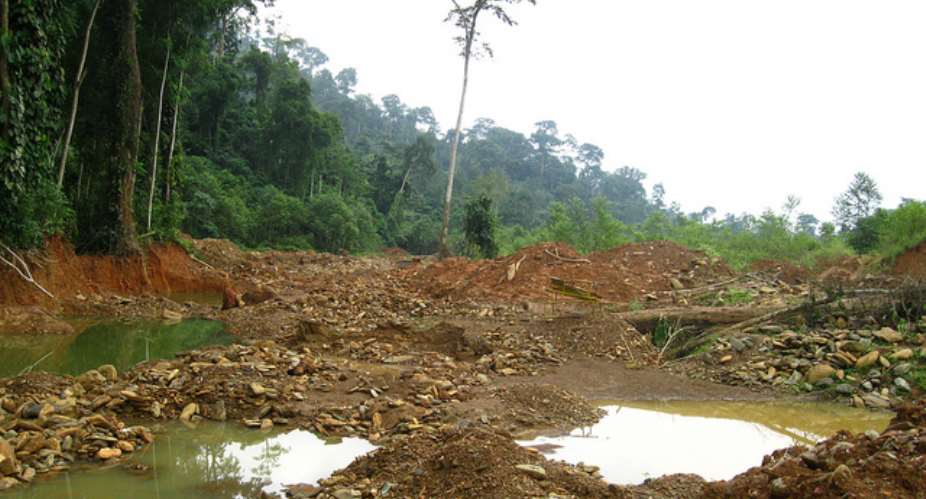
Ghanafuor, on 27 October 2026, after forty days of counting, Operation Green Shield began in the Atewa Range Forest Reserve. Soldiers went in. The Minister for Lands and Natural Resources, Hon. Emmanuel Armah-Kofi Buah, and the NAIMOS Commander, Colonel K. S. Appiah, said the right things. Something has begun, and those of us who have shouted about Atewa for decades should be honest enough to say so.
Then read the design of it, because the design tells you where it will fail.
The Minister set out three stages: clear and disrupt, hold and stabilise, and then transition and handover to the Forestry Commission. The first has soldiers, vehicles and fuel. The second has patrols, for a season. The third has a sentence.
Ghanafuor, we have been here before. The promise came on 15 September. The operation came on 27 October. Then the photographs, then a decent interval, then the miners drift back and the rivers run the colour of milky chocolate again. Counting is what we do while we wait. Holding is the hard part, and nothing in the plan pays for holding.
We know why. At A Rocha Ghana's engagement with the Okyeman Traditional Council on 22 September, the point was made plainly: the Forestry Commission does not have the resources to manage a reserve under this kind of pressure. So the handover stage will hand Atewa to the one body that cannot afford to keep it.
Here is what I would fund next, and I would rather cost it than merely demand it.
A Rocha's own baseline counts 40 settlements around the reserve with about 75,000 people, and close to 95 per cent of households draw on the forest for food, medicine, firewood or building materials. Atewa has neighbours. They are the reason it is being eaten, and the only reason it can be saved.
Money raised to save the world's biodiversity hotspots should be leveraged to pay those communities, through their CREMAs, USD300 a month to each household for five years, to keep out galamseyers, illegal loggers and hunters.
Now let me be honest about the arithmetic, because those who oppose this will be. At USD300 a month to every resident, this is USD1.35 billion over five years, more than the USD1,157 million A Rocha values in thirty years of protecting the forest. So it must be per household, on a published register fixed at the start, scoped to defined communities. At four to a household that is about USD337 million over five years; narrowed to the eight communities of the Atewa CREMA, or the ten Tropenbos International Ghana studied, about USD67.5 million. A Rocha puts the value of non-timber forest products to these communities at about USD12.4 million a year. A properly scoped payment therefore costs roughly what the forest already yields to the people who cut it. That is not charity. That is a market price for a service worth far more than the price.
Three conditions separate stewardship from a new allowance. It must be earned: no new pits, seedlings still standing, water quality holding at the Birim, Ayensu and Densu headwaters. It must be held by institutions: CREMA registers fixed at the baseline, published accounts, independent audit, because Tropenbos rightly identified elite capture as the chief threat to benefit sharing at Atewa. And it must end properly: at year five it converts into a share of what the forest earns from its carbon and its water, for a forest holding some 3.6 million tonnes of carbon whose rivers supply more than five million people.
One thing this must never become is an excuse for the state. The state protects Atewa because Atewa secures water for millions of people. That's a national security issue. Hotspot money should buy the five years that prove community stewardship works. It must not buy Accra's way out of its own duty.
The same caution applies to national park status, which A Rocha rightly keeps demanding. A park is a legal designation, not a relationship with the people who live at its edge, and declared without benefit sharing it creates a boundary they have every reason to test. Bauxite licences have come and gone here; whatever is agreed must bind governments, not individuals.
The men in the forest will do their part. The Commission will do what its budget allows, which is not enough. Ghanafuor, what Atewa needs is a line in a budget, a register, and a five-year contract with the people who will still be standing at the forest edge in 2031, when Operation Green Shield is only a distant memory, oooo. Yooooooooooo. A word to the wise...



 Mahama Defends Gold Export Restrictions, Signals Ban on Raw Mineral Exports by 2...
 Judicial Secretary Urges JUSAG to Suspend Planned Strike
 Education Ministry Orders Probe into Alleged Assault at Techiman SHS
 Chief Inspectors’ Amnesty Promotion: Supreme Court grants Police Administration ...
 Police deploy officers and cameras nationwide as TraffiTech-GH enforcement begin...
 Govt to fund travel expenses of mother of murdered Ghanaian teenager to US funer...
 Stop labelling menopausal women as witches – Public told
 Ghana woos investors for US$100million vaccine manufacturing project
 Eight killed, 21 rescued in bus collision on Elubo–Takoradi Highway
 NPP asks US Embassy to suspend recognition of Ghanaian diplomatic and service pa...


