




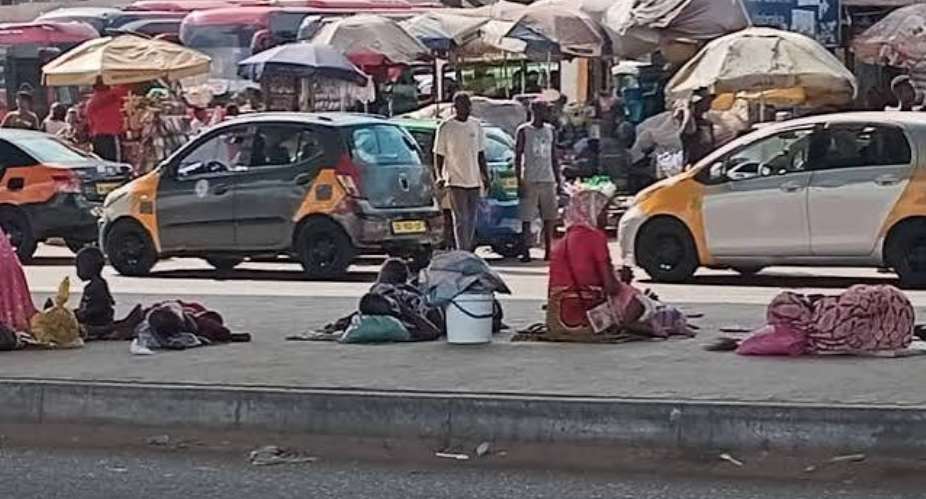
Street begging has become an increasingly visible social problem in Ghana's major cities, particularly Accra and Kumasi. At busy intersections, markets and commercial centres, adults and children approach motorists and pedestrians seeking financial assistance. While some are driven by poverty, unemployment and disability, concerns are growing about the possible exploitation of children and the involvement of organised groups in street begging.
In Accra, locations such as Lapaz, Shiashie and the 37 Military Hospital intersection are among the areas where begging activities are frequently observed. Some adults carry young children while appealing for assistance from motorists, while others rely on religious messages and personal stories to attract sympathy.
These practices raise important questions about the circumstances forcing people onto the streets and whether some vulnerable individuals are being exploited for financial gain.
In Kumasi, street begging is also visible around Kejetia, the Central Market and other busy commercial areas. Reports and public discussions have drawn attention to the presence of migrant families, including people believed to have travelled from neighbouring West African countries.
However, the presence of foreign nationals should not automatically be interpreted as evidence of criminal activity or organised trafficking. Poverty, displacement, unemployment and the search for better economic opportunities are among the factors that can contribute to migration and street begging.
Of particular concern is the growing visibility of children begging along major roads. Some move between vehicles in heavy traffic, exposing themselves to accidents, harsh weather, abuse and other dangers.
There are also allegations that certain adults supervise children at traffic intersections and collect money obtained through begging. Such claims require proper investigation to establish whether children are being subjected to exploitation, forced begging or human trafficking.
Ghana's Children's Act, 1998 (Act 560), provides safeguards against child exploitation and activities that threaten children's health, education and development. The Human Trafficking Act, 2005 (Act 694), as amended, also establishes legal measures against trafficking and exploitation.
Ghana has additionally maintained legislation addressing begging and destitution, including the Beggars and Destitute Act, 1969 (NLCD 392). Nevertheless, the legal and social issues surrounding street begging require careful consideration, particularly where children, persons with disabilities and vulnerable migrants are involved.
Over the years, security agencies and immigration authorities have undertaken operations targeting street begging and immigration violations. However, enforcement campaigns alone have not provided a lasting solution.
The claim that more than 4,200 migrant beggars were removed from Accra and Kumasi requires confirmation from official records before it can be presented as an established figure. Similarly, allegations that deported individuals routinely return to Ghana through unauthorised border crossings should be supported by reliable evidence.
The persistence of street begging suggests that the problem cannot be solved simply by removing people from roads and markets. Poverty, limited employment opportunities, inadequate social protection and difficulties accessing education and essential services remain important underlying challenges.
Government agencies, metropolitan assemblies, social welfare institutions and civil society organisations must therefore adopt a more coordinated and humane approach.
First, children found begging on the streets should be assessed by trained social welfare officers to determine their circumstances and protection needs. Where exploitation is suspected, the appropriate authorities should investigate and take action against those responsible.
Second, vulnerable adults should be supported through practical livelihood programmes, vocational training and access to appropriate social assistance. Small business development, skills acquisition and employment opportunities could help reduce dependence on street begging.
Third, Ghana should strengthen cooperation with neighbouring countries and relevant diplomatic missions to address cases involving vulnerable migrants, while respecting human rights and applicable immigration laws.
Public education is equally important. Although giving money to someone begging may be motivated by compassion, direct cash donations to children can sometimes encourage their continued exposure to dangerous street conditions, particularly where adults are exploiting them.
Members of the public should therefore be encouraged to support credible child protection organisations, social welfare programmes and community initiatives that provide sustainable assistance.
At the same time, society must avoid treating every person begging on the street as a criminal. Many are genuinely vulnerable and require protection, rehabilitation and opportunities to rebuild their lives.
The challenge facing Ghana is to distinguish between people in genuine need, those who may be exploiting vulnerable individuals, and criminal networks where credible evidence establishes their involvement.
Street begging is not merely a traffic management problem. It reflects wider issues of poverty, migration, child welfare, unemployment and urban development.
Accra and Kumasi cannot achieve safer and more orderly streets through periodic enforcement operations alone. Lasting progress will require effective child protection, responsible immigration management, targeted social interventions and economic opportunities for vulnerable populations.
Ghana must protect its children, support people in genuine need and ensure that those who exploit vulnerable individuals are held accountable.
The ultimate goal should not simply be to remove beggars from public view, but to address the conditions that force people onto the streets in the first place.


 Ghanaian father narrates how his 15-year-old son was always bullied by two schoo...
 9% public sector salary increase for 2027 an insult to workers — Minority
 Kumasi residents to experience scheduled power cuts between October and November...
 Why charge GH¢5,000 just for people to declare interest in parliamentary primar...
 October 30: Cedi sells at GHS12.25 on forex market, GHS11.66 on BoG interbank
 Tinubu prays for end to insecurity, lasting peace in Nigeria during Umrah in Sau...
 Kofi Boat, Inusah Ahmed plead guilty in US$100m international romance scam
 Police confirm crash involving service vehicles and motorcyclist using opposite ...
 Talensi Assembly says cash payments of GH¢181,170 was for refreshments
 Criticism helps me govern better — Mahama


