




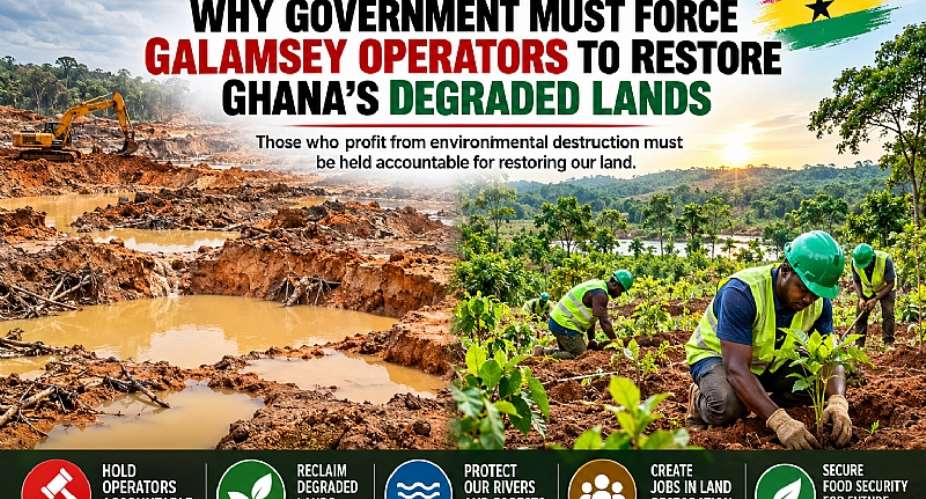
Ghana's fight against illegal mining, popularly known as galamsey, has reached a stage where arrests, military operations and the seizure of mining equipment can no longer be considered sufficient responses to the environmental destruction taking place across the country. The widespread degradation of agricultural lands, forests and water bodies demands a fundamental change in national policy, one that places responsibility for environmental restoration directly on those who cause the damage.
For decades, illegal mining has threatened Ghana's ecological security, agricultural productivity, public health and rural livelihoods. Vast stretches of once-productive farmland have been excavated, leaving dangerous pits, exposed soils and degraded landscapes. Rivers that previously supported domestic water supplies, fishing and agricultural activities have suffered severe pollution from mining sediments and potentially hazardous chemicals.
The Pra, Ankobra, Birim and Offin river systems have become prominent symbols of the environmental consequences associated with illegal mining. Increased turbidity, sedimentation and chemical contamination have placed considerable pressure on water treatment facilities and communities that depend on these rivers for their survival.
The consequences extend beyond environmental degradation. Cocoa farms have been destroyed or converted into mining sites, threatening agricultural livelihoods and the long-term sustainability of one of Ghana's most important export industries. Food crop production has also been affected in mining communities, while abandoned excavation pits create serious hazards for residents, particularly children and livestock.
Yet, despite the magnitude of the destruction, Ghana's response has concentrated largely on stopping illegal mining activities rather than ensuring that damaged lands are restored to productive use.
This approach has created a troubling imbalance. Illegal mining operators and their financiers may accumulate substantial profits from mineral extraction, while the environmental and financial consequences are transferred to communities, taxpayers and future generations.
The fundamental question Ghana must now confront is simple: Why should the state and innocent citizens bear the financial burden of restoring lands destroyed by individuals and organisations that profited from illegal mining?
The answer lies in establishing a comprehensive, legally enforceable land-reclamation policy based on the internationally recognised Polluter Pays Principle. Under this principle, those responsible for environmental damage should bear the costs of preventing, controlling and remedying that damage.
Ghana already has a legal foundation for environmental responsibility in mining. The Minerals and Mining Act, 2006 (Act 703), as amended, establishes the regulatory framework for mineral operations, while environmental permitting and reclamation obligations form part of the country's mining governance system. The Environmental Protection Act, 2025 (Act 1124), also provides an updated framework for environmental regulation and enforcement.
However, the existence of legislation does not automatically translate into effective environmental restoration. The central challenge remains enforcement, particularly against illegal operators who work outside established licensing, environmental permitting and reclamation arrangements.
The government must therefore strengthen the application of existing laws and, where necessary, introduce targeted amendments to ensure that individuals convicted of illegal mining can be held financially responsible for restoring the environments they have destroyed.
Mandatory reclamation should become an integral component of environmental enforcement rather than an optional administrative exercise.
When illegal miners are arrested and prosecuted, the authorities should assess the extent of environmental damage attributable to their activities. Courts should have clear legal mechanisms to impose restoration orders, recover rehabilitation costs and pursue the assets of convicted operators and financiers, subject to due process.
Such an approach would ensure that criminal penalties are accompanied by meaningful environmental accountability.
Importantly, reclamation should not be confused with merely filling abandoned mining pits. Effective rehabilitation requires a scientifically informed process involving land assessment, stabilisation of excavated areas, appropriate backfilling, erosion control, soil rehabilitation, contamination management and the restoration of suitable vegetation.
Where soils or water bodies have been contaminated with mercury or other hazardous substances, specialised environmental assessment and remediation may be necessary before the land can safely return to agricultural or community use.
Replanting trees on contaminated land without addressing underlying pollution would amount to cosmetic restoration rather than genuine environmental recovery.
The Environmental Protection Authority, Minerals Commission, Water Resources Commission, Forestry Commission, relevant district assemblies and technical institutions should therefore collaborate to establish measurable national reclamation standards.
These standards must specify the conditions under which reclaimed land can be certified as environmentally stable, safe and suitable for its intended future use.
A particularly important policy reform would be the establishment of a National Illegal Mining Environmental Restoration and Liability Framework.
Under such a framework, every identified illegal mining site would be documented, mapped and assessed to determine the extent of environmental damage, the responsible parties where identifiable, and the estimated cost of rehabilitation.
Modern technologies, including satellite imagery, drones, geographic information systems and remote sensing, could support the identification and monitoring of degraded mining areas.
These technologies would also help authorities distinguish between newly disturbed sites and older mining landscapes, strengthening evidence gathering and reducing disputes over responsibility.
The financial obligations of convicted operators should be calculated using independently assessed restoration costs rather than arbitrary penalties that may bear little relationship to the environmental harm caused.
For example, where an illegal mining operation has destroyed several hectares of productive farmland, the responsible parties should face the cost of restoring the affected landscape, including necessary soil rehabilitation, drainage management and revegetation.
Where complete restoration is technically impossible, the law should provide for appropriate remediation, compensation and environmental recovery measures without pretending that every damaged ecosystem can be returned to its original condition.
The government must also extend accountability beyond the individuals physically operating excavators and washing plants.
Illegal mining frequently involves complex networks of financiers, equipment owners, mineral buyers, transporters and other intermediaries. Concentrating enforcement exclusively on low-level operators risks allowing those who organise and profit most from environmentally destructive activities to escape meaningful responsibility.
Investigations should therefore follow financial transactions, equipment ownership records, mineral supply chains and other available evidence to identify individuals and businesses that knowingly finance or facilitate illegal operations.
Where liability is established through lawful procedures, courts should be empowered to order appropriate asset recovery and environmental compensation.
Such measures would make environmental destruction a substantially more expensive undertaking and weaken the financial incentives sustaining illegal mining.
Nevertheless, compulsory reclamation must operate within Ghana's constitutional and legal safeguards. Restoration orders, financial penalties and asset forfeiture must be imposed through lawful procedures, with proper evidence, judicial oversight and opportunities for appeal.
Compulsory labour should not be adopted as a shortcut to environmental justice. Instead, the government can use lawful court-ordered remedies, financial recovery mechanisms and professionally supervised rehabilitation contracts to ensure that offenders contribute to restoring damaged environments.
Beyond enforcement, a national reclamation programme presents an important opportunity for employment creation, particularly among young people in mining-affected communities.
Environmental rehabilitation requires skilled and semi-skilled workers in land surveying, earthmoving, drainage construction, soil improvement, nursery development, tree planting, ecological monitoring and land management.
A structured programme could engage local contractors, agricultural cooperatives, environmental organisations, universities and technical training institutions in restoring degraded lands.
Young people who might otherwise be attracted to illegal mining could acquire practical skills in environmental restoration, sustainable agriculture, forestry and green entrepreneurship.
This would transform environmental rehabilitation from a purely punitive exercise into an opportunity for rural economic renewal.
However, the financing structure must be carefully designed. Public resources may initially be required to address urgent environmental hazards, especially where the responsible operators cannot be identified or located. Such expenditure should not relieve identifiable offenders of liability.
Money recovered through environmental penalties, lawful asset forfeiture and court-ordered restoration payments could be directed into a transparently administered rehabilitation fund, subject to the necessary legislative and public financial management arrangements.
The fund should publish regular reports showing the amounts recovered, sites rehabilitated, hectares restored, expenditure incurred and environmental outcomes achieved.
Without transparency and independent auditing, even a well-intentioned reclamation programme could become another avenue for waste, corruption and ineffective public spending.
Community participation must also be central to the restoration process.
Farmers, traditional authorities, landowners, local assemblies, women and youth groups should be involved in identifying damaged areas, determining appropriate future land uses and monitoring rehabilitation activities.
In agricultural communities, restoring land to productive farming may be the priority. In ecologically sensitive areas, reforestation, wetland restoration or biodiversity conservation may be more appropriate.
Not every degraded site should automatically be converted into farmland. The ultimate objective must be environmentally safe, scientifically justified and economically sustainable land recovery.
Independent monitoring should continue after physical reclamation has been completed. Vegetation survival, soil stability, water quality and the recurrence of illegal mining activities should be assessed over an appropriate period.
A contractor or responsible operator should not receive final environmental clearance merely because an excavation pit has been filled or seedlings have been planted.
Successful reclamation must be demonstrated through measurable environmental outcomes.
Ghana can also draw lessons from established mine-rehabilitation practices in countries such as Australia, Canada and South Africa, where regulatory systems use combinations of rehabilitation plans, financial assurance, closure obligations and environmental monitoring to manage mining impacts.
Although these arrangements primarily apply to licensed mining operations, their underlying principles provide useful guidance for strengthening accountability and cost recovery in Ghana.
The distinction is important: Ghana should not create a system that inadvertently legitimises illegal mining by treating offenders as though they were simply operating under ordinary mining permits. Rather, environmental restoration should be an additional legal obligation that accompanies, rather than replaces, criminal prosecution and other applicable sanctions.
The long-term economic implications of inaction are enormous.
Degraded agricultural lands undermine food production and household incomes. Polluted rivers increase water treatment costs and threaten access to safe drinking water. Forest destruction reduces biodiversity, weakens ecological resilience and contributes to climate-related vulnerabilities.
These losses are not always captured in the immediate financial calculations surrounding illegal mining, but they represent substantial liabilities for Ghana's economy and future development.
Indeed, the true cost of galamsey cannot be measured solely by the value of gold extracted or the number of mining machines seized. It must also include the agricultural output lost, water resources damaged, ecosystems destroyed, health risks created and public expenditure required to restore affected communities.
A national policy that ignores these costs effectively allows private operators to profit while society absorbs the losses.
That situation is economically indefensible and environmentally unsustainable.
Ghana must therefore move beyond a narrow enforcement strategy that measures success mainly by arrests, confiscations and temporary shutdowns.
The country needs a results-oriented approach that measures how much degraded land has been reclaimed, how many polluted sites have been remediated, how many affected communities have regained safe access to their natural resources, and how much rehabilitation expenditure has been recovered from those responsible.
The government should publish an annual national environmental restoration scorecard covering illegal mining-affected areas, with independently verifiable indicators and clear institutional accountability.
District assemblies in mining-affected regions should also incorporate land-reclamation targets into their medium-term development plans, supported by technical expertise and appropriate funding arrangements.
Most importantly, the government must demonstrate that environmental accountability applies equally to everyone, regardless of political influence, financial resources or social standing.
The fight against galamsey will remain incomplete as long as individuals can destroy productive landscapes, extract valuable minerals and walk away without bearing responsibility for the environmental consequences.
The principle must be unmistakable: those who destroy Ghana's land must be held accountable for its restoration.
This does not mean that every damaged ecosystem can be restored immediately or that environmental rehabilitation alone will eliminate illegal mining. It means establishing a credible legal and financial system in which environmental destruction carries enforceable consequences extending beyond arrest and prosecution.
Ghana's forests, rivers, agricultural lands and mineral resources constitute a national inheritance that must be managed for both present and future generations.
The government has a responsibility not only to stop ongoing destruction but also to ensure that the damage already inflicted is systematically addressed.
Mandatory reclamation, backed by scientific standards, enforceable restoration orders, financial accountability, community participation and transparent monitoring, offers a practical pathway towards achieving that objective.
Ghana must send a decisive message to illegal mining operators and their financiers: extracting gold cannot confer the right to abandon poisoned rivers, dangerous pits and devastated farmlands.
The era of mining, destroying and walking away must end. Those who profit from environmental destruction must pay for environmental restoration


 Ghanaian father narrates how his 15-year-old son was always bullied by two schoo...
 9% public sector salary increase for 2027 an insult to workers — Minority
 Kumasi residents to experience scheduled power cuts between October and November...
 Why charge GH¢5,000 just for people to declare interest in parliamentary primar...
 October 30: Cedi sells at GHS12.25 on forex market, GHS11.66 on BoG interbank
 Tinubu prays for end to insecurity, lasting peace in Nigeria during Umrah in Sau...
 Kofi Boat, Inusah Ahmed plead guilty in US$100m international romance scam
 Police confirm crash involving service vehicles and motorcyclist using opposite ...
 Talensi Assembly says cash payments of GH¢181,170 was for refreshments
 Criticism helps me govern better — Mahama


