




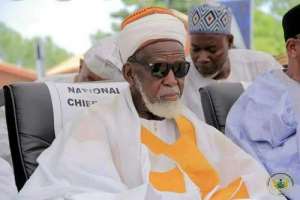
It has been a recurrent claim among specific Muslim clerics in Ghana that Rawlings handpicked Shaykh Usman Nuhu Sharubutu as Imam for the Ghanaian Muslim community. The most recent example of this claim came from a Muslim cleric who publicly petitioned President John Dramani Mahama at a Muslim gathering, while attempting to declare the office of the National Chief Imam an outright imposition by Rawlings. Considering that such public claims are not new, and that underexplored scholarly works have already discussed the matter of Sharubutu’s Imamship and what went into his appointment, I decided to wade into the issue not to settle it, but to draw important attention to the ignored aspects of its dimensions. The opinions I share here are largely traceable to existing scholarship I have cited, which I think those raising this topic have mostly ignored.
The Office of the National Chief Imam of Ghana is the outcome of a consultative conference of Muslim leaders following PNDC Law 221, announced on June 14, 1989. According to this law, all religious bodies in Ghana were required to register with the National Commission for Culture. The announcement by the then Government of Ghana (GoG) received mixed reactions. It has been argued by scholars such as Elom Dovlo in “Religion in the Public Sphere: Challenges and Opportunities in Ghanaian Law-making” that the Christian community protested the law because they viewed it as a clever extension of government machinery to control religious freedom in Ghana.
The Muslim community equally had its challenges. Apart from the fact that some Muslim leaders were suspicious of the law, there were intense sectarian conflicts whose implications affected the ability to present a uniform voice for a single Muslim leader for the country. Interestingly, however, among the dissenting voices against those opposing the new law were opinion leaders who identified the loopholes in the law and therefore took advantage of it for the benefit of the larger Muslim community. To them, the law offered a great opportunity for public participation by Muslims in Ghana in an organized manner. If the question is raised as to whether that aim was achieved, my answer would be yes.
The law later gave Ghanaian Muslims the best opportunity for proper organization and public participation, especially considering their position as a minority faith in a secular state. However, other challenges were still visible. Muslims in Ghana failed to take advantage of the opportunity that gave them an official national leadership position to succeed in many areas. For example, apart from the founding fathers of Ahlus Sunna wal-Jama’ah (ASWAJ) rejecting the first officeholder (not the office itself) on grounds of sectarian differences, it was Shaykh Nuhu Sharubutu who rather added value to the office through his personal branding, instead of the office establishing structures for proper continuity.
Mohammed Kassim Ameen documented the formation of the office and its challenges in his paper “The National Chief Imam of Ghana: Intervention, Collaboration and Contestation.” He acknowledged the contributions of Muslims of different backgrounds who assisted in the registration process. Mr. Braimah, a lecturer at the Department for the Study of Religions at the University of Ghana, participated fully in the organized conference for that purpose and proposed “Din al-Islam, Ghana” (DIG), which was accepted for the final registration and certification on May 25, 1990. The conference created additional offices, some of which I faintly remember, with the Office of the Chief Imam being paramount. Understandably, what Ghanaian politicians contributed to this effort was to give visibility to the office; they did not create it. And the choice to settle on Mallam Nuhu Sharubutu was due to critical considerations, chief among them being that he was the successor of Imam Abbas, the Imam of the nation's capital.
And although there were, understandably, concerns about wider consultations, as Kassim captures in his paper, those agitations were expected. Traditionally, there is scarcely a selection of a Muslim leader or a traditional Muslim authority in the country without such concerns. However, perhaps fortunately for Sharubutu, the majority of the Muslim community in Ghana had approved of his leadership by the end of the 20th century. Today, almost all the Muslim sects in Ghana have their own national structure. Yet, it is almost a unanimous conclusion that they all recognize Shaykh Sharubutu as the official Chief Imam of Ghana. Interestingly, even when a respected Ghanaian Muslim leader like Shaykh Abdullahi Maikano had personal differences with Sharubutu, so much that he sometimes publicly registered his displeasure against him, he still recognized and publicly acknowledged him as Ghana’s Chief Imam. In addition, Sharubutu currently enjoys both national and global validation of his mandate. This alone, in my view, is enough to address the concerns of the cleric dragging Rawlings into this debate.
So was Sharubutu really appointed by Rawlings? The answer is a definite no. Did the former president give him visibility? Indeed, he did. But this was part of Rawlings' own politics of survival and entrenching his support within the Muslim community. It was the same attempt he made through his close connections with Farrakhan's Nation of Islam side in the late 1980s or so. However, one thing that Rawlings failed to realize was that Muslims in Ghana would appreciate his role in giving an indigenous Imam government visibility. They were not ready to accept a Black American coming to teach them how they should practice their faith. This is a story for another time.

 NDC Enforces Strict Verification and Voting Rules as Constituency Elections Begi...
 Protests against cost of living expected in Italy under heavy security
 Lula, Bolsonaro clash on living costs, corruption in final Brazil election debat...
 Ebola vaccine trial begins in DR Congo
 Trump says US may launch ‘another little Epic Fury’ attack on Iran
 ‘Too arrogant, too sure of itself’ France confronts its legacy in Africa
 Nigeria's unwritten power-sharing rule looms over presidential race
 Several killed, dozens wounded in Jordan church shooting
 ‘I killed lots of terrorists, but it didn’t make me feel better’: The trauma hau...
 Casualties feared as multi-storey building collapses in Nairobi


