




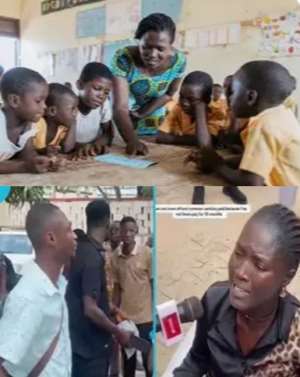
I love teaching, and I have always taught passionately. Teaching for me has never been just a job to pass time; it has been a calling that gives me joy every time a learner understands something new. From 1998 to 2013, I taught in various private schools in Accra and at the college level in Lome, where I prepared final-year students for the Brevet d'Etude du Premier Cycle (BEPC) examinations with outstanding outputs. I spent fifteen (15) uninterrupted years either on full or part-time basis standing in front of learners, preparing lesson notes late into the night with chalk dust on my hands, and celebrating the success of my pupils as if it were my own.
In 2013, driven by the same passion but also by a desire to create a more flexible learning environment, I established a mini Language and ICT Centre in Accra. Through this centre, I currently mentor aspiring teachers online in pedagogy and classroom practice, and teach English online to corporate personnel and individuals or students both in Ghana and beyond. At the time, I believed that my fifteen years of classroom experience from basic schools in Accra to college level in Lome backed with my passion were more than enough to qualify me as a teacher.
However, in 2021, life presented me with a humbling reality check that completely changed my understanding of what it means to be a teacher. I applied for several teaching positions in Dubai, confident that my long years of experience and my passion would speak for me. To my surprise, I was rejected across board. The reason, which was communicated clearly, was that I was not a professionally trained and qualified teacher on paper. I had no teaching license, no recognized professional certification. That rejection, though painful, became the most important turning point in my professional journey.
Consequently, I decided to do the right thing. I enrolled in a proper professional teacher education program and obtained my teaching license. Furthermore, I trained as a TESOL certified teacher, which has equipped me with international standards for teaching English to speakers of other languages. Today, I am not only a professionally qualified teacher but also a PhD Candidate in Educational Leadership, still researching how we can make our educational system better. More importantly, I now mentor aspiring teachers online, providing Continuous Professional Development (CPD) in pedagogy and TESOL techniques, and guiding them to enroll in accredited professional programmes for their licensing.
It is against this personal background that I want to explain not only why teachers in Ghana are not paid well, but also, more importantly, how we can fix it permanently. The recent strike on 25th September 2026, where about 80,000 teachers laid down their tools over a promotion increase of only GHS100.00 is not just about money. It is about dignity which has been eroded over many years because of how we treat entry into the profession.
-
Who is in the classroom? The devaluation starts here.
Firstly, we must confront the uncomfortable truth about who is teaching in many of our private basic schools. In many private schools across Accra and indeed across Ghana, the classrooms are filled with SHS leavers and unemployed university graduates who have no training in education but who see teaching as an avenue for survival. I say this with no disrespect, because I understand the pressure of unemployment. When a school can employ someone without any professional qualification and pay them GHS500.00 a month over the counter, it sends a powerful signal to society that teaching does not require expertise. As a result, government, parents, and even policymakers begin to believe, consciously or unconsciously, that anyone can teach. If anyone can teach, then the logic follows that ANY salary is enough for a teacher. This is the root of the poor or low pay. You cannot pay peanuts and expect professionalism, but you also cannot demand professionalism when you have allowed anyone to enter.
-
We have the law — we need enforcement, not new laws.
Secondly, we do not need new laws. Instead, we need strict enforcement of the existing law. Ghana already has a robust legal framework under the Education Regulatory Bodies Act, 2020 (Act 1023). Section 67(1) of the Act states clearly that a person shall not practice as a teacher unless
registered as a professional teacher by the National Teaching Council (NTC). Section 79 further provides that any person who knowingly or negligently employs an unlicensed teacher commits an offence and is liable on summary conviction to a fine of 500 to 1000 penalty units or imprisonment of six months to one year, or both. The problem has been enforcement. How should it be enforced?
First, the NTC must be resourced to conduct unannounced compliance inspections in all private and public basic and senior high schools nationwide, as it threatened from January 2023, and publish the list of non-compliant schools. Second, the Metropolitan, Municipal and District Education Directorates must be mandated to link school licensing and renewal to proof of 100% licensed staff, with no renewal for schools employing unlicensed teachers. Third, a definitive national deadline must be enforced — for example, December 2026 — after which the 18-week fast-track PGDE programme and the temporary licence window closes, and Section 79 sanctions are applied to both the unlicensed teacher and the proprietor who employs him.
-
If we demand qualification, we must pay for it.
Thirdly, once we enforce qualification, we must be prepared to pay for it. It is unfair to demand high standards and then pay poor salaries. In my considered view, which is also informed by international comparison, a qualified basic school teacher in Ghana should earn between $500 and
$700, a secondary school teacher a minimum of $1000, and a university lecturer $2000 and above. Countries like Dubai pay well precisely because they demand high qualification and they enforce it strictly. If Ghana wants to retain passionate and qualified teachers and stop the brain drain, we must align pay with qualification. When teachers are well-paid, they stay, they invest in their own Continuous Professional Development (CPD), and they teach with dignity.
-
For Those Asking: "How Do I Upgrade?" — The NTC Roadmap for 42,000 Teachers, your answer.
On 10th May 2026, the National Teaching Council (NTC) disclosed through a nationwide survey that more than 42,000 teachers currently teaching in Ghana's basic and senior high schools do not possess professional teaching qualifications. According to the NTC Director in charge of Licensing and Registration, Mr Francis Addai, about 12,279 of these unqualified teachers are in Senior High Schools, while over 30,000 are in basic schools.
To address the situation, the NTC has partnered with five universities — University of Cape Coast, University of Education Winneba, University of Skills Training and Entrepreneurial Development, Valley View University, and University for Development Studies — to roll out an 18-week fast-track Postgraduate Diploma in Education programme to enable them to obtain teaching licences as required by law, at a subsidized fee of GH
¢5,000 for two semesters. The first cohort of about 1,400 teachers is expected to complete in August, and registration for the second cohort opens in June, with academic work beginning in September. This is the legal and most affordable route for every graduate teacher currently in the classroom to secure the legal right to teach. If you are teaching without a licence, this is your opportunity.
-
Two Non-Negotiable Administrative Reforms: Bank Pay and Tax at Source
Furthermore, there are two administrative reforms that are non-negotiable if we want to professionalize teaching. No teacher should be paid over the counter. In the early years of my Language and ICT Centre, I also used to pay my teachers over the counter in cash, and I now understand that this practice is unprofessional and unsustainable. All teachers, whether in public or private sector, should be paid through the Controller and Accountant General's Department or through a structured bank payroll system directly into their bank accounts, with clear payslips that show basic salary, allowances, and deductions.
Finally, all deductible taxes should be taken at source. SSNIT contributions, PAYE, and Tier 2 pensions must be deducted at source, and teachers must receive clear payslips that show what has been taken. This protects the teacher for retirement and gives government accurate data for planning. You cannot professionalize a profession that is paid in an envelope.
In essence, passion brought me into the classroom in 1998, but professionalism is what has kept me and elevated me since 2021. From preparing college students for BEPC in Lome with outstanding results to mentoring aspiring teachers online today, I have learned that teaching cannot continue as a survival job for anyone who needs quick cash. It must become a protected profession with clear entry, mandatory licensing, and dignified pay through the banking system.
If we enforce Act 1023, regularize all private school teachers through the roadmap backed by the NTC's 18-week programme, pay every teacher through the bank with transparent payslips, and align salary with certification, Ghana will not only solve the low-pay problem but also restore honour to the teaching profession. That is the Ghana our children deserve.
By Demagnala Folly-Bebe
( a PhD Candidate in Educational Leadership, Professional Qualified Teacher, TESOL Certified Mentor of Aspiring Teachers Online, and Owner of a Language and ICT Centre in Accra which he has run since 2013 )


 Protests against cost of living expected in Italy under heavy security
 Lula, Bolsonaro clash on living costs, corruption in final Brazil election debat...
 Ebola vaccine trial begins in DR Congo
 Trump says US may launch ‘another little Epic Fury’ attack on Iran
 ‘Too arrogant, too sure of itself’ France confronts its legacy in Africa
 Nigeria's unwritten power-sharing rule looms over presidential race
 Several killed, dozens wounded in Jordan church shooting
 ‘I killed lots of terrorists, but it didn’t make me feel better’: The trauma hau...
 Casualties feared as multi-storey building collapses in Nairobi
 Adwoa Safo's Dome-Kwabenya comeback bid must push Elikplim Akurugu to deliver mo...


