




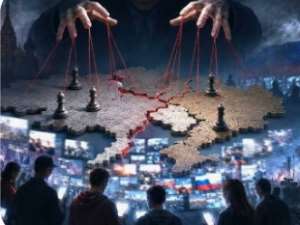
Foreign Information Manipulation and Interference (FIMI) is no longer an abstract concern for West Africa. It shapes how citizens learn about their governments, their security forces and their international partners.
FIMI differs from ordinary disinformation. Ghana's National Media Commission has warned that it can exploit genuine information, not just falsehoods, to create divisions and weaken social cohesion. That makes it harder to fact-check and easier to deny.
The Sahel as the front line
The scale is striking. Research by the EU Institute for Security Studies, drawing on Africa Center for Strategic Studies data, found that West Africa is the most targeted region in Africa, with 40% of disinformation campaigns, half of them linked to Russia.
The same study describes a pattern in the Sahel in which a surge of pro-Russian media precedes the arrival of Russian forces, known as the Africa Corps, formerly Wagner. Outlets such as Sputnik and the African Initiative have been named among the tools used in Mali and Burkina Faso, where public support for Russian leadership has grown.
Analysts at CDD-West Africa caution against a one-actor story. They note that disinformation aimed at the region does not come from Russia alone, and some Western actors have their own niche. They also describe FIMI as a precursor to hybrid warfare, with great-power rivalry turning the region into a theatre for proxy information wars.
Why the region is vulnerable
Participants at the first Africa Forum on Countering Foreign Interference, held in Dakar in February 2026, pointed to weaknesses in Africa's information ecosystem that make it susceptible to manipulation.
Senegal shows both the strength and the limits of resilience. It scores 60 out of 100 on the EUISS FIMI Index, the most resilient in West Africa [5]. Yet a 2025 AfricTivistes study found it still exposed through political polarisation and the economic fragility of the media, and one contributor argued that its laws on foreign interference are incomplete.
Responses and their risks
Counter-measures are gathering pace. The EU has launched a regional campaign with CJID and DUBAWA to expose and counter FIMI across West Africa, expanding fact-checking and open-source investigation.
Africans should still ask who funds this work and who defines "interference." A counter-FIMI agenda driven from Brussels or Washington can become another narrative contest. Governments may also be tempted to use the label against critics at home. The non-aligned approach suggested by regional think tanks deserves serious attention .
What should be done
Strengthen sovereign capacity. Regional fact-checkers, universities and regulators need home-grown tools for tracing coordinated campaigns.
Protect media economics. A financially secure press is harder to buy or bypass.
Legislate carefully.
Laws should target covert, coordinated, foreign-directed manipulation, not dissent or journalism. Build media literacy, including in Hausa and other local languages, so Zongo communities and rural audiences are not left out.
Apply one standard to all external actors, whether Russian, Turkish, Gulf, Chinese or Western. West Africa does not have to choose which foreign narrative to believe. It needs the capacity to decide its own story.
Mustapha Bature Sallama
Medical/Science communicator, Private Investigator, Criminal Investigation and Intelligence Analysis,United States Institute of Peace (USIP), [email protected] +233555275880
Sources
Terren, L., Van Aelst, P. & Van Damme, T. (2025). Shifting Alliances in West Africa: Measuring Russian engagement to support counter-FIMI strategies. EUISS Brief 4/2025. https://iss.europa.eu/sites/default/files/2025-04/Brief_2025-4_FIMI%20in%20West%20Africa.pdf
Ajanaku, A. (2024). "Beyond Disinformation: Countering FIMI." CDD-West Africa, 20 Nov 2024. https://www.cddwestafrica.org/blog/beyond-disinformation-countering-foreign-information-manipulation-and-interference-fimi/
"Political parties urged to guard against foreign manipulation of information" (remarks by George Sarpong, NMC). MyJoyOnline. https://www.myjoyonline.com/political-parties-urged-to-guard-against-foreign-manipulation-of-information/
"Experts Highlight How Foreign Actors Are Exploiting Weaknesses in Africa's Information Ecosystem." allAfrica, March 2026. https://allafrica.com/stories/202603130023.html
AfricTivistes & International IDEA (2025). Analytical Report on FIMI in Senegal. https://africtivistes.com/en/analytical-report-on-foreign-information-manipulation-and-interference-fimi-in-senegal
"EU, CJID and DUBAWA launch regional resilience campaign against FIMI and disinformation." DUBAWA Ghana. https://ghana.dubawa.org/eu-launch-regional-resilience-campaign-against-fimi-and-disinformation/


 Cabinet approves bill to regulate public relations practice – Shamima Muslim
 ‘Extremely disturbing and unacceptable,’ – Otiko Djaba condemns alleged sexual a...
 Bawumia was right; NDC's economy is only on paper, not in people's pockets – Kwa...
 NDC should credit Bawumia for introducing gold-for-reserves policy – Kwadwo Poku
 Obuasi SHTS sex scandal: Gender Ministry deploys team to support affected studen...
 Adwoa Safo's Dome-Kwabenya comeback bid must push Elikplim Akurugu to deliver mo...
 Obuasi SHTS sex scandal: Parliament Gender committee demands full accountability
 Some NDC MPs didn't vote for me; NPP votes made me Speaker in 2021 – Bagbin
 Ghana Armed Forces to hold land combat firepower demonstration at Bundase on Oct...
 Obuasi SHTS sex scandal: GES to ban teachers from inviting students to bungalows...


