




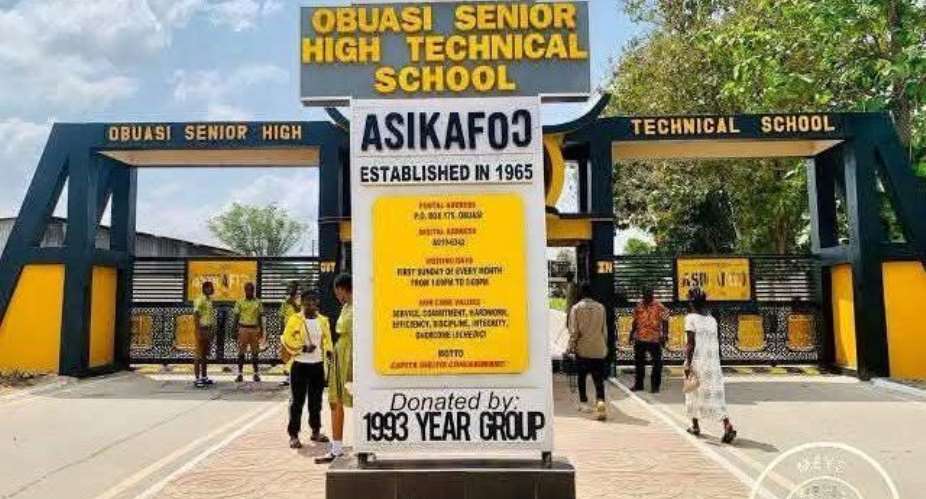
This article is an open discussion of the sexual abuse case at Obuasi SHTS based on reports available as of 22 October 2026. It is worth noting that the allegations discussed here are unproven: they are under investigation by the police and the Ghana Education Service (GES), and the accused is entitled to the presumption of innocence.
The Facts So Far
An investigative documentary by JoyNews’s Manasseh Azure Awuni titled “Inside the Dreaded Headmaster’s Bungalow,” has documented allegations of sexual abuse against the headmaster of Obuasi Senior High Technical School, Zakaria Abdulai. The number of victims has grown as the investigation progressed. The journalist says the initial information concerned five students, the number rose from 14 to 16 during the investigation, and has reached 19 after the documentary aired. One accuser, identified as Victim A, says the headmaster forced himself on her at his official residence and then tried to silence her with GH¢100.00. When asked, Mr Abdulai declined to comment, citing the ongoing police and GES investigations.
An official action followed quickly once the story broke. The Education Minister directed his suspension pending investigation, the GES interdicted him on 14 October, and the Minister referred the allegations to the CID so police could examine the criminal aspects while the GES ran its administrative inquiry. I regard that response as appropriate and necessary. It was also late, and that is the crux of this case.
The Case against the System
The strongest evidence of institutional failure is that authorities were reportedly told before the documentary. The Obuasi West Municipal Director of Education confirmed that five girls reported alleged sexual assault by the headmaster to his office in March 2026, after a report from the school’s safeguarding officer, and three submitted written complaints. Seven months passed between those complaints and the suspension, and the suspension came only after a national broadcast. The Parent-Teacher Association’s national general secretary faulted the GES Director-General and his team for acting only after the Minister issued a statement.
There is also a pattern. The journalist notes that a similar case at the same school in 2018 led to the dismissal of a senior housemaster, and that he had visited Obuasi over that case. Meanwhile, the GES’s own handling of the headmaster has been questioned. A GES committee examining a campus disturbance recommended that the headmaster and other staff be reposted to different schools, a fact disclosed by the Deputy Director-General on 15 October. Reposting an officer under suspicion moves the risk without removing it. The same official also said the GES Council approved about 15 dismissals in October 2026 in sexual harassment cases dating back to 2021, which suggests such cases take years to conclude.
Criticism is not confined to one political side or camp. The Parliament’s Gender Committee vice-chair, Zuwera Mohammed Ibrahimah, said authorities and stakeholders failed to act decisively on reports of abuse, and the GES Director-General is expected to appear before a parliamentary committee. A spokesperson for a former Education Minister demanded the Director-General explain the delay in interdicting the headmaster. Eduwatch has called for an independent audit led by child protection and investigative institutions outside the GES, examining the actions and omissions of school, municipal and regional officials. I agree with that proposal, because institutions cannot credibly audit themselves.
The Political Dimension
Reporting identifies Mr Abdulai as a serving constituency secretary of the governing NDC. The journalist’s interviewees alleged that some party figures intervened in earlier cases, and these remain allegations. What is documented is the party’s current position: it directed him to withdraw from the Juaben chairmanship race or face disqualification, with a party representative explaining that he is under investigation by law enforcement agencies. That decision was correct. Still, the question of whether political connections slowed any earlier response should be a formal term of reference in the independent audit, and not left to speculation.
The Defense Side and the Limits of the Evidence
Fairness requires noting what cuts the other way. One person interviewed in the investigation claimed the girls had been coached and that some teachers disliked the headmaster. No evidence for that claim has been presented in any reports, but it should be tested like every other claim. Scale alone does not prove guilt, though the number of accounts, written complaints and the municipal director’s confirmation make this difficult to dismiss as a single rumor. Mob justice is equally wrong. Police arrested six students suspected of involvement in a rampage and physical attack on the headmaster, and violence against a suspect is itself a crime that undermines the girls’ case.
The Legal Picture
Under Ghanaian law, defilement is the carnal knowledge of a child under 16, carries seven to 25 years’ imprisonment, and consent is irrelevant. The age of consent is 16, so for girls aged 16 and 17 the law does not automatically criminalize sex, and scholars and rights advocates have noted this gap. In such cases, prosecutors would need to prove absence of consent, which is where threats, coercion and abuse of authority become central. The ages of the 19 victims have not been, so one cannot say which provisions would apply. That is a matter for the CID and prosecutors.
What Should Happen Next
The evidence points to a few conclusions. First, the police must finish a transparent, timely investigation, and the public should hold them to that, since the MP argued the documentary contains an admission that should put the headmaster behind bars. Second, anyone who received complaints and sat on them should face scrutiny. Gender-rights advocate Angela Dwamena-Aboagye has said everyone who helped conceal the alleged abuse must be identified. Third, safeguarding officers need a direct line to an authority outside the school and district chain, since the March report passed through exactly that chain without result. Fourth, the girls need protection from retaliation. Whatever the court eventually decides about one man, the record already shows that complaints sat for months until a journalist arrived. A system that needs a documentary to hear children has failed them, and fixing it should not wait for the verdict.

 Ghana Armed Forces to hold land combat firepower demonstration at Bundase on Oct...
 Gambia to pay victims of Yahya Jammeh’s rule from proceeds of his seized US mans...
 Kolgo Paramount Chief questions 24-hour economy market without security
 'ABFA utilisation data excluded from PIAC's report not withholding of informatio...
 Obuasi SHTS sex scandal: Manasseh never said headmaster is a rapist - Brako-Powe...
 Government targets GH¢15.38bn domestic financing in Q4 to support 2027 bond buyb...
 Obuasi SHTS sex scandal: GES to ban teachers from inviting students to bungalows...
 Adwoa Safo to contest Dome-Kwabenya parliamentary seat again
 UG directs students with CGPA below 1.00 to go home
 Uganda Revenue Authority delegation visits TOR to understudy Ghana’s oil refinin...


