




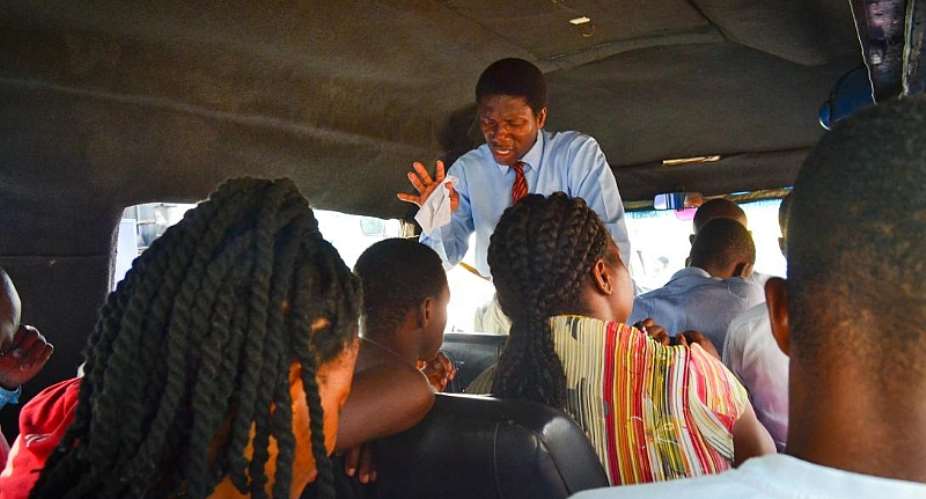
Ghana is a deeply religious country where the Christian faith occupies an important place in the lives of millions of citizens. Across our cities, towns and villages, evangelists proclaim the Gospel in churches, markets, lorry parks, streets and other public spaces. In our commercial vehicles, too, it is not unusual to encounter preachers who use the opportunity presented by a journey to share their faith with fellow passengers.
For many of these evangelists, the motivation is sincere. They believe that the Gospel must reach people wherever they may be found, including those who might never voluntarily enter a church. Their zeal deserves to be understood rather than automatically condemned.
However, a sincere intention does not necessarily make every method of evangelism appropriate in every circumstance.
The recent public discussion surrounding the restriction on preaching in moving public and commercial vehicles presents an opportunity for Christians, transport operators and the general public to reflect on an important question: Can we preserve the freedom to preach the Gospel while ensuring that our roads and public transport systems remain safe for everyone?
In my considered opinion, the answer is yes. Indeed, the distinction between preaching in a stationary vehicle and preaching in a moving one deserves serious reflection.
The Issue Is Not the Gospel, but the Circumstances of Its Delivery
It is important to begin by establishing what this debate should not be about.
It should not be a contest between the government and the Church. Neither should it be interpreted as a struggle between religious freedom and an allegedly hostile secular system. Above all, it should not become an occasion for questioning the sincerity of evangelists who have devoted themselves to spreading the Christian message.
The real issue is whether preaching inside a moving commercial vehicle is always an appropriate activity, given the responsibilities of the driver and the safety of passengers.
There is a fundamental difference between preaching in a stationary trotro at a lorry station and preaching in the same vehicle while it travels through traffic.
When the vehicle is stationary, the driver can concentrate on boarding procedures, waiting for passengers or preparing for the journey without simultaneously negotiating moving traffic. When the vehicle begins moving, however, the circumstances change. The driver must pay attention to the road, monitor other vehicles, anticipate the behaviour of pedestrians, observe traffic signals and respond promptly to unexpected situations.
Even a momentary lapse in concentration can have serious consequences.
A moving vehicle is not a church auditorium. It is a transport environment in which the driver's attention is essential to the safety of everyone on board.
The question, therefore, is not whether the Gospel is important. It is whether the delivery of a religious message should take precedence over the responsibilities associated with operating a moving vehicle.
I believe it should not.
A Driver's Attention Is Not a Minor Matter
Driving is a task that requires sustained attention, sound judgment and the ability to respond rapidly to changing conditions.
A preacher speaking passionately inside a vehicle may unintentionally compete for the driver's attention. The driver may listen to the message, react to a particularly emotional statement, become distracted by the preacher's movements or feel pressured to respond to an invitation for prayer.
Even when the driver makes a conscious effort to ignore the sermon, the activity can create an additional source of noise and distraction within the vehicle.
Some may argue that experienced drivers are accustomed to listening to conversations, music and other sounds while driving. That is true. However, the fact that drivers encounter distractions does not mean that we should deliberately introduce additional distractions into their working environment.
Road safety is not simply about whether a driver believes he can cope with a particular situation. It is also about reducing avoidable risks before they result in accidents.
Consider what might happen if a preacher is making an emotional appeal while the driver approaches a busy junction. A pedestrian suddenly crosses the road, another vehicle brakes unexpectedly, or a motorcyclist appears in the driver's path. The driver must react immediately.
In such circumstances, every additional demand on attention matters.
The preacher may have the best intentions, but good intentions cannot prevent an accident caused by a moment of inattention.
Moreover, the preacher himself is a passenger in the vehicle, and the consequences of an accident could affect him just as seriously as everyone else.
It is therefore reasonable to ask whether the spiritual purpose of the activity requires it to continue while the vehicle is moving, particularly when the same message can be delivered before departure or after the vehicle has stopped.
Can the Bible Support a Concern for Road Safety?
Some Christians may question whether a restriction on preaching in moving vehicles is compatible with the biblical command to proclaim the Gospel.
They may point to the words of Jesus in Mark 16:15: "Go ye into all the world, and preach the gospel to every creature" (King James Version).
This is a powerful missionary instruction. It reminds Christians that the proclamation of the Gospel must not be confined to church buildings or restricted to people who already share their beliefs.
Nevertheless, the command to preach everywhere does not necessarily mean that every location, activity or method is appropriate at every moment.
The Christian faith does not teach that the pursuit of one good objective eliminates every other moral responsibility.
In Matthew 10:16, Jesus instructs His disciples to be "wise as serpents, and harmless as doves" (KJV). This counsel combines wisdom with innocence. It suggests that Christian witness should be accompanied by prudence, discernment and consideration for others.
An evangelist who seeks to win souls should therefore consider not only what he wishes to communicate but also the circumstances in which he communicates it.
Would it be wise to insist on preaching while a vehicle is moving if doing so creates an avoidable risk? Could the same message be delivered while the vehicle is stationary, without compromising the central purpose of evangelism?
These are questions that Christians should be willing to examine honestly.
The Bible also teaches the importance of loving one's neighbour. In Mark 12:31, Jesus identifies the command to love one's neighbour as one of the greatest commandments.
Love for one's neighbour cannot be reduced to speaking to that person about salvation. It also includes concern for that person's physical well-being.
If I preach about eternal life while disregarding the safety of the people sitting beside me, have I fully considered my responsibility towards them?
Christian witness should reflect concern for the whole person: spiritual, physical and social.
Romans 13:1–7 discusses the Christian's relationship with governing authorities, while Romans 13:10 teaches that love does no harm to a neighbour. These passages do not mean that every government action is beyond criticism, nor do they remove the Christian responsibility to examine laws and public policies carefully. They do, however, provide a basis for reflecting on lawful authority, public order and the obligation to avoid harming others.
Similarly, 1 Corinthians 10:23 states that not everything that is permissible is beneficial. Although this passage addresses a different context, its underlying principle is relevant: the question is not merely whether one desires to do something, but whether doing it is beneficial and appropriate.
Evangelism should not be measured solely by the number of people who hear a sermon. It should also be measured by the wisdom, compassion and responsibility demonstrated by those who proclaim it.
Does God Require Us to Preach at Every Possible Moment?
One argument advanced in defence of preaching on moving vehicles is that Christians must take advantage of every opportunity to spread the Gospel.
There is merit in the desire to make the most of every opportunity. Yet an opportunity to preach is not necessarily an obligation to preach immediately, regardless of the circumstances.
Ecclesiastes 3:1 reminds us that there is a time for everything. In the same spirit, Ecclesiastes 3:7 speaks of a time to keep silence and a time to speak.
These verses are not a direct prohibition against preaching on buses. Rather, they remind us that wisdom involves recognising the appropriate time and circumstances for different activities.
An evangelist who enters a stationary vehicle and shares a brief message before departure may be acting just as faithfully as one who insists on continuing the sermon throughout the journey.
Indeed, a preacher who willingly pauses when the vehicle begins moving demonstrates that he understands the relationship between spiritual zeal and practical responsibility.
There are many opportunities to evangelise: at lorry stations, in markets, at public gatherings, in homes, through personal conversations, in churches and through modern communication platforms.
No Christian should conclude that the Gospel will lose its power simply because a sermon must stop when a commercial vehicle begins moving.
The message remains the same. Only the timing and circumstances of its delivery change.
What About Religious Freedom?
Another important consideration is the constitutional protection of religious freedom and freedom of expression.
In Ghana, these freedoms are protected under Article 21 of the 1992 Constitution. Christians must be able to practise their faith, communicate their beliefs and participate in religious activities without unjustified interference.
These protections are important, and any restriction affecting religious activities deserves careful scrutiny.
However, freedom of religion does not automatically settle every question about the use of shared public spaces or the conduct of activities within commercial transport.
A public vehicle carries people with different religious convictions, personal preferences and reasons for travelling. Some passengers may welcome a sermon. Others may prefer silence, may belong to another faith or may simply wish to rest after a long day of work.
The question is how to accommodate religious expression without disregarding the legitimate interests and safety of other people.
This requires a distinction between the freedom to hold and communicate religious beliefs and the expectation that every available public environment must accommodate every form of religious activity at every moment.
A person may be free to express a religious conviction without being entitled to insist that a particular activity continue regardless of the circumstances.
The principle should apply consistently across religious traditions. A safety rule governing the conduct of people inside moving commercial vehicles should not favour one faith over another.
If the concern is distraction and public safety, the relevant standard should be the activity and its circumstances, not the religious identity of the person undertaking it.
The objective should be reasonable regulation, not religious suppression.
But What About Tourist Guides Who Speak on Moving Buses?
This is an important question, and it deserves a serious answer.
Tourist guides regularly address passengers while travelling on tour buses. They explain the history of landmarks, introduce visitors to local customs, identify places of interest and provide information about the destinations ahead.
If a tourist guide can speak while a bus is moving, some may ask why an evangelist should not be permitted to do the same.
At first glance, the comparison appears convincing. Both individuals speak to passengers inside a moving vehicle. Both may use their voices to communicate information, and both may hold the attention of the people on board.
It would therefore be simplistic to argue that every spoken word inside a moving vehicle is necessarily dangerous.
The more useful question is whether the two activities are always equivalent in their circumstances and potential effects.
Tourist commentary is generally part of an organised service. The guide's role, the timing of the commentary and the nature of the information provided can be planned in advance. A professional tour operator may also establish procedures intended to prevent the guide from distracting the driver.
For example, a guide may be seated in a designated position, speak through an appropriate sound system and avoid engaging the driver while the vehicle is negotiating difficult road conditions. Where necessary, commentary can be paused.
These arrangements do not eliminate every possible distraction, but they can help manage it.
By contrast, preaching in a commercial vehicle may be spontaneous and may involve standing, moving through the aisle, speaking loudly, inviting passengers to respond collectively or making emotional appeals. Such activities can potentially create different demands on the driver's attention and affect passengers' ability to remain safely seated.
However, we must be fair: not every evangelist behaves in this manner, and not every tourist guide conducts commentary responsibly. A quiet, seated preacher may cause less distraction than an animated tour guide who repeatedly engages the driver.
The distinction, therefore, should not be that tourism is inherently harmless while religion is inherently dangerous. The distinction should be based on the actual activity, its manner of delivery and the risks it creates.
This is an essential qualification.
If a tourist guide's commentary distracts the driver, the same safety concerns arise. Professional status or the educational value of the information does not automatically make an activity safe.
Likewise, an evangelist's sincere religious purpose does not automatically make every form of preaching appropriate while the vehicle is moving.
The appropriate response is to establish and enforce consistent safety standards.
Tour operators should ensure that guides do not interfere with the driver's concentration. Transport operators should likewise ensure that activities inside their vehicles do not compromise safe driving.
Where commentary can be conducted safely under established procedures, it should not be assumed to present the same level of risk as every other form of passenger activity. Where it cannot be conducted safely, it should be modified or suspended.
The existence of tourist guides who speak on moving buses is therefore not, by itself, a sufficient argument for permitting unrestricted preaching in moving commercial vehicles. Rather, it challenges us to develop a consistent and evidence-based approach to passenger activities.
If we demand that evangelists exercise restraint, we should be equally willing to demand appropriate restraint from tourist guides and everyone else who addresses passengers on moving vehicles.
Consistency is the foundation of public confidence.
The Rights of Passengers Must Also Matter
There is another dimension to this discussion that should not be overlooked: the rights and comfort of passengers.
A commercial vehicle is a shared transport space. Passengers board it for different reasons, including work, education, medical appointments, family responsibilities and other daily activities.
Some may welcome the opportunity to hear the Gospel. Others may not.
A passenger who does not wish to participate in a religious activity should not automatically be regarded as hostile to Christianity. Nor should a person be expected to demonstrate respect for religion by participating in a sermon that he or she did not seek out.
Christianity itself teaches that genuine faith involves the heart and conscience, not merely outward compliance.
Jesus frequently taught people, invited them to respond and addressed their spiritual needs. His ministry demonstrates the importance of communicating the truth, but it should not be used to justify ignoring the circumstances or legitimate interests of others.
Allowing an evangelist to preach in a stationary vehicle, where circumstances permit, provides an opportunity for those who wish to listen to do so.
It also allows the journey to proceed without an additional activity competing for attention.
This arrangement need not be interpreted as hostility towards religion. It can instead be understood as an attempt to balance the interests of people who share a public transport environment.
The same principle applies to political speeches, commercial promotions and other activities that may impose themselves on passengers.
Public transport should not become a space where the loudest person automatically determines what everyone else must listen to.
Is Preaching While the Vehicle Is Stationary a Reasonable Compromise?
I believe the distinction between a stationary vehicle and a moving one offers a practical starting point for balancing these competing considerations.
When a vehicle is stationary at a lorry station, an evangelist may have an opportunity to share a message with passengers before departure, subject to the applicable rules, the operator's arrangements and the circumstances at the station.
When the vehicle begins moving, the focus should shift to safe transportation.
This approach does not require the Church to abandon public evangelism. It simply recognises that different environments require different methods.
Of course, the precise arrangements matter. A vehicle stopped temporarily in the middle of traffic is not necessarily an appropriate venue for preaching. Nor should a preacher delay departure or pressure a driver to remain at a station against the operator's wishes.
The objective should be to make reasonable opportunities available without creating additional risks or interfering with transport services.
Transport operators can communicate clear expectations to passengers and evangelists. Religious leaders can educate their members about responsible evangelism. Drivers should be empowered to prioritise safety without being drawn into unnecessary confrontations.
Authorities, for their part, should communicate the applicable regulations clearly and ensure that enforcement is fair, proportionate and consistent.
These practical measures would help prevent a legitimate safety concern from becoming an unnecessary confrontation between religious communities and public authorities.
A Word to Our Evangelists and Church Leaders
My appeal to evangelists is not that they should preach less passionately, but that they should preach more wisely.
The Gospel deserves to be communicated with conviction, courage and compassion. Yet the manner in which it is communicated can either strengthen or undermine the public's appreciation of the Christian witness.
When an evangelist willingly pauses his message to respect the safety of passengers, he is not necessarily surrendering his faith. He may instead be demonstrating that the message he proclaims is consistent with the responsibility he owes to others.
Church leaders should encourage their members to distinguish between genuine opposition to the Gospel and reasonable measures intended to protect human life.
Not every restriction on the timing or location of an activity amounts to persecution. At the same time, public authorities must remain sensitive to constitutional freedoms and should avoid unnecessarily broad restrictions that could unjustifiably interfere with religious expression. Both sides have responsibilities. The Church should not dismiss every safety concern as an attack on Christianity. Authorities should not dismiss every religious objection as an unwillingness to obey the law. A mature society allows legitimate concerns to be discussed openly while maintaining a commitment to public safety, constitutional rights and mutual respect.
Conclusion: Let Us Preach the Gospel Without Neglecting Our Neighbour
The debate about preaching in moving commercial vehicles invites us to reflect on a broader Christian principle: the pursuit of a worthy objective should not lead us to disregard our responsibilities towards others.
The Great Commission remains central to Christian life. The call to share the Gospel remains important. Nothing in this argument should be interpreted as a suggestion that evangelism ought to be confined to church buildings.
Nevertheless, there is a difference between refusing to abandon the Gospel and refusing to adjust one's method of communicating it.
An evangelist can remain faithful to his calling while recognising that a moving vehicle is primarily a transport environment. A church can remain committed to public evangelism while encouraging its members to observe reasonable safety requirements. A government can seek to protect passengers while respecting the constitutional freedoms of religious communities. The central question should not be whether evangelism is important. It unquestionably is to Christians.
The question is whether the desire to preach at a particular moment justifies introducing an avoidable risk into an environment where human lives depend on a driver's sustained concentration.
For me, the answer is clear: no religious activity should be pursued in a manner that unnecessarily compromises the safety of human life.
Let us remember that the people travelling beside us are not merely potential converts. They are fellow human beings whose lives, safety and dignity also deserve our consideration.
If the message of Christianity calls us to love our neighbours, then concern for their safety must be part of our witness. Let us preach with conviction, evangelise with courage and serve with compassion. But let us also exercise wisdom in choosing the appropriate time and place. The Gospel does not become less powerful because a preacher pauses when a vehicle begins moving. Sometimes, the most responsible testimony is not to insist on speaking at every opportunity, but to recognise when love for our neighbour requires us to wait.
After all, winning souls should never mean disregarding the safety of the very people whose souls we hope to reach.

 Ghana Armed Forces to hold land combat firepower demonstration at Bundase on Oct...
 Gambia to pay victims of Yahya Jammeh’s rule from proceeds of his seized US mans...
 Kolgo Paramount Chief questions 24-hour economy market without security
 'ABFA utilisation data excluded from PIAC's report not withholding of informatio...
 Obuasi SHTS sex scandal: Manasseh never said headmaster is a rapist - Brako-Powe...
 Government targets GH¢15.38bn domestic financing in Q4 to support 2027 bond buyb...
 Obuasi SHTS sex scandal: GES to ban teachers from inviting students to bungalows...
 Adwoa Safo to contest Dome-Kwabenya parliamentary seat again
 UG directs students with CGPA below 1.00 to go home
 Uganda Revenue Authority delegation visits TOR to understudy Ghana’s oil refinin...


