




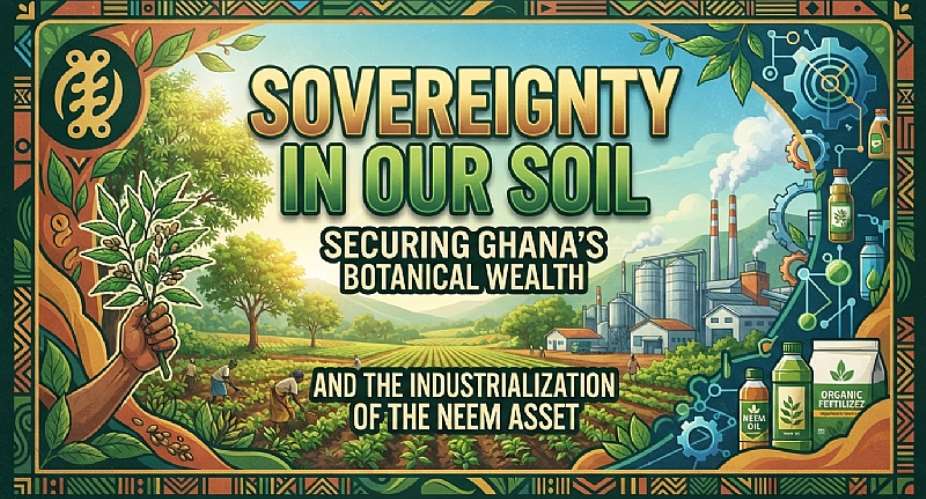
In the shifting landscape of global pharmacology and bio-economics, traditional botanical knowledge has emerged as a high-stakes frontier for intellectual property exploitation. While multinational entities aggressively scour the global South for biological leads, developing nations face an invisible drainage of wealth—a process academically defined as biopiracy. The historic ten-year legal battle surrounding India’s iconic Neem tree (Azadirachta indica), where a corporate conglomerate sought to monopolize a tree with over 300 documented medicinal uses, stands as a definitive warning. For Ghana, this is not a distant Asian narrative. The Neem tree grows with aggressive, resilient ubiquity across the length and breadth of our nation—stretching extensively across the Accra Plains, dominating coastal thickets, and lining the rural landscapes of the Volta and Northern regions.
To formalize our national defense against this predatory commercialization, this article proposes the enactment of the National Botanical Heritage and Biopiracy Defense Act. This legislative framework provides a rigorous, policy-focused analysis designed to motivate Ghanaian stakeholders to transform this local ecological asset into a protected, state-backed industrial powerhouse before external actors commodify our landscape under foreign patents.
The Bio-Economic Landscape: From the Accra Plains to National Ubiquity
Introduced to the Gold Coast decades ago, the Neem tree has acclimatized so completely that it forms a core pillar of Ghana's coastal and savanna ecosystems. Yet, its immense industrial and clinical potential remains largely trapped within informal parallel healthcare structures.
- The Accra Plains Ecosystem: In the arid and semi-arid stretches of the Greater Accra and Eastern regions, Neem acts as a critical ecological anchor, resisting desertification and providing a localized "pharmacy" for thousands of smallholder farming communities.
- The Agronomic Value Ledger: Beyond its traditional use for dental hygiene and fever reduction, the active compound azadirachtin found within local Neem seeds offers a premium, non-toxic organic pesticide blueprint capable of revolutionizing domestic crop protection.
- The Soil Restorative Dimension: Neem cultivation has demonstrated profound capabilities in restoring heavily degraded lands, offering an ecological antidote to territories stripped by structural deforestation and unregulated mining activities.
Regional Insights and Voices from the Field
To truly understand the value of this resource, one must look to the regional practitioners who manage its application daily. In the Ketu North Municipality of the Volta Region, local agroforestry operators and herbal medicine practitioners frequently observe the plant's dual-action dominance in crop safety and clinical care.
"We have treated the Neem tree as a common wild weed for too long," notes Togbe Kwasi, a veteran herbal practitioner based near the Keta basin. "When chemical fertilizers and foreign pesticides become too expensive or destroy our soil, it is the crushed Neem seed emulsion that protects our vegetable beds from pests without poisoning our consumer markets. It is our natural sovereignty, growing right in our backyards."
Similarly, clinical researchers collaborating with institutions like the Centre for Plant Medicine Research at Mampong-Akuapem emphasize that the highly potent anti-malarial, anti-bacterial, and anti-fungal properties observed in local Neem strains present a billion-dollar pharmaceutical opportunity that remains entirely untapped by domestic industrialists.
OPEN SECURITY MEMORANDUM & DIRECTIVE
TO:
The Inspector General of Police (IGP), Ghana Police Service
The Commissioner, Customs Division of the Ghana Revenue Authority (GRA)
SUBJECT: Urgently Halting the Illicit Logging, Smuggling, and Depopulation of Ghana’s Ancient Neem Genetic Heritage by Foreign "Tree Hunters"
Dear Sirs,
We write to draw your immediate, high-alert attention to an unfolding environmental and national security crisis threatening Ghana’s sovereign biological assets. Sophisticated cross-border syndicates and local middlemen—internally dubbed "Neem tree hunters"—have launched aggressive, systematic extraction campaigns across our rural belts. Their targets are venerable, multi-decade-old Neem trees between 50 and 100 years old.
Because these ancient giants contain highly concentrated, irreplaceable chemical and genetic profiles, they are being cut down and processed into raw biomass, roots, and lumber for bulk export to foreign manufacturing hubs. This unregulated exploitation threatens to permanently depopulate our natural ecosystem, stripping the Accra Plains and coastal belts of their vital ecological defenses.
By this open directive, your respective commands are urged to implement the following immediate operational measures:
- Border Interdiction Dragnet: Border control officers at all entry and exit points—most notably the Tema and Takoradi ports, alongside major land borders—must enforce a total zero-tolerance hold on outbound shipping containers or haulage trucks carrying raw, unprocessed Neem logs, roots, or bulk bark.
- Transit Corridor Checkpoints: Police highway checkpoints and Forestry Commission teams must treat any transport of mature Neem logs as a severe biosecurity violation. Foreign actors frequently mask these operations under the guise of general "clearing lumber" or "firewood" by exploiting loosely vetted local felling permits. Any transit of these materials must be impounded immediately pending multi-agency forensic clearance.
- Intelligence Surveillance: The National Intelligence Bureau (NIB) must be deployed to track the financial backers powering these syndicates, ensuring that local traditional authorities or bureaucratic gatekeepers are held strictly accountable if they facilitate the destruction of these irreplaceable community groves.
We must act decisively to halt this environmental sabotage. Our ancestral biological shield cannot be clear-cut to line the pockets of foreign corporations at the expense of our future bio-economy.
Respectfully,
The Patriotic Stakeholders and Conservation Alliances of Ghana
Commercial Frontiers: Low-Barrier Business Ventures for Ghanaian Youth
The industrialization of the Neem tree offers an incredibly positive landscape for youth employment. Ghanaian youth do not need multi-million-dollar laboratories to tap into this value chain; several viable, high-margin startup pathways can be pursued immediately with minimal capital:
- Organic Agro-Inputs Manufacturing: Young entrepreneurs can set up localized crushing and formulation setups to produce cold-pressed Neem seed oil and Neem cake fertilizers. Local farmers are actively seeking affordable, organic alternatives to imported chemical pesticides, creating an instant domestic market.
- Natural Cosmetics and Personal Care Brands: Neem's proven anti-bacterial and anti-inflammatory properties make it a premium ingredient for the booming global organic skincare market. Youth-led startups can formulate high-value organic Neem soaps, acne treatments, and natural oral hygiene products targeted at urban consumers and regional export markets.
- Aggregated Supply Chain and Processing Hubs: Setting up structured solar-drying and collection networks across the Accra Plains allows young professionals to build tech-enabled supply chains. By aggregating high-quality, standardized raw seeds and leaves, youth cooperatives can become the primary suppliers to large-scale domestic and international manufacturing companies.
Funding Innovation: Local and International Capital and Grants
To move these youth-led businesses from concepts into scaled industrial realities, a robust ecosystem of specialized funding, research grants, and impact capital is accessible to forward-thinking entrepreneurs and researchers:
- Domestic Innovation Financing: Locally, agencies such as the Ghana Export Promotion Authority (GEPA) and the NEIP (National Entrepreneurship and Innovation Programme) offer targeted seed capital and export facilitation support for unique indigenous products. Furthermore, the Venture Capital Trust Fund (VCTF) provides equity financing tailored to scalable agro-processing ventures.
- Global Research and Scientific Grants: For researchers looking to run clinical trials or chemical finger-printing alongside the CSIR, international funding bodies offer massive financial backing. Agencies like the African Development Bank (AfDB) via their Agri-business funds, the European Union's Horizon Europe framework, and the Global Environment Facility (GEF) actively award multi-million-dollar grants focused on biosecurity, traditional medicine validation, and climate-resilient agriculture.
- Green Bonds and Impact Financiers: International impact funds and climate investors are aggressively looking to fund projects that offer dual returns—environmental restoration and community enrichment. Ventures that combine Neem cultivation with land reclamation are prime candidates for Green Climate Fund (GCF) allocations and global carbon credit financing.
Enforcing Intellectual Property Rights: The CSO-Community Partnership
A central mechanism of the proposed National Botanical Heritage and Biopiracy Defense Act is the creation of a grassroots enforcement shield. Laws are only as strong as the systems that monitor them. Civil Society Organizations (CSOs) must step into the gap to partner directly with rural communities—the true custodians of traditional knowledge—to actively guard these rights:
- Establishing Community Biocultural Protocols (CBPs): CSOs can facilitate workshops to help local communities formally document their ancestral uses of Neem and other flora. These protocols legally state: "We own this knowledge; it is not a corporate discovery."
- Legal Literacy and Paralegal Training: CSOs can train local community leaders and youth as "biocultural paralegals." These individuals act as local watchdogs, trained to flag suspicious foreign researchers, corporate "bio-prospectors," or entities collecting local seeds and plant samples without a clear, signed Material Transfer Agreement (MTA).
- Creating Fair Access and Benefit-Sharing (ABS) Mechanisms: When legitimate industrialists wish to source Neem commercially from the Accra Plains or rural districts, CSOs can offer legal aid to communities. This ensures that a fixed percentage of all processing profits flows directly back into local schools, clinics, and water infrastructure.
Academic Data Analysis & Bibliography: Intra-African Botanical Trade
A data-driven look at the continent reveals that botanical trade within the African Continental Free Trade Area (AfCFTA) is severely hindered by a lack of harmonized intellectual property standards and formalized extraction value chains. According to trade tracking assessments, while sub-Saharan Africa accounts for over 25% of the global green genetic resource pool, it captures less than 1% of the global patented pharmaceutical market value.
The Council for Scientific and Industrial Research (CSIR) in Ghana must lead the scientific charge to reverse this trend. By partnering with the CPMR and regional bodies, the CSIR can provide the definitive chemical fingerprinting of Ghanaian Neem. This scientific mapping registers our indigenous strains on global databases, presenting an unassailable wall of "prior art" that stops foreign patent offices from approving biopiracy claims.
Selected Academic Bibliography
- Council for Scientific and Industrial Research (CSIR) - Ghana. (2024). National Registry of Phytomedicinal Assays and Economic Botany in the Savanna and Coastal Belts. CSIR Press, Accra.
- Mgbeoji, I. (2018). Global Biopiracy: Patents, Plants, and Indigenous Knowledge. UBC Press. (Analyzing the structural vulnerabilities of West African ecosystems to foreign patent raiding).
- Shiva, V., & Radha, H. (2002). The Neem Patent Victory: A Landmark for Traditional Knowledge and Public Sovereignty. Research Foundation for Science, Technology and Ecology, New Delhi.
- World Health Organization (WHO) Regional Office for Africa. (2025). Progress Report on the Integration of Traditional Medicine into National Health Systems within the ECOWAS Sub-Region. WHO-AFRO, Brazzaville.
An Urgent Strategic Directive for Ghanaian Stakeholders
Transitioning the Neem resource from a backyard remedy into a standardized, GDP-contributing sector requires a coordinated, cross-sectoral policy framework. The call to action is directed to the following institutions:
- The Food and Drugs Authority (FDA): The FDA must step forward to design standardized, fast-tracked regulatory pathways for locally processed Neem-based therapeutics and cosmetic compounds, ensuring domestic production meets international export criteria without losing its cost-disruptive edge.
- The Environmental Protection Agency (EPA): The EPA must actively incorporate large-scale Neem agroforestry projects into nationwide environmental restoration initiatives, explicitly utilizing the plant's soil-restoring and carbon-sequestering profiles to reclaim lands damaged by environmental degradation.
- The Ministry of Agriculture: Policymakers must formally integrate Neem-derived organic pesticides into national agricultural support frameworks, substituting expensive, imported chemical alternatives with locally processed, eco-friendly options to strengthen smallholder food security.
- The Ministry of Finance & Domestic Industrialists: Capital investment must be intentionally funneled toward domestic bio-processing factories. The Ministry of Finance should establish tax-incentivized structures for local SMEs and industrialists to acquire advanced extraction machinery, capturing the value chain within Ghanaian borders rather than exporting raw botanical materials.
- The Council for Scientific and Industrial Research (CSIR) Strategic Blueprint: To move beyond relying entirely on wild, unmapped trees, the CSIR—in close partnership with the Ministry of Agriculture—must spearhead a nationwide project for deliberate, large-scale commercial planting zones. Establishing massive, systematically cultivated Neem plantations across the Accra Plains and northern savannas guarantees a uniform, predictable supply of high-yield genetic strains. These specialized, state-protected agricultural zones will be dedicated solely to Scientific and Industrial Development Research and Use, creating a controlled infrastructure where researchers can securely optimize the raw botanical properties of the plant to feed domestic pharmaceutical and organic agro-chemical factories without degrading our native wild forests.
Capital Call: Aligning with President Mahama's Agribusiness Industrialization Vision
The economic transformation of Ghana's Neem resource is fully aligned with the forward-looking economic directives of His Excellency President John Dramani Mahama. Under President Mahama’s targeted initiatives, the government is executing a bold industrial strategy driven by the $10 billion New Economy Policy, which channels $2 billion annually directly into agro-processing, local manufacturing, and industrial hubs like the Afienya Industrial Park. This presents an unprecedented golden opportunity for visionary local and international financiers.
Under the framework of the CEO-Government Compact, President Mahama has explicitly called upon private sector leaders and industrialists to forge deeper public-private partnerships to build a resilient, self-sustaining economy. Furthermore, with state-backed allocations already targeting massive land reclamation programs—such as the GH¢200 million initiative to restore lands degraded by illegal mining—investors in ecological restoration, carbon offsetting, and sustainable agroforestry will find zero-risk, high-reward synergy with current executive priorities.
We invite agro-processors, pharmaceutical venture capitalists, and domestic industrialists to boldly step forward and pioneer commercial Neem-extraction facilities within our free-zone enclaves. The infrastructure is scaling, the policies are secure, and the state-level political will is unyielding.
The narrative of the Neem tree is a stark reminder that nature's shared heritage is continuously vulnerable to commercial exploitation. For developing countries like Ghana, our rich biodiversity is not just an environmental asset—it is a critical socio-economic lifeline. We must transition from passive observers to proactive guardians of our traditional wisdom. By legalizing protection via the National Botanical Heritage and Biopiracy Defense Act, registering ancestral knowledge through the CSIR, empowering local community watchdogs via CSOs, implementing ironclad timber export restrictions on aged groves, and fostering local industrial innovation under current presidential agribusiness initiatives, we ensure that our natural wealth remains a public good that continues to heal and empower generations of Ghanaians to come.
Editor’s Note & Investor Contact Information:
Are you an investor, agricultural corporate entity, international grant-maker, or a young Ghanaian entrepreneur looking to capitalize on Ghana’s emerging organic bio-economy? For strategic guidance, comprehensive business models, funding application directions, or connectivity to licensed community cooperatives in the Accra Plains, please contact the author directly at [email protected] or connect via phone at +233 23 414 0626.
✍️ Submitted by:
Retired Senior Citizen
For and on behalf of all Senior Citizens of the Republic of Ghana 🇬🇭
Teshie-Nungua
[email protected]


 Abronye loses again as Court of Appeal dismisses bid to halt Samson Anyenini’s d...
 Over 30 women feared trapped in prostitution in Savannah as GIS arrests traffick...
 Govt pays GH¢24.8bn to statutory funds since January — Ato Forson
 Seven missing Axim fishing canoe crew located in Togo’s waters — Western Regiona...
 Health Ministry assures Ghanaians of readiness to manage Ebola cases
 FDA shuts down Arcan Bitters factory again over illegal production in Ashanti Re...
 PAC chair praises NPA CEO Edudzi Tameklo’s performance at committee hearing
 Ghanaian jailed nine months in US for using relative’s social security number to...
 Ukraine war: I'm going to Russia to convince President Putin to ceasefire — Maha...
 'Prof. Jane Naana is Vice President of Ghana; not for women and girls' — Victori...


