




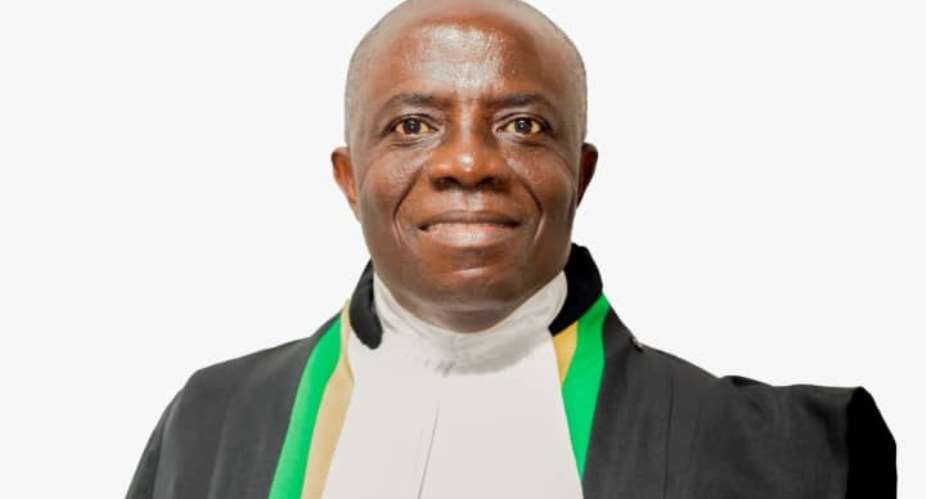
A judge of the African Court on Human and Peoples’ Rights, Justice Dennis Dominic Adjei, has challenged Ghana’s conventional approach to accountability, arguing that it must extend beyond political leaders and public institutions to include private, religious, traditional and family authorities.
Justice Adjei, who is also a Justice of the Supreme Court of Ghana, said accountability should not focus only on the President, Vice-President, Speaker of Parliament, Chief Justice and ministers, but must also cover directors, chief executive officers, board members, Metropolitan, Municipal and District Chief Executives (MMDCEs) and other public officials.
He further called for the accountability chain to extend to private and social power holders, including bishops, priests, pastors, imams, traditional priests, heads of religious associations, non-governmental organisations, paramount chiefs, Adikrofo, heads of schools, teachers and heads of families.
“Ghana must extend the accountability chain to private and social power holders: bishops, priests, pastors, imams, fetish priests, heads of Knights and Ladies of St John International, Christian Mothers Association, Laity Council, NGO heads, paramount chiefs, Adikrofo, heads of schools, head teachers, and heads of families.”
Justice Adjei made the call during the inaugural Annual St. John the Baptist Memorial Lecture in Accra, organised by the Joint Board of the Supreme Subordinate Commandery and Ladies’ Auxiliary of the Knights of St John International, Ghana.
The event, which was held on the theme, “Speaking Truth to Power: Upholding Justice, Morality and National Accountability”, brought together the Vice-President, Speaker of Parliament, superior court justices, religious and traditional leaders as well as members of the diplomatic corps.
Justice Adjei said effective accountability at the local and community levels was essential to strengthening accountability within national institutions.
“Where power is well managed at the church and mosque levels, and those people who hold power are held accountable, it translates to the national public institutions, as all the national leaders are mainly Christians and Muslims.”
He used the relationship between teachers and pupils in a classroom to illustrate the different ways power operates, noting that while teachers exercise visible institutional authority, pupils can also exercise less visible forms of resistance.
He said the analogy demonstrated that anyone who exercises authority, whether in public, private, religious, traditional or family settings, also wields power and must therefore be accountable.
Justice Adjei identified seven broad forms of power that require accountability in Ghana.
They include constitutional and legal power derived from the Constitution and statutes; political and decision-making power exercised by executive, legislative and assembly members, chiefs and religious leaders; and administrative and bureaucratic power exercised by administrators, teachers, church and mosque committees and court registrars.
He also identified judicial and adjudicative power exercised by judges, chiefs in arbitration and religious leaders in disciplinary matters.
The other forms are financial and economic power, involving control over budgets, tithes, zakat, stool proceeds, family lands and NGO funds; moral, expert and charismatic power exercised by religious leaders; and coercive and disciplinary power exercised by the military, police and judiciary, as well as through customary and religious disciplinary mechanisms.
Justice Adjei stressed that accountability must operate across all these spheres if Ghana is to build a just society.
“Ghana cannot build a just republic if accountability stops at the gates of Jubilee House,” he said.
He argued that national accountability should form a continuous chain extending from the Presidency to religious institutions, Parliament to traditional authorities, and schools to families.
According to him, Ghana’s future depends on creating a society where those who wield power remain answerable to truth, justice and the people.
He said an accountable society must protect those who speak out against wrongdoing while ensuring that allegations or concerns raised receive lawful and reasoned responses.
Justice Adjei also drew lessons from the biblical account of St. John the Baptist in the Gospel of Mark, where John challenged the conduct of Herod despite the ruler’s authority to imprison him.
He said John’s eventual death demonstrated the consequences of allowing authority to protect pride at the expense of conscience.
“John’s message also reached beyond the palace. In Luke, he called upon people with food and clothing to share; upon tax collectors to collect only what was prescribed; and upon soldiers to refrain from extortion and false accusation. His teaching connected personal repentance to the treatment of neighbours and the responsible use of office,” Justice Adjei stated.
The memorial lecture was instituted to promote national reflection on conscience, law and accountability, providing a platform for discussions on constitutional governance and ethical leadership.

 'Prof. Jane Naana is Vice President of Ghana; not for women and girls' — Victori...
 Mahama Ayariga warns Ghana is prioritising hygiene infrastructure over service d...
 Speaking truth to power is constitutional duty, not just moral courage — Supreme...
 We must extend accountability chain to private and social power holders – Africa...
 Obuasi SHS headmaster sues Manasseh Azure Awuni, Multimedia Group for GH¢2m over...
 YEA deploys over 11,700 youth under Community Police Assistant Model – Basintale
 Parliament’s Human Rights Committee demands swift investigations in Obuasi SHTS ...
 'Let the law take its course' – Veep on Obuasi SHTS sexual abuse allegations
 Obuasi SHTS sex scandal: 'The powerful ride the law to trample the weak' – Kofi ...
 19-year-old remanded over alleged fatal stabbing of boyfriend at Ofankor


