




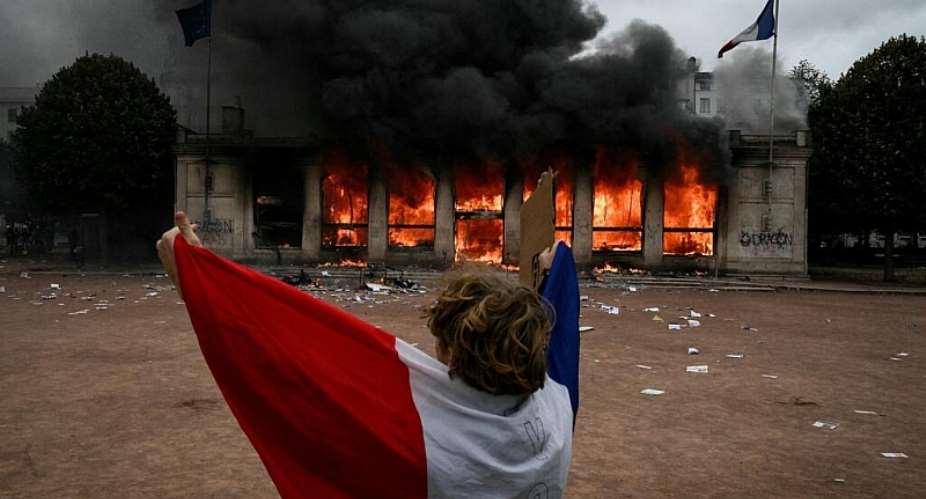
At least 3,000 shops were damaged or looted nationwide on 17 and 18 October, with losses estimated at several hundred million euros.
With presidential elections just six months away, the question of who was behind the violence – whether it was politically organised, largely opportunistic or linked to immigration – has become central to the debate over public order and the government's authority.
Some 2,500 people have been taken into police custody in connection with last weekend's violence and 1,000 referred to a judge or prosecutor, the Justice Ministry has said.
Courts using special fast-track procedures have convicted 150 people so far.
“If we don't deliver an extremely firm penal response, then residents will take justice into their own hands,” Justice Minister Gérald Darmanin said on Tuesday.
'Barbarians' to blame
Government spokesperson Maud Bregeon said those primarily responsible were “troublemakers and scum”.
“There are delinquents on the one hand, and then there is the planning of an insurrection led by far-left groups,” Bregeon told BFMTV. “We've seen the pictures; we know who we're dealing with.”
Racaille, the French word for “scum”, carries strong class and racial connotations. It became politically charged in 2005 when Nicolas Sarkozy, then interior minister and later president, visited a poor housing estate in the Paris suburbs and offered to clean it up.
“Are you fed up with this bunch of racaille? We'll get rid of them for you,” Sarkozy said.
The violence was “predictable”, Marine Le Pen, presidential candidate for the far-right National Rally, told FranceInfo on Wednesday morning. “We've been seeing far-left rioters and looters in the suburbs for several years now.”
Far-right presidential candidate Eric Zemmour explicitly linked the violence to immigration the day after the rioting.
“What we saw yesterday is the true face of the Great Replacement,” he told LCI, referring to the ungrounded theory that there is a deliberate plan to replace the white, Christian European population with Africans through immigration and demographics.
The “face”, he said, was “a horde of Maghrebi and African barbarians entering the cities”. He claimed the rioters' faces, voices and language showed “who they are” and “where they come from”.
Zemmour's comments prompted viewer complaints to France's broadcast regulator Arcom and a criminal complaint by an MP from the hard-left France Unbowed, known as LFI.
An unhappy republic: France's troubles extend beyond the street
'No typical profile'
President Emmanuel Macron rejected claims on Wednesday that France had been “invaded” by migrants and Islamists, accusing foreign leaders of spreading false information about the recent unrest and exploiting the situation in France for their own political ends.
Little is known about the ethnic origins of the rioters and looters because France's strong anti-discrimination laws ban the publication of such data.
About 70 percent of those taken into custody were adults and the vast majority were men, the Justice Ministry has said.
Those arrested for looting and rioting fall into two broad categories: organised ultra-left activists, known as black blocs, who defend the use of violence for political aims, and people exploiting chaos on the streets to steal from shops.
The first group was largely known to police and the justice system, while the second included people with no previous criminal record and no apparent political affiliation, Justice Ministry spokesperson Sacha Straub-Khan said on Tuesday.
The first court hearings have so far provided little evidence of a single profile.
In Brest, two people accused of looting a sports-shoe shop were 18-year-old students taking vocational courses in accounting and electrical engineering. Neither had a criminal record, regional newspaper Le Télégramme reported.
They appeared alongside a 32-year-old homeless man with previous convictions for offences including theft and drug use.
In Rennes, a 22-year-old man with a clean criminal record was convicted after being found with luxury glasses and electrical appliances reported stolen during the unrest, the newspaper reported. He told the court he held three jobs and earned between €2,700 and €2,800 a month.
His father described him as the pillar of the family, notably helping his autistic brother.
“There is no typical profile. We have people from all walks of life, of all ages, whether they're from Paris or not,” lawyer Sonia Boundaoui, who is representing defendants on a voluntary basis, told RFI.
“As for the disturbances that took place in the capital – whether politically motivated or not – there is absolutely no typical profile that can be identified amongst those arrested.”
Boundaoui deals mainly with minors, including pupils who had “come to demonstrate and found themselves there without really knowing why”.
“We've got secondary school pupils who, purely by chance, walked into a shop that had already been ransacked and were arrested because the police were already in the vicinity.”
Black Bloc violence mars Yellow Vest first anniversary protests
Political motives unclear
Paris prosecutor Laure Beccuau has also urged caution over attributing far-left political motives to those arrested.
“I absolutely can't tell you what political position they wish to take,” Beccuau told TF1 on Monday.
A number of those in custody were remaining silent and had made no political demands.
While some defendants have described targeting public buildings as a way to express political anger, others have said they joined crowds impulsively or took advantage of the opportunity to steal.
In Avignon, a 26-year-old man convicted of damaging the gate of the Vaucluse prefecture said he believed traditional demonstrations were no longer an effective way to be heard.
Quoted by public broadcaster ICI, he told the court there needed to be “symbolic destruction”, but admitted it had not been a good idea.
In the southern city of Pau, a 43-year-old delivery driver with no previous criminal record was sentenced to four months in prison for throwing projectiles at police. He said he had acted impulsively after becoming angry at the use of tear gas.
Politically charged debate
The clearest reported link between a suspect and an organised political movement concerns the torching of the historic town hall in Limoges, central France. French security forces arrested a man on Tuesday believed to have links to the ultra-left in connection with the fire.
The violence has intensified an already confrontational debate between the government and the radical-left LFI party led by Jean-Luc Mélenchon.
Interior Minister Laurent Nuñez has accused LFI of bearing some responsibility for the unrest through what he called its “support for the radicalised far left”.
LFI denies encouraging the violence, though it has actively supported the protests, which were first launched by high school pupils in mid-September over failings in education.
Regional intelligence officers were instructed to state that LFI initiated the protest movement, investigative website Mediapart alleged this week.
A report this week by investigative website Mediapart alleges that regional intelligence officers were instructed to state that LFI initiated the protest movement.


 Abronye loses again as Court of Appeal dismisses bid to halt Samson Anyenini’s d...
 Over 30 women feared trapped in prostitution in Savannah as GIS arrests traffick...
 Govt pays GH¢24.8bn to statutory funds since January — Ato Forson
 Seven missing Axim fishing canoe crew located in Togo’s waters — Western Regiona...
 Health Ministry assures Ghanaians of readiness to manage Ebola cases
 FDA shuts down Arcan Bitters factory again over illegal production in Ashanti Re...
 PAC chair praises NPA CEO Edudzi Tameklo’s performance at committee hearing
 Ghanaian jailed nine months in US for using relative’s social security number to...
 Ukraine war: I'm going to Russia to convince President Putin to ceasefire — Maha...
 'Prof. Jane Naana is Vice President of Ghana; not for women and girls' — Victori...


