




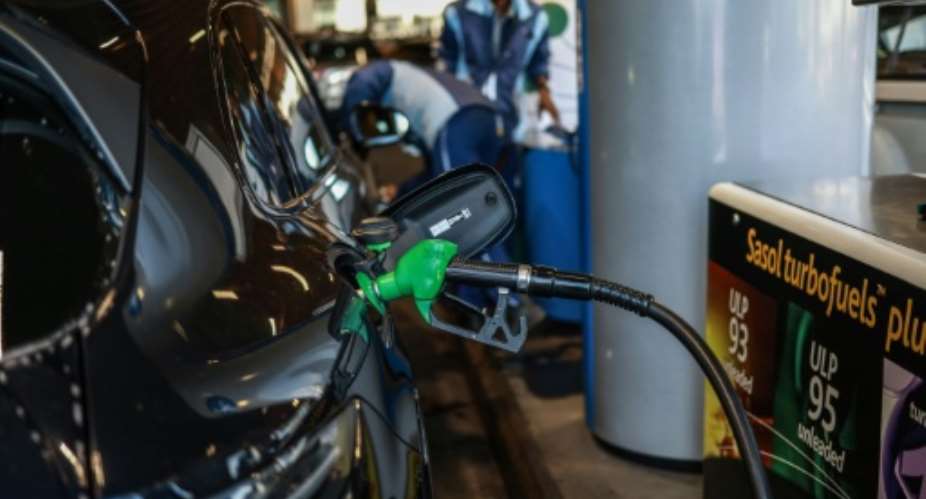
South Africa announced fresh fuel-relief measures on Wednesday to cushion motorists and commuters battered by record pump prices as uncertainty roils global energy markets.
Africa's most industrialised economy, which imports most of its fuel, has been hit hard by price swings and supply disruptions triggered by the US-Israeli war on Iran and the choking off of the strategic Strait of Hormuz.
The general fuel levy would be cut by three rand ($0.18) per litre of diesel and 1.50 rand per litre of petrol, Finance Minister Enoch Godongwana said in his mid-year budget speech.
The relief would take effect on November 4 and run until December 1, Godongwana said, adding that a smaller cut would apply into the new year.
The measure will cost 10 billion rand ($611 million) in foregone revenue, offset by the return of funds transferred to the state-owned Central Energy Fund, which supports South Africa's energy security.
In October, pump prices surged to record highs, with petrol topping 30 rand a litre and diesel exceeding that level, while paraffin prices also climbed, squeezing low-income households that rely on the fuel for cooking and heating.
Wednesday's fuel-levy relief follows a similar measure in March, as the government seeks to contain the cost-of-living fallout ahead of next month's local government elections.
"Despite global volatility, South Africa is weathering the storm much better than its peers because we have been able to consistently take hard decisions over the last five years that have built our fiscal buffers and fortified our resilience," Godongwana said.
Stronger corporate, dividend and value-added tax collections have boosted the revenue outlook, lifting the 2026/27 tax forecast.
Much of the improvement reflects higher commodity prices, however, and is expected to fade over the medium term.
The growth outlook has weakened, with the economy now forecast to expand by 1.2 percent in 2026, down from the 1.6 percent projected in February.
Growth is expected to reach 1.6 percent in 2027 and two percent by 2029, while public debt is forecast to stabilise at 78.4 percent of GDP in 2025/26, its first such pause in nearly two decades.


 'Prof. Jane Naana is Vice President of Ghana; not for women and girls' — Victori...
 Mahama Ayariga warns Ghana is prioritising hygiene infrastructure over service d...
 Speaking truth to power is constitutional duty, not just moral courage — Supreme...
 We must extend accountability chain to private and social power holders – Africa...
 Obuasi SHS headmaster sues Manasseh Azure Awuni, Multimedia Group for GH¢2m over...
 YEA deploys over 11,700 youth under Community Police Assistant Model – Basintale
 Parliament’s Human Rights Committee demands swift investigations in Obuasi SHTS ...
 'Let the law take its course' – Veep on Obuasi SHTS sexual abuse allegations
 Obuasi SHTS sex scandal: 'The powerful ride the law to trample the weak' – Kofi ...
 19-year-old remanded over alleged fatal stabbing of boyfriend at Ofankor


