





On the first day of early voting, hundreds of students from the country's largest Black university marched to a ballot box their campus did not have. Half of America's press saw a civil-rights stand. The other half saw a "race hoax". Almost no one printed the one fact that could have settled the argument.
It was already 85 degrees when the students stepped off the campus of North Carolina A&T State University on Thursday 15 October. Some carried signs. Some came straight from class. Ahead lay a 45-minute walk to Union Square, the nearest early-voting site, along streets where the sidewalk ran out and fallen branches pushed the column into traffic.
"Greensboro definitely is not a walkable city," Shia Rozier, an A&T senior and co-founder of the student coalition Protect Ours NC, told NPR. The route crossed the train tracks.
At Union Square the line spilled out of the door. Dasiyah Weiters, a first-year at UNC Greensboro, had joined the walk after class to cast her first ballot. The state House minority leader, Robert Reives, told the crowd: "You turned out when they took your voting site away."
Three days later, on Sunday 18 October, two American news sites told their readers about that afternoon.
NPR: "Greensboro, NC students protest the absence of early voting sites on campus."
The Post Millennial: "Did North Carolina Dem Senate hopeful Roy Cooper push a race hoax to incite black voters?"
It was the same march on the same weekend, told as two stories that cannot both be true in full. TRT Intelligence coded 28 American news items on the dispute, from the first board votes in December to the weekend of the march. The pattern is stark. Left-leaning outlets saw students denied a ballot box. Right-leaning outlets saw underused polling sites and a Democratic stunt. Almost nobody checked the claim that would have decided between them.
The fact almost nobody printed
A&T has never had an early-voting site in a midterm election. Not once. Guilford County first put a site on campus in 2004 and has used A&T and UNC Greensboro in every presidential year since 2012. No Guilford college has ever hosted one in a midterm. "'Remove' isn't the right word," the county elections director, Charlie Collicutt, told PolitiFact. "'Not chosen' is more accurate."
That fact does not end the argument. It starts a better one. Since a 2024 law, every election board in North Carolina has had a Republican majority. The state board rejected an A&T site 3–2 along party lines in January, then again in August. In July, Guilford's board approved 17 sites, the most ever for a midterm, without either campus. In 2024 the two campus sites had ranked 16th and 17th in the county, with roughly 6,500 to 6,800 early voters each. The board did add a rural town hall that had drawn the fewest early voters of any site (NC Newsline).
When A&T students sat silently at the front of a state board meeting in January, the chair, Francis X. De Luca, had a short answer: "There are plenty of places. Go vote" (Democracy Docket). The boards cited low campus turnout, parking, and a downtown alternative at Union Square, about 1.5 miles from A&T. A Democratic board member called the plan an attempt to suppress Black and brown votes. A student told Ms. Magazine it was "a modern-day poll tax on students."
Every one of those claims was reported somewhere. Almost no outlet reported all of them. Which ones a reader saw depended on which side of America's media divide they read.
Version one: a ballot box taken away
Left-leaning outlets owned this story. They produced 17 of the 28 items we coded, and their story had a clear arc. In January, Democracy Docket's headline said the board had rejected an early-voting site "at country's largest Black university". By August, AlterNet had widened it: "A swing state made voting harder — and they targeted one vulnerable group." By October, Urban One's BlackAmericaWeb was cheering the marchers on: "By Any Means!"
In this version the students are heroes. They are "determined" and "leading the fight", heirs to a "rich history of activism" in the city of the 1960 Woolworth's sit-ins. The decision is "cut", "denied", "axed". The boards "sought to limit" voting and went to "great lengths to hold power". Voting access was the dominant frame, scoring 67 out of 100 for intensity.
It is a powerful story, and much of it is true. The chart below shows what it cost.
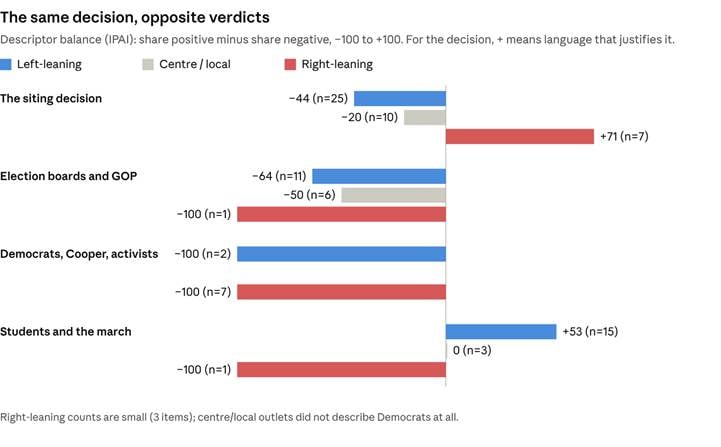
The study coded 28 US media items, 12 Dec 2025 – 19 Oct 2026; 88 descriptors
The sympathy was a legitimate editorial choice. The omissions are harder to defend. Only 29% of left-leaning items carried the boards' own reasons. Only 24% mentioned that A&T had never had a midterm site. NPR's report from the march quoted Rozier making exactly that point, but it carried no statement from the board and no Republican voice. And the harshest verdicts came from the outlets themselves, not their sources. Headlines and authors scored the decision at −80; the people they quoted scored it at −20.
Version two: underused sites and a 'hoax'
The first thing to know about right-leaning coverage is how little there was. We found three items. Two came from the Carolina Journal, published by the conservative John Locke Foundation in Raleigh. One came from The Post Millennial. Fox News, the Washington Examiner, the Daily Caller, Breitbart and the Daily Signal ran nothing we could find.
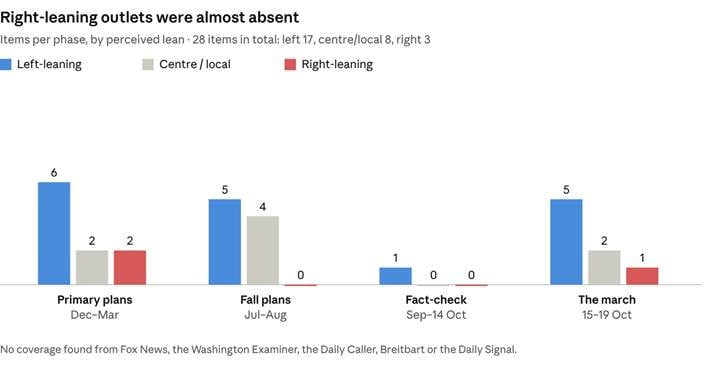
Coding of 28 US media items, 12 Dec 2025 – 19 Oct 2026
For most of the year, the right's version was dry and administrative. Campus sites were "underused", "among the least-used" in their counties, and "not required" for a midterm primary. Protesters' complaints were "slogans and protests". Every right-leaning item carried the boards' reasons, and two of the three compared campuses. The students themselves were almost invisible.
Then, on the weekend of the march, the tone hardened. The Post Millennial's piece began on solid ground. Cooper had said the site was "removed", and PolitiFact had rated that claim Mostly False. But it went much further. Critics were "propaganda pushers" engaged in "race-baiting" and "pseudo-outrage". The march was "dubious". The headline's charge, that a Senate candidate set out to "incite black voters", was asserted rather than shown. All seven descriptors the right applied to Democrats and activists were negative.
Silence shaped the story as much as any headline did. Left-leaning outlets covered the dispute almost six times as often as right-leaning ones. As a result, a conservative reader who heard about the march at all most likely heard it called a hoax. Most other readers met it as a story about race and access. Few readers on either side were offered both.
The question that would have settled it
Beneath the march lay a heavier charge: that North Carolina's Black campuses lost their polling places while its white campuses kept theirs. If true, that is a civil-rights violation in all but name. If false, it is a grave accusation against public officials. Either way, it can be checked with public records. The coverage almost never checked it.
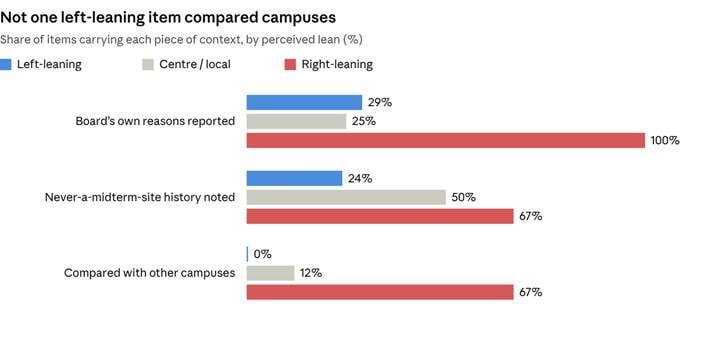
The coding of 28 US media items: 17 left-leaning, 8 centre/local, 3 right-leaning
So we checked what we could.
| Campus | Profile | Early-voting site (as reported) |
| NC A&T State | HBCU | None in fall 2026; never in a midterm; presidential years since 2004 |
| Bennett College | HBCU | None; no Guilford campus has ever hosted a midterm site |
| UNC Greensboro | Racially diverse | None in fall 2026; presidential years since 2012 |
| NC State | Predominantly white | Kept, but moved about a mile off central campus (parking cited) |
| Western Carolina | Predominantly white | Closed by the state board for the 2026 primary |
| Fayetteville State | HBCU | Site across from campus kept in primary plans |
| ECU, App State, UNC-Chapel Hill | Predominantly white | Kept in primary plans |
The verdict is uncomfortable for both sides: partly supported, not proven. The Greensboro HBCUs have no site while several predominantly white flagships keep theirs. But Western Carolina, a predominantly white campus, lost its site too. Fayetteville State, an HBCU, kept one. And Guilford's never-in-a-midterm pattern is two decades older than the current boards. Settling the question would take a statewide audit of every campus by demographics, enrolment, past use and distance to the nearest site.
Not one of the 17 left-leaning items attempted that comparison. The only outlets that compared campuses were the Carolina Journal and Carolina Public Press, and the Journal did it to wave the complaint away. The claim that gave the march its moral force was assumed on one side and dismissed on the other. Neither side tested it.
What journalism owes the next march
1. Tell your own readers the fact they least want to hear. For the left, that was "never in a midterm". For the right, it was that the boards dropped two busy campus sites and added a rural one that drew the fewest early voters in the county.
2. Test the comparison before printing the accusation. "Black campuses lost, white campuses kept" is a measurable claim. A public-records check would produce a table like the one above. No outlet in our sample published a statewide one.
3. Put officials' reasons on the record, then press them. Only about a third of items carried the boards' own rationale. Where reasons were missing, readers filled the gap with motive.
4. Fact-check both sides of the same story. PolitiFact rightly rated "removed" Mostly False. No one fact-checked "race hoax", a bigger claim with less support.
5. Silence is a framing choice too. When national conservative outlets ignored the march, they handed the frame to the one outlet that called it a hoax.
6. Treat students as sources, not symbols. One side celebrated them and the other doubted them. Few asked them what a fair siting rule would look like.
Back on the sidewalk
Strip away the headlines and the march was simple. Young people walked 45 minutes in the heat, crossed the train tracks, stood in a line out of the door, and voted. Whatever the boards intended, the students did what democracy asks of its citizens. Whatever the politicians claimed, the record of the dispute is more complicated than "removed".
The real danger in Greensboro is not that partisan outlets disagree. They always will. The danger is that trust in the people who run elections now depends on which story a voter happened to read. In a state where every election board has a partisan majority, that trust is the one thing worth protecting. The students already walked to the polls. The least the press owes them is to report the whole road.
About the Author: Messan Mawugbe PhD,
About the data. This study coded 28 US media items from 19 outlets published between 12 December 2025 and 19 October 2026: 17 on full text or substantive excerpts and 11 at headline level. Outlets were grouped by perceived lean using AllSides and Media Bias/Fact Check ratings where available, otherwise by ownership, mission and audience. Advocacy groups, campus newspapers, aggregators and social media were excluded. The descriptor balance (IPAI) is the share of positive minus the share of negative descriptors, from −100 to +100. The right-leaning sample is small (three items) and all figures are indicative.
Sources. PolitiFact · NPR · WFDD · Rolling Out · The Post Millennial · Carolina Journal (news) · Carolina Journal (opinion) · Democracy Docket · AlterNet · Ms. Magazine · Capital B · NC Newsline (Guilford) · NC Newsline (NC State) · Carolina Public Press · The Greensboro Thread · WFDD (WCU closure)
 YEA deploys over 11,700 youth under Community Police Assistant Model – Basintale
 Parliament’s Human Rights Committee demands swift investigations in Obuasi SHTS ...
 'Let the law take its course' – Veep on Obuasi SHTS sexual abuse allegations
 Obuasi SHTS sex scandal: 'The powerful ride the law to trample the weak' – Kofi ...
 19-year-old remanded over alleged fatal stabbing of boyfriend at Ofankor
 Woes of SHTS Headmaster deepen as he resigns as old students’ chairman
 'NPP has 35 NDC scandals to drop from now till 2028 elections' — Sammi Awuku
 'NDC will pay for Obuasi SHTS sex scandal' – Sammi Awuku warns
 Use of hormonal contraceptives linked to increased breast cancer risks – Doctor ...
 ECOWAS deepens EU cooperation to improve disaster response in West Africa


