




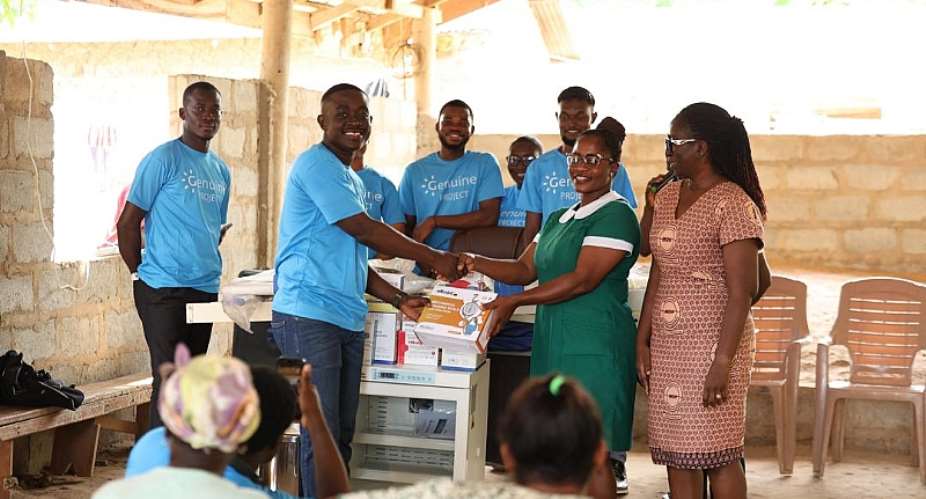
The Genuine Project, a non-profit organisation, has donated medical equipment and essential supplies to the Abome Community Clinic in the Asuogyaman District of the Eastern Region to improve access to healthcare services.
The donation included a vaccine refrigerator, hospital bed, weighing scales, blood pressure monitor, digital thermometers, fetal Doppler, circumcision set and various diagnostic equipment. The clinic also received malaria, hepatitis B, typhoid and urine test kits, alongside blood glucose and haemoglobin meters, gloves and syringes.
Receiving the items, Ms Linda Animwa Danquah, a Nurse with the facility expressed appreciation for the intervention, noting that the lack of adequate equipment had previously limited the clinic’s ability to provide certain essential services.
She said some residents had to travel approximately 10 kilometres to access basic healthcare elsewhere, adding that the donated items would strengthen the clinic’s capacity to deliver more services within the community.
The Chief of Abome also welcomed the donation, expressing gratitude to The Genuine Project and its donors. He explained that although the community had worked to establish the health facility, equipping and furnishing it remained a major challenge.
Project Coordinator of The Genuine Project, Eugene Ansu Ohene-Tutu, reaffirmed the organisation’s commitment to working with communities to identify and address their development needs. He acknowledged the contributions of the organisation’s donors and partners, mainly based in the United States, whose support made the donation possible.
On behalf of the organisation’s chairman, Ivan Mieses; co-chair, Savannah Brancato; and the project team, including Paa Kwesi Essonh Abaka Bonney, he thanked everyone whose involvement and contributions made the donation a success.
The donation formed part of a two-day community engagement initiative aimed at identifying priority development needs and informing future interventions in Abome.
As part of the initiative, residents participated in workshops held on October 9 and 10, following earlier research involving interviews with more than 130 community members and a quantitative survey. The research identified access to clean water, poor roads and inadequate toilet facilities as the community’s three leading concerns.
Lecturers from the University of Environment and Sustainable Development and Ho Technical University facilitated the workshops, with six interns from the former institution assisting as research assistants. The sessions provided residents with an opportunity to discuss the challenges and explore possible solutions, Mr. Ohene-Tutu reiterated.
Founded in 2021, The Genuine Project supports community development and vocational training by mobilising resources for initiatives shaped by local needs and priorities.
Its previous interventions include the Siwdu Sanitation Initiative, which provided a sanitation facility with 14 toilets and six sinks, as well as the establishment of the Aboom Computer Lab at Kwegyir Aggrey School in Cape Coast. The computer laboratory, equipped with 10 desktop computers and other learning resources, serves more than 750 students.
The organisation says its approach centres on collaborating with communities to identify their needs and support sustainable development initiatives.

 YEA deploys over 11,700 youth under Community Police Assistant Model – Basintale
 Parliament’s Human Rights Committee demands swift investigations in Obuasi SHTS ...
 'Let the law take its course' – Veep on Obuasi SHTS sexual abuse allegations
 Obuasi SHTS sex scandal: 'The powerful ride the law to trample the weak' – Kofi ...
 19-year-old remanded over alleged fatal stabbing of boyfriend at Ofankor
 Woes of SHTS Headmaster deepen as he resigns as old students’ chairman
 'NPP has 35 NDC scandals to drop from now till 2028 elections' — Sammi Awuku
 'NDC will pay for Obuasi SHTS sex scandal' – Sammi Awuku warns
 Use of hormonal contraceptives linked to increased breast cancer risks – Doctor ...
 ECOWAS deepens EU cooperation to improve disaster response in West Africa


