




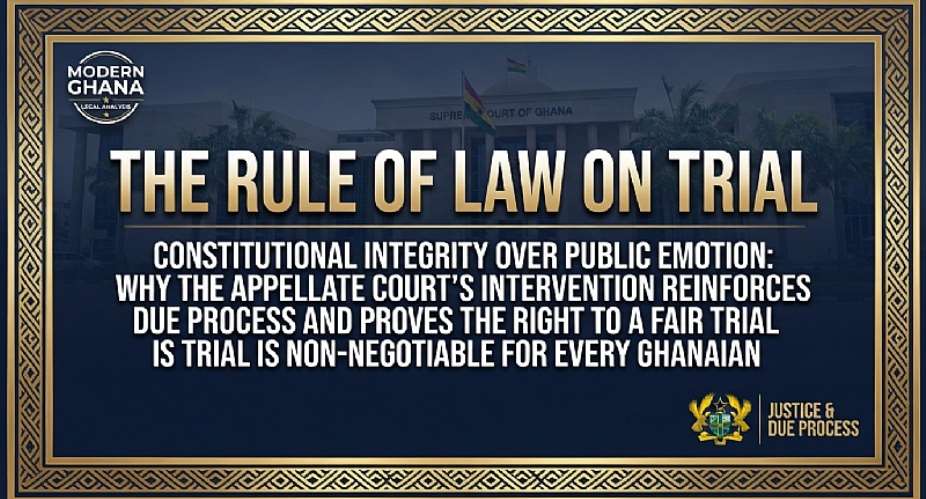
On Monday, October 19, 2026, the Court of Appeal delivered a landmark ruling that underscores the foundational pillars of Ghana’s constitutional democracy: due process and the right to a fair trial. Presided over by Justice Noble Nkrumah, the court granted an application by Hanan Abdul-Wahab Aludiba to stay proceedings in his high-profile criminal trial at the High Court. This decisive intervention puts the substantive trial on hold pending the determination of an appeal challenging the very validity of the state's charge sheet. In a climate often dominated by public passion and political undertones, this ruling serves as a potent reminder that the law operates not on sentiment, but on strict adherence to constitutional safeguards. At its core, this dispute interrogates a fundamental question of justice: can an accused person be lawfully tried on charges that the defense argues are vague, ambiguous, and structurally defective?
The Genesis of the Legal Dispute
The journey to the Court of Appeal began with a fundamental challenge mounted by Hanan Abdul-Wahab’s defense counsel, the former Attorney General Godfred Yeboah Dame Esq. The defense argued that the prosecution's charge sheet was incurably defective, failing to meet the constitutional standards required under Article 19 of the 1992 Constitution, which guarantees the right to a fair trial.
According to the defense, the charges lacked the specificity required for the accused to understand the exact allegations and prepare an adequate defense. Specifically, several counts spanned an extended timeline from 2017 to 2025 without clearly isolating individual transactions, payments, or representations. Furthermore, the defense questioned the legal propriety of the prosecution simultaneously charging both stealing and defrauding by false pretences over the exact same transactions.
The prosecution, led by Dr. Justice Srem-Sai, fiercely contested this stance, maintaining that the charge sheet, when read alongside its accompanying documents, provided sufficient particulars for the accused to understand the case against them.
The High Court’s Interlocutory Stance
On July 23, 2026, Justice Francis Apangabuno Achibonga of the High Court declined the defense's application to strike out the entire charge sheet. While the trial judge agreed that certain elements were imperfect—notably identifying explicit defects in Counts 9 and 14 regarding defrauding by false pretences against Hanan and his wife, Faiza Seidu Wuni—he ruled that these errors were not fatal. Instead of dismissing the case, the High Court ordered the prosecution to amend the defective counts.
Dissatisfied with this outcome, and maintaining that fundamental constitutional defects cannot simply be cured by mid-trial amendments, Godfred Dame Esq. appealed the ruling and sought to halt the High Court trial. After the High Court rejected the request to pause, the defense renewed its application before the Court of Appeal.
Why the Court of Appeal Intervened
The Court of Appeal’s decision to grant the stay of proceedings hinges on the establishment of "exceptional circumstances." By pausing the trial, the appellate court acknowledged that proceeding with a full criminal trial on a potentially flawed foundation could result in an irreversible miscarriage of justice or render the pending appeal nugatory.
Key Takeaways from the Ruling
- Constitutional Superiority over Expediency: The ruling affirms that the right to a fair trial under Article 19 is an absolute safeguard, not a technical privilege.
- The Necessity of Particulars: A charge sheet must be precise. Vague timelines (e.g., 2017–2025) without distinct transaction breakdowns challenge the constitutional right of an accused to know exactly what acts they must answer for.
- Jurisdictional Order: By staying proceedings, the judiciary ensures that higher court determinations on constitutional validity take precedence over ongoing lower court trials.
- The Limits of Amendments: The substantive appeal will now determine whether fundamental defects in a charge sheet can be salvaged by a prosecution amendment, or if they render the entire document void from the outset.
Recommendations and Suggestions
- Precision in State Prosecutions: The Attorney General’s Department and state prosecutors must exercise meticulous care when drafting charge sheets, particularly in complex financial or state-loss cases. Relying on broad, multi-year timelines without clear itemization invites lengthy interlocutory appeals that delay justice.
- Clarification on Duplicitous Charges: The appellate court should provide definitive guidance on whether the state can concurrently prefer mutually distinct charges like stealing and defrauding by false pretences for the identical transaction at the embryonic stage of a trial.
- Public De-escalation and Legal Literacy: Public commentary regarding high-profile corruption or criminal cases must be guided by legal literacy rather than political affiliation or public outrage. The public must understand that demanding due process for an accused is not a declaration of innocence, but a protection of the system itself.
The rule of law dictates that due process must mean the exact same thing for every citizen, regardless of status, political color, or public sentiment. The Court of Appeal’s decision to pause the trial of Hanan Abdul-Wahab Aludiba is not a victory on the merits of his innocence or guilt; rather, it is a victory for procedural integrity. Justice is a double-edged sword that demands the state prove its case beyond a reasonable doubt, using tools that are legally flawless and constitutionally sound. Ghana’s democracy grows stronger when our courts insist that shortcuts cannot be taken on the path to justice, ensuring that the shield of the Constitution protects all who stand before the law.
✍️ Submitted by:
Retired Senior Citizen
For and on behalf of all Senior Citizens of the Republic of Ghana 🇬🇭
Teshie-Nungua
[email protected]


 Adu-Boahene’s lawyers ask court to strike out fabricated, invented evidence in D...
 'He is part of National Film Authority' – Kwasi Kwarteng exposes Obuasi SHTS hea...
 'Mahama should have appointed Edudzi Tameklo to EC to teach hypocrite NPP some s...
 'You have no moral right to complain about cost of living' – Prof Anankware to B...
 'You did the same thing' – Solomon Owusu defends EC appointment
 GFL vows to pursue justice for worker who lost five fingers at Afienya Industria...
 State to call first witness on January 12 in Canadian murder case
 Haruna Iddrisu refers Obuasi SHS headmaster's sexual misconduct allegations to C...
 Bawumia is a ‘prophet of pocket economy’ in opposition, ‘priest of paper economy...
 Bolgatanga Technical University Council Chairman allegedly locks up Vice-Chancel...


