




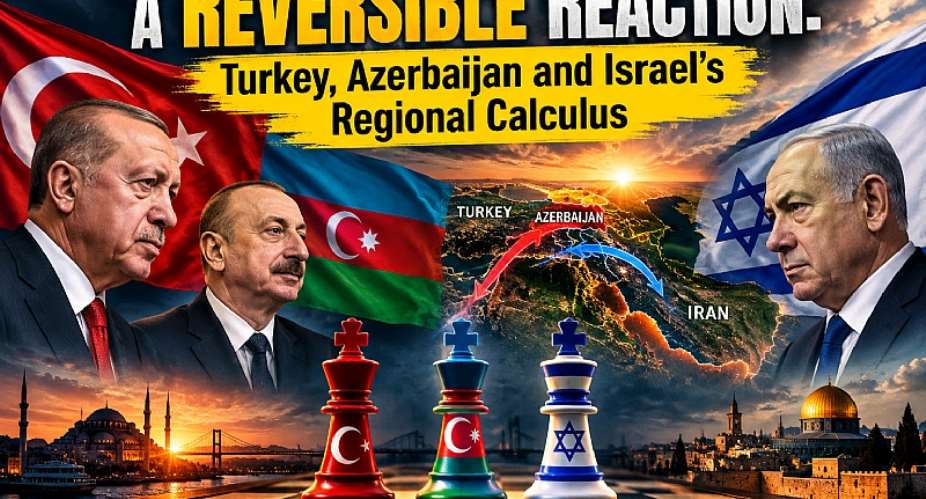
The chemistry of a chemical reaction teaches us that reactants and products do not always reach equilibrium without the right conditions. In some reactions, a catalyst can accelerate change without becoming the final product itself. A similar principle applies to geopolitics, where a single regional actor can alter strategic calculations, reshape diplomatic relationships and reverse an outcome that once appeared inevitable. Diplomatic decisions rarely remain permanent because the catalyst can change the equation as a whole. In international politics, doors are neither permanently open nor permanently closed; their status changes when circumstances shift and the balance of power turns. Recent developments in West Asia and the South Caucasus reveal how Ankara is attempting to maintain a delicate equilibrium between Baku and Tel Aviv while navigating tensions across the wider Muslim world. But can geography itself become a catalyst for stability when competing strategic interests continue to pull the region in opposite directions?
The latest reaction became visible at the seventh summit of the Conference on Interaction and Confidence Building Measures in Asia (CICA), held in Baku in October 2026. When Israeli President Isaac Herzog began addressing the gathering on October 15, Turkish Foreign Minister Hakan Fidan and representatives of several other countries walked out of the hall. The gesture reflected diplomatic opposition to Israel's treatment of Palestinians, while Azerbaijan continued to host an Israeli president with whom it maintains strategic relations. Fidan subsequently met Azerbaijani President Ilham Aliyev, demonstrating that political disagreement need not automatically terminate bilateral engagement. Reports from the summit highlighted the widening gap between diplomatic engagement and political acceptance. Meanwhile, controversy over Azerbaijan's school clothing regulations, which have been interpreted as restricting the headscarf, exposed another source of friction between Ankara and Baku. Azerbaijan has defended its domestic authority against external criticism. If Turkey and Azerbaijan share deep historical, cultural and strategic bonds, how far can Ankara challenge Baku's domestic policies without undermining the partnership it seeks to preserve? The dilemma resembles other regional rivalries, including Pakistan and Afghanistan's difficult relationship with India in their respective strategic calculations, although the historical circumstances differ.
Israel's regional calculations introduce another dimension to this equation: geography. Azerbaijan's proximity to Iran, its strategic partnership with Israel and its position in the South Caucasus give it considerable significance in the wider security environment. From an Israeli perspective, partnerships beyond the immediate neighbourhood can provide diplomatic reach and potential strategic advantages. However, allegations that Israeli intelligence is supporting separatist or insurgent activity inside Iran require credible evidence and should not be treated as established fact. The possibility of external actors exploiting ethnic divisions nevertheless remains a legitimate regional security concern. Azerbaijan's geographical position also places it near Turkey, creating overlapping interests that extend beyond the Iranian question. Washington's support for Israel adds another layer to this strategic landscape. Yet the central question remains: does expanding security cooperation genuinely reduce regional threats, or can it encourage neighbouring powers to interpret every new partnership as an emerging encirclement strategy? For Tehran and Ankara, both of which possess substantial regional influence, such perceptions can become destabilising even when the declared objective is deterrence.
Turkey, meanwhile, faces the difficult task of protecting its strategic interests without becoming trapped by the contradictions of regional politics. Under President Recep Tayyip Erdoğan and Foreign Minister Hakan Fidan, Ankara has pursued diplomatic engagement across competing political camps while maintaining its support for Palestinian rights. Its relationship with Baku remains particularly important, but the gradual normalisation process with Armenia adds a further complication. Turkey and Armenia have continued efforts to restore relations and improve connectivity, while progress towards a durable Armenia-Azerbaijan settlement remains central to the broader regional opening. Official diplomatic statements have described practical steps towards normalisation and regional cooperation. This creates a diplomatic balancing act: Ankara must maintain solidarity with Azerbaijan while exploring opportunities for peace and trade with Armenia. Reports of intelligence-level contacts, where details remain unconfirmed, should not be used to infer a secret settlement or an undisclosed political bargain. Can Erdoğan promote regional reconciliation without alienating Baku, and can Ankara defend its diplomatic principles while pursuing interests that sometimes demand compromise? These questions will determine whether Turkish diplomacy can convert competing pressures into a sustainable regional arrangement.
The decisive test, however, lies in the changing relationship between strategic interests and political legitimacy. Turkey and Israel once maintained substantial economic and diplomatic ties, but the Gaza war and the wider confrontation involving Iran have deepened political divisions. Azerbaijan's continued engagement with Israel, meanwhile, reflects its own calculations rather than an automatic alignment with every Israeli policy. Ankara cannot simply dictate Baku's foreign policy, just as Baku cannot disregard the political sensitivities shaping Turkey's relations with the wider Muslim world. The United States, Russia and other regional powers will also influence the eventual outcome. The real question is whether these competing interests can be channelled into confidence-building, economic cooperation and restraint rather than another cycle of confrontation. Will Baku become the catalyst for a new diplomatic equilibrium between Ankara and Tel Aviv, or will the conflicting pressures keep the regional reaction moving backwards and forwards? In geopolitics, equilibrium is never guaranteed. It must be negotiated, tested and repeatedly renewed.


 Adu-Boahene’s lawyers ask court to strike out fabricated, invented evidence in D...
 'He is part of National Film Authority' – Kwasi Kwarteng exposes Obuasi SHTS hea...
 'Mahama should have appointed Edudzi Tameklo to EC to teach hypocrite NPP some s...
 'You have no moral right to complain about cost of living' – Prof Anankware to B...
 'You did the same thing' – Solomon Owusu defends EC appointment
 GFL vows to pursue justice for worker who lost five fingers at Afienya Industria...
 State to call first witness on January 12 in Canadian murder case
 Haruna Iddrisu refers Obuasi SHS headmaster's sexual misconduct allegations to C...
 Bawumia is a ‘prophet of pocket economy’ in opposition, ‘priest of paper economy...
 Bolgatanga Technical University Council Chairman allegedly locks up Vice-Chancel...


