




They told us the Sahel was dead.
Geneva told us. Paris told us. Washington told us. They came with reports and seedlings planted for cameras that died when the funding cycle died.
Then a farmer from Yatenga came with a shovel, a bag of manure, and holes.
THE "MADMAN" THEY LAUGHED AT
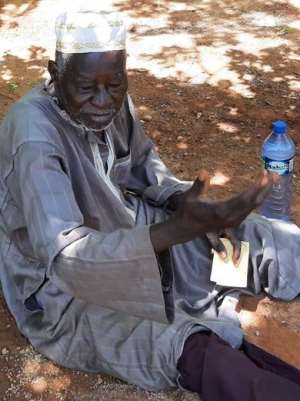
Yacouba Sawadogo was born 1 January 1946 in Gourga, Yatenga, northern Burkina Faso. No colonial school. No degree. Koranic school in Mali, then a market trader.
In the 1970s and 80s, the Sahel collapsed. Rainfall down 30%, harvests down up to 80%. Soil turned to concrete - ferruginous crust. Water could not enter. Seeds refused. In his area around Ranawa, many left.
One man stayed. They called him a madman.
His equipment: a shovel. Manure. A willingness to dig in the dry season when others waited for donors.
No logframe. No project vehicle. Just inherited knowledge and 40 years of stubborn patience.
On land experts classified as permanently dead, he created what Reuters documented as a 40-hectare oasis, with a 27-hectare dense core forest - Bangre Raaga. More than 60 species of trees and shrubs, documented at over 90 in recent counts. A forest where there was desert. "This forest that you see today was really a desert - there was not even the shade of a single tree here," he said.
He received the Markham Award in 2010, the Right Livelihood Award [Alternative Nobel] in 2018, and was named UN Champion of the Earth in 2020. He died 3rd December 2023 in Ouahigouya.
Forty years late. The forest was his certificate long before Stockholm clapped.
THE SYSTEM: KNOWLEDGE OLDER THAN THE WORLD BANK
His weapon was Zaï plus stone bands. Our grandfathers' technology.
Zaï, in Mossi, means "to start early."
Dig pits, 20-30cm wide and deep, about 90cm apart, in the dry season. Fill with compost and manure. Add termites. Neighbours laughed, but termites break the crust and dig tunnels that store water deep for the seed.
No tractor. No patent.
According to UNEP, when rains collect in his pits, yields increased by up to 500%. Peer-reviewed research in Sustainability (2018) shows 100% increase even in drought years, plus improved food security, groundwater and tree cover. Across Yatenga and Gourcy provinces alone, tens of thousands of hectares have regained productivity, with hundreds of thousands across Burkina over three decades.
That increase is not statistics. It is a mother feeding her children from October to October without queuing for aid.
Not through World Bank extension. Through farmer-to-farmer. One African showing another what works. The most powerful communication system Africa ever had.
This is Indigenous Knowledge System. Climate-tested for 500 years, not 5 years in a lab.
THE WEAPON: AID AS A BUSINESS MODEL
They planted 10,000 seedlings for the report. Yacouba planted termites for the soil.
Much of the aid architecture is built to manage poverty, not end it.
The model is familiar: first, local seed is labelled low-yield and backward, then hybrid that cannot be replanted is promoted, then fertilizer dependence follows, then food imports crash local prices so your farmer cannot sell.
Zaï could not be sold in a bag, so no company marketed it. A hole cannot be patented. Manure from your own kraal cannot be invoiced. It spread farmer-to-farmer instead, not through dealer networks.
When a farmer cannot plant her own seed without buying from outside, she is not a farmer. She is a consumer. She is dependent.
This is why Food Sovereignty is Money Sovereignty.
THE CRUEL TRUTH
Yacouba is not a climate story. He is a blueprint for every sector - fintech, manufacturing, trade.
The same ferruginous crust that killed Ranawa in the 1980s is now in Matabeleland South, in Chikwawa, in Turkana. Zaï is not Burkinabe - it is Sahelian, it is Kalahari, it is ours. Similar techniques now inspire restoration along 6,000km of the Great Green Wall from Senegal to Ethiopia.
His lesson:
Trust your own brain.
Intellectual is not from school. Africa sits on solutions the world needs, but we often wait for external validation before we trust our own.
Patience over per diems.
Development projects last 3 years. Yacouba worked 40. Development is not a sprint funded by a cycle. It is digging holes when no one sees you.
People over papers.
Zai spread across provinces without internet. One Market, One Payment, One Future will not come from a communique. It will come from one trader showing another what works.
We love aid because aid lets us avoid hard work.
It is easier to attend a workshop on climate resilience in a hotel than to dig pits at 5am in October heat.
And a dependent market never becomes a competitor.
Yacouba refused to beg. He dug.
WHAT DIGGING AFRICA MUST DO ON MONDAY MORNING
This piece is not against emergency relief. It is against 40 years of structural dependency.
1. For Farmers and Youth:
Organize 10 neighbours, restore 10 hectares with your own manure and pits this dry season. No donor needed. That is People Participation.
2. For Schools and Universities:
Document and teach Indigenous Knowledge Systems as primary science, not folklore. A student must graduate knowing how termites store water, not just how to import drip kits.
3. For Ministries of Agriculture:
Make Zaï, half-moons, and stone bands part of national extension curricula before fertilizer promotion. Every extension officer must be able to dig, not just distribute.
4. For Development Partners:
Shift 30% of climate budgets from hotel workshops and seedling photo-ops to farmer-to-farmer exchange, community compost banks, and local seed banks. Fund what lives after the project ends.
5. For Regional Bodies:
Under AfCFTA and COMESA, create a Pan-African Indigenous Knowledge Exchange - so a technique proven in Yatenga reaches Chirundu, Turkana, and Karamoja in months, not decades.
Africa, how many deserts are expanding in your economy, your politics, your industry, in your mind, because you are waiting for Geneva to save you?
African salvation is from our own knowledge and work, inward not outward.
One Hole. One Seed. One People. One Future.
- Madondo (African Teacher) [email protected]


 Adu-Boahene’s lawyers ask court to strike out fabricated, invented evidence in D...
 'He is part of National Film Authority' – Kwasi Kwarteng exposes Obuasi SHTS hea...
 'Mahama should have appointed Edudzi Tameklo to EC to teach hypocrite NPP some s...
 'You have no moral right to complain about cost of living' – Prof Anankware to B...
 'You did the same thing' – Solomon Owusu defends EC appointment
 GFL vows to pursue justice for worker who lost five fingers at Afienya Industria...
 State to call first witness on January 12 in Canadian murder case
 Haruna Iddrisu refers Obuasi SHS headmaster's sexual misconduct allegations to C...
 Bawumia is a ‘prophet of pocket economy’ in opposition, ‘priest of paper economy...
 Bolgatanga Technical University Council Chairman allegedly locks up Vice-Chancel...


