




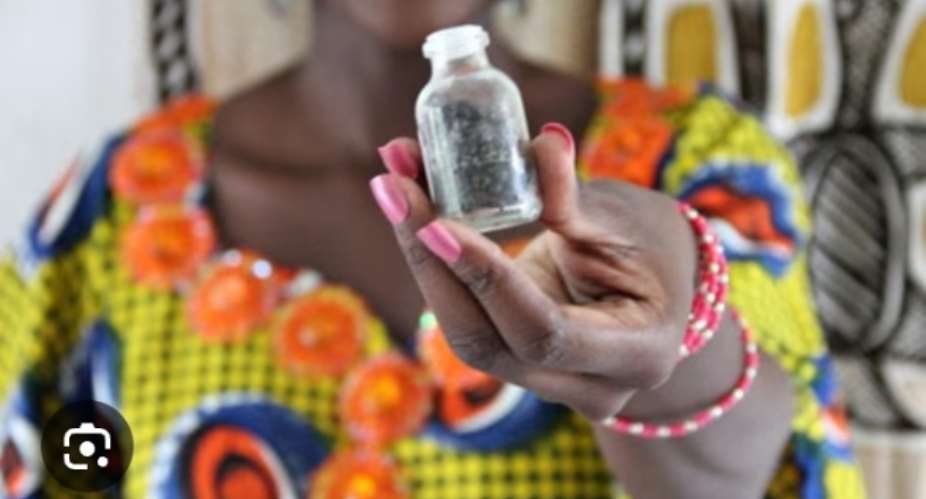
Walk through any market in northern Nigeria, or scroll through social media in the Hausa-speaking world, and you will meet Kayan-Mata. The term refers to herbal preparations, oils, powders, perfumes and creams that women have long used in connection with intimacy and marriage. For generations it was a quiet cultural practice.
Today it is big business, sold by informal vendors and promoted online with bold claims about winning a partner, keeping a husband or fixing a troubled home.
That shift has worried many people.
Religious leaders, counsellors and families have asked whether the commercial push is creating dependence, draining household money and fuelling conflict that ends in divorce. Others go further and suggest that some women use these products to manipulate, deceive or exploit their partners. These are serious claims, and until now they have rested mostly on gossip. We decided to test them.
What we did
Our study covered the six Area Councils of the Federal Capital Territory: Abaji, AMAC, Bwari, Gwagwalada, Kuje and Kwali. This gave us a mix of city, town and village life.
We surveyed 400 adults who had experienced marriage or a marital relationship, and we interviewed 20 key informants, including marriage counsellors, social workers, criminologists and family-law practitioners.
We were careful from the start to separate three things that are often confused: using Kayan-Mata, depending on it, and committing a crime. Using it is not an offence, and we did not treat it as one.
What we found
Awareness is almost universal. About 87 percent of respondents knew what Kayan-Mata is. Use is more varied: roughly a quarter had never used it, while others reported rare, occasional, frequent or very frequent use. Awareness, in other words, does not mean use, and use does not mean dependence.
Where dependence did appear, it was driven less by access than by expectation. The strongest sign of dependence was the belief that Kayan-Mata is needed to keep an intimate relationship going. Many respondents also felt their partners expected continued use. Fear of being unable to get the products ranked lowest. The pressure, it seems, comes from what people believe a marriage demands of them.
Respondents also agreed that Kayan-Mata-related disputes can make existing marital problems worse. They named excessive spending, disagreements over its use and unrealistic expectations between partners as sources of tension.
But they did not agree that Kayan-Mata alone can end a marriage. Asked whether dependence by itself is enough to cause divorce, they largely said no. The picture they painted is one of an extra strain on marriages that were already struggling with money, trust or communication.
The statistics point the same way. Higher dependence was linked to higher levels of marital dissolution, and also to higher reported levels of unlawful behaviour. The most commonly reported offences were threats or intimidation, followed by fraud or deception, assault, theft, blackmail and extortion. But a link is not a cause.
When we looked at what predicts marital breakdown, marital conflict was the strongest factor, followed by Kayan-Mata dependence and economic difficulty. Social support worked in the opposite direction: the more support people had from family, friends and community, the less likely the marriage was to end.
Why this is not a story about bad women
It would be easy to read our findings as proof that Kayan-Mata turns women into criminals. That would be wrong, and it is a reading we reject. The crime figures come from self-reports and must be treated with caution. Our interviewees were clear that Kayan-Mata does not automatically cause offending.
What they described instead was a chain of pressure: a woman who is short of money, unemployed or trapped in an unhappy marriage spends heavily on products she believes will save her relationship, falls deeper into financial difficulty, and may then be drawn toward deception, theft or exploitation.
Criminologists call this General Strain Theory. People who feel blocked from the things they value, such as affection, security and a stable home, may respond with frustration and anger, and some cope in harmful ways. Feminist criminology adds that women's choices are shaped by economic dependence, social expectations and unequal power at home. A woman with few legitimate options may make decisions that look very different from those of someone with more freedom.
A West African question
Our evidence comes from the FCT, and we do not claim it applies automatically elsewhere. But the questions it raises belong to the whole West African sub-region. Families from Katsina to Kumasi, and from Niamey to Accra's Zongo communities, face similar pressures: economic hardship, changing ideas about marriage, and a booming informal market that now reaches buyers through mobile phones.
Products and practices linked to intimacy travel along the same trade and social-media routes as everything else. Whether the patterns we found in Abuja also appear in other countries is a matter for further research, and we hope colleagues across the region will take it up.
What should be done
Our recommendations are practical. First, governments, religious institutions, civil society groups and professional bodies should make marital counselling affordable and confidential, covering communication, intimacy, money and emotional needs.
Second, public education should give people honest, culturally sensitive information about what these products can and cannot do, and warn against overspending, without shaming users.
Third, law enforcement should act on evidence of specific offences, not on assumptions about women who use traditional products. Fourth, women facing violence, threats or economic dependence in marriage need access to counselling, social work and legal help.
Finally, women's economic empowerment through skills, jobs, small-business support and financial literacy can reduce the pressures that push people toward harmful choices.
The bottom line
Kayan-Mata is neither a harmless trifle nor a criminal conspiracy. It is a widely known cultural practice that has been commercialized, and for some people it has become a source of financial strain and marital tension.
The deeper causes of divorce, and of crime, are conflict, hardship and isolation. If we want stronger marriages and safer homes, we should invest in counselling, support networks and women's economic security, rather than blame women for what they buy.
Mustapha Bature Sallama, Medical/Science Journalist and Private Investigator, Criminal Investigation and Intelligence Analysis.
Aisha Lawal Malumfashi, Criminologist, Department of Sociology, University of Abuja
References
Agnew, R. (1992). Foundation for a general strain theory of crime and delinquency. Criminology, 30(1), 47–87.
Agnew, R. (2006). Pressured into crime: An overview of general strain theory. Oxford University Press.
Akers, R. L. (1998). Social learning and social structure: A general theory of crime and deviance. Northeastern University Press.
Daly, K., & Chesney-Lind, M. (1988). Feminism and criminology. Justice Quarterly, 5(4), 497–538.
Malumfashi, A. L., Egwu, G. E., & Awa, P. T. (2026). Kayan-Mata dependence and female criminality: A criminological perspective on marital dissolution in the FCT Department of Sociology, University of Abuja.


 'Prof. Jane Naana is Vice President of Ghana; not for women and girls' — Victori...
 Mahama Ayariga warns Ghana is prioritising hygiene infrastructure over service d...
 Speaking truth to power is constitutional duty, not just moral courage — Supreme...
 We must extend accountability chain to private and social power holders – Africa...
 Obuasi SHS headmaster sues Manasseh Azure Awuni, Multimedia Group for GH¢2m over...
 YEA deploys over 11,700 youth under Community Police Assistant Model – Basintale
 Parliament’s Human Rights Committee demands swift investigations in Obuasi SHTS ...
 'Let the law take its course' – Veep on Obuasi SHTS sexual abuse allegations
 Obuasi SHTS sex scandal: 'The powerful ride the law to trample the weak' – Kofi ...
 19-year-old remanded over alleged fatal stabbing of boyfriend at Ofankor


