




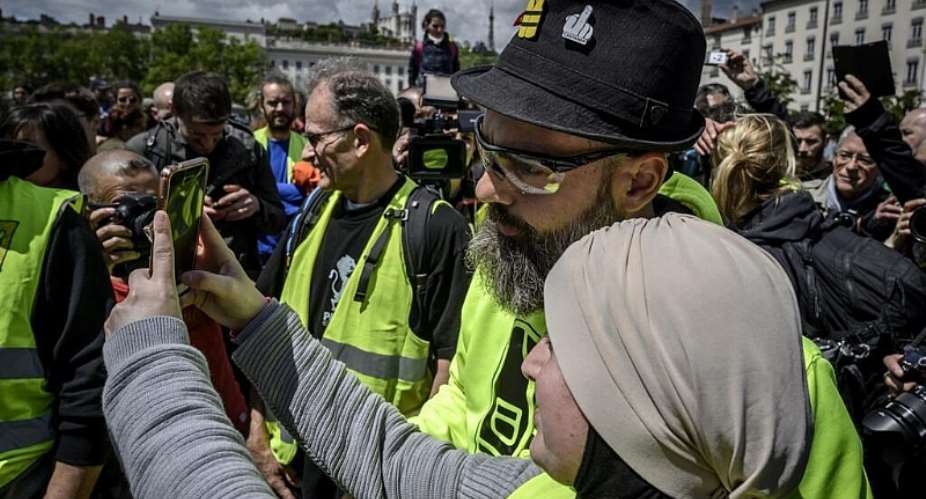
After weeks of student protests, is France about to witness a resurgence of the Yellow Vest movement?
Protests, roundabout blockades and gatherings in front of gas stations and oil depots are among the actions planned for Saturday's nationwide demonstrations.
A map published on Thursday on the website 17octobregiletjaune.net listed more than 1,000 events plannd around the country to denounce rising fuel prices and support high-school students who have been protestingfor nearly a month to demand better classroom conditions.
Read more 'We're fed up': Paris students rise up in a movement that shows no sign of slowing
The initiative began with a viral TikTok video posted by a young man frustrated by rising prices at the pump. It was later backed by left-wing politicians including Communist Party leader Fabien Roussel and Green leader Marine Tondelier.
Saturday's planned demonstrations were not initially linked to the original Yellow Vest movement, which began in 2018 with widespread protests over rising fuel prices before growing into a broader revolt against economic inequality that drew tens of thousands onto the streets. The movement takes its name from the fluorescent yellow high-visibility vests that French law requires drivers to carry in their vehicles and which protesters wore during demonstrations.
Some of the Yellow Vests' former leading figures were initially wary of the latest protest action, including Maxime 'Fly Rider' Nicolle, who recently announced that he would travel to Paris to demonstrate after changing his mind about participating.
"No Yellow Vest was behind the (October 17 protests). Now, as soon as people talk about fuel and discontent, they are immediately labelled 'Yellow Vests'. It's almost become a brand," said Jérôme Rodrigues, a prominent figure in the Yellow Vest movement who lost an eye after being struck by a rubber-ball grenade during a protest in 2019.
During the 2018-2019 protests, nearly two-dozen people suffered the loss of an eye, mainly after being hit by rubber bullets fired by police. In total, 2,500 protesters and 1,800 police officers were injured over the course of a year. France's crowd-control tactics drew widespread criticism, including from the United Nations, and have come under renewed scrutiny amid the high-school student protests.
“We didn't coordinate beforehand with other prominent figures to call for protests but we all had the same reaction when we saw the police violence against high-school students,” François Boulo, another prominent Yellow Vest figure, told AFP.
'More serious than back then'
Rodrigues sees Saturday's demonstration as a continuation of the high-school student protests, saying students have faced police “repression” similar to that experienced by the Yellow Vests.
Read more Severe injuries at French student protests draw scrutiny to police tactics
Police meanwhile have opened internal investigations into 36 claims of officer violence against protesters, including four children who were allegedly "mutilated" by explosive weapons and six who suffered "significant injuries." Other complaints included physical blows, insults, and alleged sexual assault.
Rodrigues said the protests reflected shared concerns over the future of workers, families and pensioners facing rising consumer and fuel prices. “But we are also talking about the future of our high-school students and young people as a whole, with dilapidated schools, staff shortages and overcrowded classrooms," he said.
"We are all connected by this common thread. Ultimately, the Yellow Vests' demands have become more pressing because the situation is even more serious than it was back then," he added.
A different landscape from 2018
Activist Sophie Tissier also sees parallels between the 2018.protests and Saturday's mobilisation. She was the first to officially register Yellow Vest demonstrations with the Paris police prefecture during the 2018 movement – a strategy that was intended to bring the protests into the mainstream, but that drew criticism from within the group.
For Saturday, she said she had registered a demonstration on the Champs-Élysées, as she did at the height of the Yellow Vest protests.
“This movement is entirely legitimate. French people are exhausted,” Tissier said. “They've had enough of the dismantling of public services. The standard of living has dropped dramatically with the rise in energy and fuel prices. And then there's a deep disgust with a political class riddled with scandals.”
Tissier said that the root of the problem is "a dysfunctional political system".
"There is no separation of powers. We claim to live in a healthy democracy and republic. In reality, we don't at all,” she said, recalling the Yellow Vests' demand for greater participatory democracy through a citizens' initiative referendum, known in France as the RIC.
But original Yellow Vests also acknowledge differences between the current protests and the movement that emerged in 2018.
“The Yellow Vests were never co-opted by a political party because most of the time, as soon as (politicians) showed up, they were immediately kicked out,” Rodrigues said. “Today, the high-school students are quite closely guided by certain political parties. So, the framework is a little more institutional compared with the spontaneous demonstrations we were used to organising.”
Read more French student protesters are being 'exploited' by political forces, Macron says
Uncertainty over turnout
Environmental groups and a farmer's union have also called on people to join the protests on Saturday.
However, the hard-left CGT (General Confederation of Labour) union has taken a more cautious approach, saying it would take part "wherever the conditions are met" while keeping its focus on November 5, when France's main trade unions have called for strikes.
Tissier said she did not yet see a genuine convergence between the different protest movements and the high-school students. After attending Tuesday's demonstration, she said there was no “real cohesion”, criticising what she described as attempts by the radical left, “from the Communist Party to France Unbowed”, to co-opt the movement.
With October 17 approaching, it remains unclear whether the enthusiasm on social media will translate into significant turnout, particularly as France's autumn school holidays begin.
Priscilla Ludosky, whose 2018 petition calling for lower fuel prices at the pump gathered more than 1 million signatures and helped spark the Yelloow Vest protests, is sceptical.
“People often say our movement was spontaneous. Not at all. It may have seemed disorganized …but we had been building momentum around the issue for more than six months with my petition, then connecting people across France. When we sent the media a map showing 700 gatherings announced on Facebook, it became tangible,” she said.
“Here, no one is putting themselves forward behind these calls. We don't know who to follow or how large October 17 will be,” Ludosky told Reporterre.
A source close to the interior minister said around 250 protest actions could take place nationwide on Saturday.
Rodrigues is also cautious about the prospects of a movement on the scale of the one that emerged in November 2018. However, he still hopes to see a resurgence of the Yellow Vests.
“As Yellow Vests, we still carry the frustration of not having finished the fight. Perhaps we were waiting for a new wave of popular mobilisation that we could join, so that we could finish what we started.”
This article has been translated from the original in French.


 Obuasi SHTS alleged sexual abuse: Kwasi Kwarteng criticises Education Minister o...
 ECOWAS’ $250,000 flood relief donation arrives in Ghana – Ablakwa
 Kennedy Agyapong has not resigned from NPP – Kwasi Kwarteng
 State failure, not GoldBod, driving galamsey – Daryl Bosu
 A Rocha Ghana raises alarm over human rights abuses in mining communities
 ECOWAS, AfDB discuss ways to advance West Africa’s development priorities
 October 16: Cedi gains against dollar, sells at GHS12.25 on forex market, GHS11....
 Galamsey: Ghana’s rivers now run chocolate and milk colour — Sam Jonah
 A nation of job-seekers will always be poor — Sir Sam Jonah
 “If you attack us with pepper spray, we’ll fight back” — NDC Yakubu Tony Aidoo w...


