




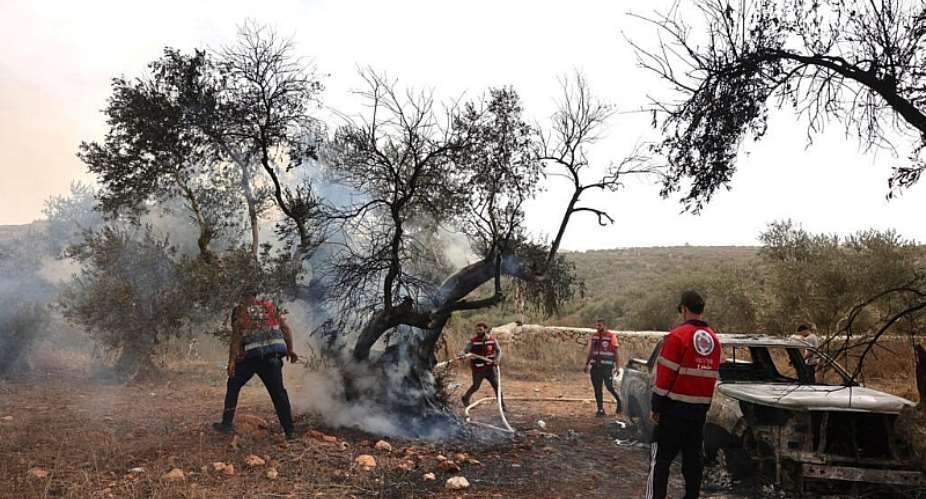
Clad in black and their faces masked, dozens of militant Israeli settlers burned olive trees and threw rocks at Palestinians in a coordinated attack on Friday on a West Bank village's annual harvest that injured at least two people, including a Washington Post journalist.
Some 80 settlers, some of them carrying gas canisters, descended from a hill above a terraced olive grove where villagers from Abu Falah had gathered to pick ripe fruit, a cherished annual tradition in Palestinian life, Reuters witnesses said.
The settlers took positions in front of the terraced lanes of olive trees. Some of them used slings to launch rocks towards Palestinian villagers, who descended towards the bottom of the hill before picking up and throwing stones to defend themselves.
"The settlers want to attack us and force us from our homes," said Moutaz Abdelhadi, 42, a farmer who witnessed the attack in Abu Falah.
Partway through the attack, at least two Israeli military jeeps sped through the area, kicking up dust as villagers ran out of their way.
The attack continued after the military's arrival, with Israeli soldiers firing tear gas in the direction of the Palestinians who had dodged the jeeps. The sound of live gunfire could be heard in the area, and a Reuters photographer saw at least one armed settler fire a gun.
In a statement, the Israeli military said soldiers and border police fired what it described as warning shots after deploying to the area and at one point fired towards a person who the troops believed had posed a threat.
"Attempts to incite friction between populations undermine security in the area," the military said. "Attacks and violence against innocent civilians are grave and unacceptable," it added.
Washington Post journalist injured
Palestinian medics said two people were injured and taken to hospitals in the area of Ramallah. One of them was Heidi Levine, a photojournalist with the Washington Post. Video of the attack showed Levine lying on her side on a dirt path with her hands over her face as at least three settlers surrounded her.
Speaking from a hospital bed later, Levine, who is in stable condition, said: "I was attacked, pushed to the ground. Luckily I had my flak jacket and helmet, otherwise I probably wouldn't even be here, because they just kept kicking me and kicking me."
Levine said the attack ended when her Palestinian colleagues intervened, after which medics rushed her in an ambulance to a clinic in Abu Falah and then to hospital in Ramallah.
Her voice shook as she spoke and she had bandages over her left hand.
In a statement, Matt Murray, the Washington Post's executive editor, called for an investigation into the incident.
"This morning, a Washington Post photographer, Heidi Levine, was attacked by Israeli settlers while reporting in the West Bank,” Murray said.
"She was wearing visible markings clearly identifying her as a journalist. While we are relieved that Heidi has received medical care and is safe, we are outraged by this unwarranted attack on a journalist doing her job and urge a thorough investigation and follow-through from authorities."
Settler violence has surged in West Bank
Israeli settler violence against Palestinians in the occupied West Bank has surged, with at least 170 attacks since September 27, around the start of the annual olive harvest, according to Yesh Din, an Israeli settlements monitoring group.
The settlers have been emboldened by the right-wing government of Prime Minister Benjamin Netanyahu, who has overseen a rapid expansion of settlements and smaller outposts across the West Bank.
Read more West Bank: Palestinians 'harassed' by settlers' increasing use of drones
Netanyahu has criticized the violence but has taken few steps to crack down on incidents that have drawn international condemnation and sanction plans by longtime Israeli allies, including Britain.
The West Bank is home to some 500,000 settlers and at least 3 million Palestinians. UN bodies and most countries deem the settlements illegal under international law regarding military occupations. Israel rejects this, viewing the territory as disputed rather than occupied.
The Abu Falah attack followed a similar attack on Friday morning in the area of Turmus Ayya village, where settlers burned three cars after attacking a group of farmers harvesting olives. The military did not immediately respond to a request for comment.
Salah Abu Niswa, who witnessed the attack in Turmus Ayya, said the settlers "snuck up like thieves, they caught someone by himself and began to beat him."
(FRANCE 24 with Reuters)

 Obuasi SHTS alleged sexual abuse: Kwasi Kwarteng criticises Education Minister o...
 ECOWAS’ $250,000 flood relief donation arrives in Ghana – Ablakwa
 Kennedy Agyapong has not resigned from NPP – Kwasi Kwarteng
 State failure, not GoldBod, driving galamsey – Daryl Bosu
 A Rocha Ghana raises alarm over human rights abuses in mining communities
 ECOWAS, AfDB discuss ways to advance West Africa’s development priorities
 October 16: Cedi gains against dollar, sells at GHS12.25 on forex market, GHS11....
 Galamsey: Ghana’s rivers now run chocolate and milk colour — Sam Jonah
 A nation of job-seekers will always be poor — Sir Sam Jonah
 “If you attack us with pepper spray, we’ll fight back” — NDC Yakubu Tony Aidoo w...



Comments
..... Hot girls are waiting for you on -- Meet4.fun