




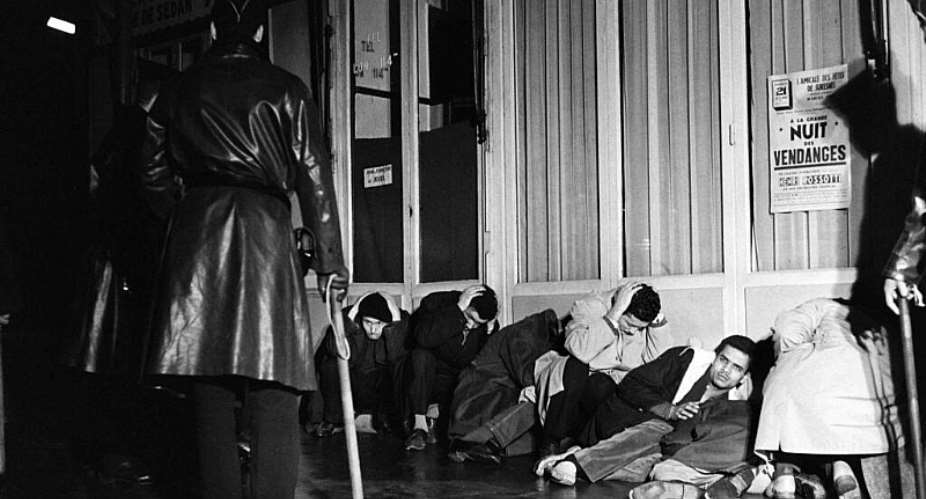
Sixty-five years ago, at the height of Algeria's war of independence against France, thousands of Algerian men and women heeded a call by the National Liberation Front (FLN) and took to the streets of Paris in protest.
The demonstrators were unarmed, but were in breach of a dusk to dawn curfew imposed on people of Algerian origin.
Police, under the authority of Paris police chief Maurice Papon, used extreme violence to disperse them.
The official death toll at the time was three. But historians' estimates have since put the figure between 100 and 200, many of whom were thrown into the River Seine.
The city of Paris began commemorating the massacre in 2001. In 2012, then-president François Hollande acknowledged a "bloody repression" and in 2021 President Emmanuel Macron described what happened as "inexcusable for the Republic".
But the French state has stopped short of taking full responsibility.
Now, some 30 mayors – including the Socialist mayor of Paris, Emmanuel Gregoire – have signed an appeal demanding full recognition of the massacre as a state crime.
1961 - Algerians massacred on Paris streets
'Facing our history'
In their statement, relayed by FranceInfo, the mayors also call for 17 October to be included in France's calendar of national days and ceremonies, and for “the continued opening up of, and access to, the archives relating to 17 October, 1961 and, more broadly, to the Algerian War”.
“I have signed the mayors' appeal: this state crime must be recognised as such. Truth. Memory. Justice,” wrote Saint-Denis mayor Bally Bagayoko of the far-left France Unbowed (LFI) party, in a social media post.
The signatories are also demanding memorial sites and educational initiatives for younger generations, so that the history of the massacre is fully taught and understood.
While the Algerian War has been part of France's secondary school curriculum since 1983, there is no obligation to cover the 17 October massacre.
The mayors claim the voices of victims, survivors and their families have been ignored for too long.
“Recognising 17 October, 1961 is not about reopening the wounds of the past. It is about facing our history. It is about delivering justice to those who were victims of this repression,” the statement said. “It is about recognising the voices of families and all those who have fought for decades to ensure that the truth is known.”
Wounds still cut deep 60 years after Algerians massacred in Paris
'Dark chapters'
In 2024, a majority of MPs voted through a resolution tabled by the Greens to recognise and condemn the massacre and establish a day of commemoration.
In October 2025, LFI tabled a resolution calling for the massacre to be officially recognised as a state crime.
Mathilde Panot, head of the LFI parliamentary group, said her party would take part in a tribute on Saturday for the victims of the massacre, adding: “We are still fighting for this massacre to be recognised as a state crime."
While left-wing parties broadly support such a move, the right-wing Republicans are opposed, arguing the historical and memorial work has already been done.
MPs with the far-right National Rally are staunchly opposed.
The party voted unanimously against the 2024 resolution. When Macron described the events as "inexcusable", Marine Le Pen – the party's candidate for next year's presidential election – slammed what she called France's "repeated acts of repentance", saying they had become "insupportable".
France and Algeria revisit painful past in battle to mend colonial wounds
However, the rector of the Grand Mosque of Paris, denies that a more complete recognition of 17 October would amount to "imposing endless guilt on France or eternally blaming itself”.
Writing on the mosque's website, Chems-Eddine Hafiz said: “To recognise is to give substance to equality – equality in knowledge – which allows us to take our natural place within the fabric of France.
"It is to integrate a section of our fellow citizens into history without detracting from its grandeur, for the history of every nation has its dark chapters."

 Obuasi SHTS alleged sexual abuse: Kwasi Kwarteng criticises Education Minister o...
 ECOWAS’ $250,000 flood relief donation arrives in Ghana – Ablakwa
 Kennedy Agyapong has not resigned from NPP – Kwasi Kwarteng
 State failure, not GoldBod, driving galamsey – Daryl Bosu
 A Rocha Ghana raises alarm over human rights abuses in mining communities
 ECOWAS, AfDB discuss ways to advance West Africa’s development priorities
 October 16: Cedi gains against dollar, sells at GHS12.25 on forex market, GHS11....
 Galamsey: Ghana’s rivers now run chocolate and milk colour — Sam Jonah
 A nation of job-seekers will always be poor — Sir Sam Jonah
 “If you attack us with pepper spray, we’ll fight back” — NDC Yakubu Tony Aidoo w...


