




The deal between Europe's two economic powerhouses aims to cut carbon emissions and support the development and manufacture of electric cars in Europe, the two countries said in a joint statement published on Friday.
"Our shared amibition is clear: to successfully transform our automotive industry while maintaining our climate ambition and ensuring that the cars of the future are produced in Europe," it said.
The deal also provides "concrete incentives for investment, research and development, European production and resilient supply chains".
The agreement still needs the backing of other EU states and the European Parliament to become law, but is expected to shape the continent's future policy.
European car manufacturers have been struggling to compete with their Chinese counterparts, which have been increasingly targeting Europe as they face barriers to selling in the United States and weaker demand at home.
Chinese electric vehicles and hybrids accounted for 10.7 percent of the European market in the second quarter of 2026, up from 5.7 percent a year earlier, Schmidt Automotive Research said.
Chinese carmakers descend on Paris as battle for European market intensifies
Franco-German dynamic
Paris and Berlin had long been at loggerheads on the course Europe should take as it seeks to revive its struggling auto industry.
Germany wanted less stringent carbon emission targets for carmakers and a broad interpretation of "made in Europe" to include key non-EU trade partners, such as Norway and the UK.
France, on the other hand, had pushed to preserve the bloc's climate ambitions and to keep the "made in Europe" public procurement scheme within the scope of EU member states.
Both countries' leaders welcomed the deal.
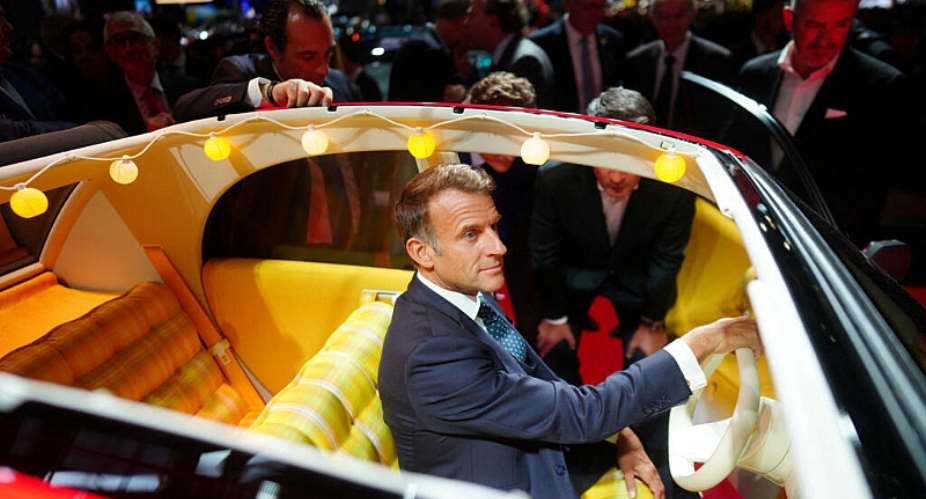
French President Emmanuel Macron said it showed a "clear ambition to successfully transform" the European automotive industry while upholding Europe's climate goals.
"We hope that this Franco-German dynamic will lead to a swift agreement with our partners, for the sake of our jobs and our industry," he wrote in a post on social media platform X.
German Chancellor Friedrich Merz described the deal as a "good day for car drivers and for jobs in Germany, France and Europe".
"This sends a pro-investment signal to the industry," he wrote, also on X.
EU set to ease 2035 combustion-engine ban amid auto industry pressure
Softened emissions targets
The European Commission proposed last year that CO2 emissions from cars should drop by 90 percent from 2021 levels in 2035, and that carmakers would have to close the gap to 100 percent by using low-carbon steel and alternative fuels.
However, under the Franco-German deal, the target would be set at 90 percent without the need for any other compensatory measures.
The softened target is broadly in line with the wishes of German car manufacturers.
The deal also opens the door for cars running on renewable fuels to count as "zero-emission" and makes it much easier for automakers to reach CO2 targets.
EU and China open crunch trade talks in Beijing on hybrid car exports
'Good news' for the UK
The provisional Franco-German plan says that, for the automotive sector, the "Made in EU" label should cover the EU's 27 member states and other European partners that were part of the EU internal market on 1 January, 2020.
That would include the UK, which officially left the EU single market on 31 January, 2020.
An official at UK Prime Minister Andy Burnham's office said it would be good news for the UK's automotive sector if it was included in the "Made in EU" scheme. He added, however, that the Franco-German proposal would need European consensus and that details were yet to be seen.
The Franco-German plan also says this inclusion should be subject to an agreement on full reciprocity, along with "dynamic alignment with EU conditions for investment from third countries and with EU trade protection measures".
That could mean the UK having to adopt the measures the EU has taken to limit imports of Chinese-built hybrid and battery electric vehicles.
(with newswires)

 Obuasi SHTS alleged sexual abuse: Kwasi Kwarteng criticises Education Minister o...
 ECOWAS’ $250,000 flood relief donation arrives in Ghana – Ablakwa
 Kennedy Agyapong has not resigned from NPP – Kwasi Kwarteng
 State failure, not GoldBod, driving galamsey – Daryl Bosu
 A Rocha Ghana raises alarm over human rights abuses in mining communities
 ECOWAS, AfDB discuss ways to advance West Africa’s development priorities
 October 16: Cedi gains against dollar, sells at GHS12.25 on forex market, GHS11....
 Galamsey: Ghana’s rivers now run chocolate and milk colour — Sam Jonah
 A nation of job-seekers will always be poor — Sir Sam Jonah
 “If you attack us with pepper spray, we’ll fight back” — NDC Yakubu Tony Aidoo w...


