




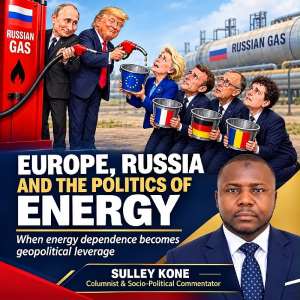
International politics has never been about charity. Countries tend to work together when their interests align, but they compete fiercely when those interests clash. And when the cost of sticking to a certain stance becomes too steep, they’re quick to abandon it.
However, there’s a crucial distinction between chasing national interests and expecting allies to make sacrifices for a shared goal, only to pivot when the fallout becomes too uncomfortable back home.
The recent events involving the United States, Russia, and the ongoing war in Ukraine bring this issue to the forefront.
For years, Washington has insisted that Russia should face economic repercussions for its full‑scale invasion of Ukraine and even before the emergence of the Ukraine conflict. Successive U.S. administrations have imposed sanctions, limited Russian energy imports, and collaborated with European allies to curb Moscow’s ability to fund its military efforts.
Europe, especially the European Union, has also rolled out significant restrictions on Russian energy imports and has been working to lessen its reliance on Russian supplies.
But then, on October 9, 2026, President Donald Trump made a surprising announcement: he struck a deal with Russian President Vladimir Putin for Russia to supply diesel to American and global markets. This announcement came with a temporary relaxation of some U.S. sanctions on Russian diesel exports.
According to the Associated Press, the deal included an immediate supply of over 300,000 tonnes, followed by another 500,000 tonnes in November and an additional million tonnes after that. This arrangement emerged amid rising diesel prices and fuel‑supply challenges.
Now, this situation raises a tricky question for Ukraine and its European allies: if Russia’s energy revenues have been seen as a strategic threat due to the war, what happens when Washington decides it needs those Russian supplies to tackle its own economic issues?
This issue isn’t just about diesel, oil prices, or a single presidential announcement. It digs deeper into the credibility of American leadership, the trustworthiness of alliances, and how far national interests can take precedence over commitments made for collective security.
When Russia decided to invade Ukraine in February 2022, the United States and its European allies sprang into action with a comprehensive set of economic sanctions.
The goal wasn’t merely to show diplomatic disapproval. The strategy aimed to hit Moscow where it hurts by imposing economic costs, limiting access to crucial technologies and financial services, and cutting down the funds available to fuel the war.
Energy quickly became a key battleground since oil and gas exports are vital for Russian state revenue.
The European Union rolled out restrictions on Russian seaborne crude oil and refined petroleum products, along with measures to curb Moscow’s earnings from international oil sales. The broader G7 price‑cap initiative also aimed to limit Russian oil revenue while ensuring that oil continued to flow into global markets.
The United States also put its own restrictions on Russian energy imports.
These policies were driven by a strategic thought process: if Russia couldn’t sell its energy at the same scale or under the same conditions, the Kremlin’s financial resources would feel the squeeze.
The political message was just as crucial. Western governments wanted to make it clear that invading a sovereign nation would have repercussions that extended beyond the battlefield.
Europe, in particular, faced a tough reality. Its past reliance on Russian energy had created vulnerabilities that Moscow could exploit during a crisis.
Cutting back that dependence meant making costly adjustments, finding new suppliers, building alternative infrastructure, and changing how energy was purchased.
European governments and consumers have been grappling with costs tied to a policy that was framed as essential for European security and support for Ukraine.
Navigating this situation was never straightforward. Russia shifted a significant amount of its energy exports to other markets, while fluctuating global commodity prices and the challenge of finding alternative supplies made it tough to gauge the effectiveness of sanctions.
Still, the core argument from the West was unmistakable: economic pressure was a crucial tool in responding to Russia’s invasion.
This context makes Washington’s recent decision particularly noteworthy.
The announcement regarding the Russian diesel arrangement marks a notable shift in the immediate trajectory of American energy policy.
As reported by the Associated Press and other news outlets, the Trump administration has granted a temporary authorization that allows certain Russian diesel shipments to move forward under relaxed sanctions. This decision was framed as a necessary response to fuel‑supply challenges and the need to stabilize energy markets.
It’s important to note that this doesn’t equate to lifting all American sanctions against Russia. Financial restrictions, individual designations, and other measures are likely to remain intact.
However, this decision is significant because it creates a direct exception to the broader policy aimed at limiting Russian energy transactions.
The contradiction here is hard to overlook.
Washington has maintained that revenue from Russian energy supports Moscow’s ability to continue its military actions. Yet, when faced with fuel‑supply issues in the American market, the administration has shown a readiness to allow more Russian diesel into the mix.
From the viewpoint of the American government, this arrangement can be justified as a practical solution to an energy shortage. Diesel is vital for freight transport, agriculture, construction, industrial operations, and many other sectors of the economy.
When fuel prices go up, it can drive up the costs of transporting food and other goods, increase business operating expenses, and put extra strain on households.
Naturally, an American administration is going to be worried about these effects.
However, the geopolitical ramifications don’t just fade away because there’s an economic reason behind a decision.
If Russia gets more chances to sell its petroleum products, those sales could bring in revenue for Russian producers and boost the overall economy. How much they benefit will depend on the actual shipment volumes, prices, costs, and the specifics of each deal.
What’s crucial to understand is that a government can aim for a valid domestic economic goal while also complicating its foreign‑policy objectives.
The real question isn’t whether America has the right to safeguard its economy; it’s whether the administration has fully thought through the impact on the broader strategy it’s been pursuing against Russia.
It wouldn’t be accurate to claim that the United States simply told every European country to stop buying all Russian oil. The restrictions from America and Europe haven’t been the same, and the European Union has crafted its own sanctions and energy‑diversification strategies.
Still, the United States has collaborated with European allies to impose economic penalties on Russia, while the EU has put in place significant restrictions on Russian energy imports.
The EU’s actions include bans on seaborne Russian crude oil and refined petroleum products, along with additional restrictions targeting energy companies, transportation, and related services. There have been some exceptions and transitional arrangements for certain measures.
Europe’s move away from Russian energy sources has been driven by worries about security, political pressure, and the dangers of becoming too reliant on a nation with which it is currently in a significant geopolitical conflict.
These strategies have forced European governments to rethink long‑standing business ties.
Energy markets don’t transform overnight. Refineries, pipelines, shipping routes, contracts, and storage facilities are all part of intricate systems. Replacing a key supplier can be a lengthy process and come with considerable costs.
As a result, European nations have had to weigh economic expenses against strategic needs.
This backdrop is important because the ongoing debate isn’t just about whether European nations should buy Russian oil. It’s about the credibility of a unified strategy.
If Washington urges its allies to bear the costs of reducing reliance on Russian energy but then eases its own restrictions when domestic needs call for more supplies, European leaders might justifiably question whether both sides share the same priorities.
This is where the notion of betrayal comes into play.
The problem isn’t that Europe has been outright banned from purchasing Russian oil while the U.S. has suddenly gained unrestricted access. The legal situation is more nuanced.
The real concern is that the United States might be altering the practical enforcement of a policy whose costs have been borne, either directly or indirectly, by its allies.
Foreign policy often requires tough compromises. Governments sometimes face the challenge of choosing between goals that cannot all be met at once.
The United States has to take into account domestic fuel prices, inflation, economic growth, national security, and its international obligations.
It’s not unusual for a government to modify its policies in response to changing circumstances.
Navigating the rationale behind such adjustments gets trickier when a government frames a policy as crucial for upholding a broader international order.
If the goal of sanctions is to make Russia feel the economic sting of its invasion of Ukraine, then easing those sanctions raises a valid concern: does the original aim still hold the same weight for the administration?
If the restrictions are designed to cripple Russia’s ability to fund its war efforts, how much extra revenue could this new arrangement bring in for Russian producers?
If the policy aims to showcase Western unity, how will Washington justify this shift to allies who have poured political and economic resources into lessening their reliance on Russian energy?
And if the decision is about stabilizing fuel prices, is there solid evidence that the extra Russian supplies will actually lead to lower prices for American consumers?
These aren’t anti‑American inquiries; they’re about accountability and maintaining a consistent strategy.
The credibility of a foreign‑policy stance hinges, in part, on whether a government sticks to its guns even when it becomes inconvenient.
A government that asks its allies to make sacrifices must be ready to clarify why it’s making exceptions for itself.
Otherwise, even a decision that seems reasonable in the short term can erode trust in the overall policy.
For Ukraine, the stakes are particularly high.
The country has faced years of conflict, infrastructure attacks, economic turmoil, and immense human suffering. Its government has leaned heavily on international military, financial, and diplomatic support.
Sanctions have played a crucial role in the broader international reaction to Russia’s invasion.
From Kyiv’s viewpoint, allowing more Russian diesel exports while the conflict rages on could undermine the economic pressure meant to keep Moscow in check.
Ukrainian President Volodymyr Zelensky voiced his disapproval of the American decision, calling it both unfair and dishonest in an interview with Axios. His remarks highlight Kyiv’s worry that relaxing energy restrictions might give Russia an economic boost while Ukraine continues to shoulder the burdens of the war.
It’s easy to see why Ukraine feels this way, even if the actual economic impact of such an arrangement is still up in the air.
But there’s another angle to consider.
A temporary exemption from sanctions doesn’t automatically dictate the war’s outcome. It also doesn’t mean that every extra dollar a Russian energy company makes will go straight into military funding.
The economic impact hinges on various factors, including the volume of exports, the prices they fetch, the costs involved, and whether these transactions genuinely generate new revenue or simply shift supplies that would have gone to another buyer.
Still, from a strategic standpoint, the symbolism carries weight.
When a nation seeks ongoing international backing against an aggressor, actions that seem to relieve the invader’s economic strain can shake confidence, even if the real‑world effects are debatable.
Thus, Ukraine must weigh not just the immediate economic fallout but also what this decision signals about the strength of American support.
Europe finds itself in a tricky spot.
The European Union and its member states have worked hard to lessen their reliance on Russian energy. They’ve implemented sanctions, diversified their supply chains, and prioritized energy security as a key part of their response to the war.
The EU has been steadily working on its strategy to phase out Russian energy imports. In its July 2026 sanctions package, it kept the pressure on Russian energy exports and introduced additional measures targeting oil traders, vessels, and related infrastructure.
In this context, Washington’s choice to ease restrictions on Russian diesel exports raises some eyebrows regarding transatlantic coordination.
European governments need to think about whether American policies will continue to align with their strategic goals.
However, this doesn’t imply that every disagreement between Washington and European capitals is a betrayal. Allies can have legitimate differences on how best to tackle a shared threat.
Moreover, European leaders shouldn’t assume that the economic situations in the U.S. and Europe are the same.
The United States has its own energy resources, industrial priorities, electoral pressures, and domestic political dynamics. Meanwhile, European nations face varying degrees of vulnerability to disruptions in the energy market.
Still, the strength of the alliance relies on more than just formal statements of friendship.
It hinges on open dialogue, reliable commitments, and a reasonable expectation that partners will take each other’s security concerns into account when making significant decisions.
When a policy shift directly impacts the economic standing of a nation that the alliance has collectively deemed a strategic adversary, communication becomes even more crucial.
If European leaders feel that Washington is making significant choices without fully considering their implications, trust can start to erode.
The risk isn’t necessarily an immediate break in transatlantic relations. Instead, it’s the slow build‑up of uncertainty about whether shared commitments will hold up during the next economic or political upheaval.
To grasp Washington’s decision, it’s essential to look at the domestic economic landscape.
Diesel isn’t just another commodity; it plays a crucial role in transporting goods, agricultural production, construction, manufacturing, and various commercial activities.
When diesel prices increase, the ripple effects can impact the entire economy.
Transport operators incur higher costs. Farmers may find it more expensive to run machinery and transport their produce. Businesses face increased distribution expenses. Ultimately, consumers might see a rise in the prices of food and other essential items.
Thus, fuel prices can turn into a political issue, especially when voters are already worried about the cost of living.
According to the Associated Press, the arrangement with Russia regarding diesel emerged as fuel‑supply pressures and soaring prices raised economic and political alarms in the United States, particularly with the congressional midterm elections set for November 3, 2026.
This backdrop offers a reasonable explanation for the administration’s push for more supplies.
However, it’s important to note that an explanation doesn’t equate to proof that the policy will meet its goals.
More supplies don’t automatically mean a significant drop in prices. Global commodity markets are shaped by factors like production levels, shipping disruptions, refinery capacity, inventories, demand, and future supply expectations.
Analysts have raised doubts about whether the Russian deal would significantly lower diesel prices, especially since additional Russian exports might replace shipments to other customers rather than substantially boost the overall fuel supply.
This is a critical point to consider.
If the arrangement provides only minimal relief to American consumers while benefiting Russian suppliers and undermining trust among allies, the administration may face scrutiny over whether the strategic costs are worth the economic gains.
One common misconception when it comes to sanctions is the belief that a country has to lift every single restriction for the targeted economy to see any benefits.
But that’s not how sanctions operate.
Restrictions can be loosened in certain areas, for specific products, for limited timeframes, or under certain conditions. Even a small exemption can open up business opportunities that wouldn’t have existed otherwise.
The arrangement set for October 2026 deals with Russian diesel supplies and a temporary easing of some American restrictions. It shouldn’t be seen as a total lifting of all U.S. sanctions against Russia.
That said, a targeted exemption can still have significant effects.
Russian producers might find new buyers, secure more deals, or enjoy greater commercial flexibility. The Russian government could also see indirect benefits from the increased economic activity tied to energy exports.
How substantial those benefits are is still up for debate.
At the same time, this arrangement could lead to implications beyond just the immediate transactions. Other governments and businesses might view this decision as a sign that American sanctions can be relaxed when market pressures become too intense.
That perception could influence how they assess the strength of future restrictions.
Sanctions serve as both economic tools and political signals. Their effectiveness hinges not just on the restrictions themselves but also on how credible the governments enforcing them are.
If a targeted government thinks that its opponents will eventually ease restrictions to safeguard their own economies, it might see the pressure as temporary or negotiable.
Just because there are exemptions doesn’t mean they completely undermine the effectiveness of sanctions. In fact, temporary exemptions can sometimes play a crucial role, like helping to stabilize markets or aiding diplomatic talks.
The key question here is whether the exemption is part of a well‑thought‑out strategy, if it’s proportional to the goal, and whether the government has considered its broader implications.
The term “betrayal” carries a lot of weight, but it’s important to analyze it closely. In the realm of political commentary, betrayal often refers to a perceived breach of trust, especially when one side feels that the other has turned its back on a shared commitment.
However, it’s not a precise legal term on its own.
The evidence shows that Washington has made moves to ease restrictions on Russian diesel exports, which has drawn criticism from Ukraine.
These facts lend credence to the argument that this decision might shake confidence in the reliability of American policy.
To reach those conclusions, we’d need a broader look at American policy, discussions with European governments, the specifics of the exemption, and the larger diplomatic picture.
Still, the political question is a valid one.
Europe has backed restrictions on Russian energy partly due to the war and the risks it poses to European security. If Washington is now allowing more Russian energy exports for its own economic reasons, European leaders have every right to question whether the strategic burden is being shared equitably.
They also have the right to wonder if American decisions are being made in consultation with allies or if European governments are simply expected to adapt to Washington’s shifting priorities.
In the realm of international relations, perceptions hold significant weight because they shape future decisions.
If a European government starts to question Washington’s reliability, it might become more hesitant to back future American initiatives. This could lead to a push for greater strategic independence, a diversification of diplomatic ties, or a demand for stronger assurances before taking on additional economic burdens.
Even if the immediate sanctions exemption is just a temporary measure, the implications could be quite substantial.
For nations in Africa, Asia, and other developing regions, this situation offers a broader insight into international relations.
Smaller countries often find themselves encouraged to align their foreign policies with those of more powerful states. They might be asked to support sanctions, back diplomatic resolutions, limit trade relationships, or make economic sacrifices in the name of a larger international goal.
At times, such cooperation is warranted by genuine shared interests.
However, the actions of powerful nations also reveal that foreign policy can shift when domestic situations evolve.
A government that once deemed a particular country an unacceptable trade partner may later engage with it if it aligns with its economic or strategic goals.
This isn’t just a phenomenon seen in the United States. Russia, China, European nations, and other major powers also pursue their national interests and adapt their policies as circumstances change.
The takeaway isn’t that international cooperation is futile or that every powerful nation operates in bad faith.
Instead, the lesson is that countries need to differentiate between lasting national interests and fleeting political alignments.
For Ghana and other African nations, it’s crucial to approach international partnerships with a clear understanding of national priorities.
Foreign policy should be driven by key factors like economic development, national security, energy security, trade, technological advancement, and the well‑being of citizens.
While partnerships with major powers can offer significant benefits, they shouldn’t overshadow the importance of independent evaluation.
Before diving into the costs tied to a major international policy, governments should consider a few essential questions:
What specific national interest does this policy serve?
What economic repercussions could arise? What commitments have the partners made?
What if those partners decide to shift their focus?
And what measures are in place to safeguard the country’s interests if the global consensus starts to falter?
These questions are particularly vital for developing countries, which often have fewer economic resources


 Obuasi SHTS alleged sexual abuse: Kwasi Kwarteng criticises Education Minister o...
 ECOWAS’ $250,000 flood relief donation arrives in Ghana – Ablakwa
 Kennedy Agyapong has not resigned from NPP – Kwasi Kwarteng
 State failure, not GoldBod, driving galamsey – Daryl Bosu
 A Rocha Ghana raises alarm over human rights abuses in mining communities
 ECOWAS, AfDB discuss ways to advance West Africa’s development priorities
 October 16: Cedi gains against dollar, sells at GHS12.25 on forex market, GHS11....
 Galamsey: Ghana’s rivers now run chocolate and milk colour — Sam Jonah
 A nation of job-seekers will always be poor — Sir Sam Jonah
 “If you attack us with pepper spray, we’ll fight back” — NDC Yakubu Tony Aidoo w...


