




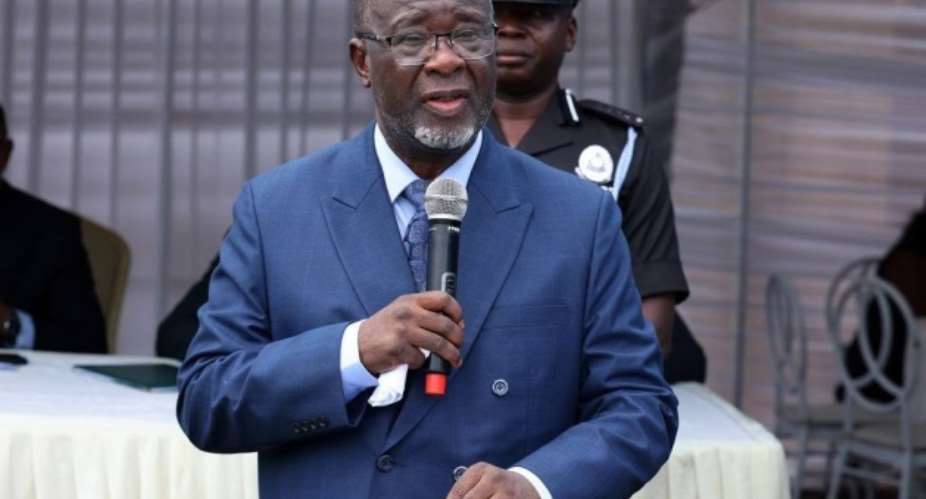
Chief Justice Paul Baffoe-Bonnie has cautioned the Judiciary against pursuing technological reforms at the expense of accessibility, stressing that innovation must ultimately make justice more accessible to citizens.
He said the success of any reform within the Judiciary should not be measured by the excitement surrounding its introduction but by its ability to withstand the test of time and continue serving citizens effectively.
Justice Baffoe-Bonnie made the remarks in a message delivered at a special church service at the Cathedral Church of the Most Holy Trinity in Accra last Saturday to mark the opening of the 69th Legal Year.
The service was held on the theme: “Strengthening the Foundations of Justice through Leadership, Innovation and Technology.”
The gathering brought together Justices of the Supreme Court, justices of the Court of Appeal, High Court judges, Circuit Court judges and magistrates, Judicial Secretary Musah Ahmed and other senior officials of the Judicial Service.
The Attorney-General and Minister of Justice, Dr Dominic Akuritinga Ayine, his deputy, Dr Justice Srem-Sai, Ghana Bar Association (GBA) President Efua Ghartey, Vice-President Victoria Barnes and Ghana Law Society President Rockson Nelson Etse Dafeamakpor were also present.
Public confidence must be earned
The Chief Justice said confidence in the Judiciary was built through the direct experiences of people who interacted with the courts, rather than through constitutional and legal provisions alone.
He explained that the manner in which citizens were received, the speed with which cases were handled, the fairness of decisions and the dignity accorded to court users all shaped their perception of the justice system.
“The citizen who enters a court does not experience the Constitution as an abstract document.
"He experiences it through the manner in which he is received, the time within which his case is heard, the fairness with which his matter is determined and the dignity with which he is treated,” he said.
Justice Baffoe-Bonnie said seemingly routine matters, including interactions at court registries, proper filing of documents and responses to telephone calls, could equally determine whether a citizen felt fairly treated.
He therefore stressed that strengthening the foundations of justice required more than producing sound judgments, arguing that the daily conduct of every judicial employee also contributed to the integrity of the institution.
Technology should not create new barriers
Justice Baffoe-Bonnie further warned that the Judiciary's digital transformation must not leave behind people who lacked the skills or resources to navigate new technologies.
He specifically mentioned people with limited digital literacy, residents of underserved communities and vulnerable litigants as groups that could be excluded if adequate measures were not taken.
“Technology must bridge the distance between the citizen and justice, not widen it,” he said.
The Chief Justice called for continuous training, retraining and institutional support as new technologies were introduced, saying judicial workers should not be expected to master new systems through trial and error.
He also reflected on the responsibility of current judicial leaders to build institutions that would serve future generations.
According to him, institutions were not the property of the people who occupied them at any particular time but were entrusted to each generation to strengthen before handing them over.
He said reforms and systems introduced today could eventually serve citizens who had not yet been born, while the standards tolerated by the Judiciary today could become the benchmark against which future generations judged the institution.
“As I approach the conclusion of my service as Chief Justice later this year, I am especially conscious of this truth,” Justice Baffoe-Bonnie said.
Bishop calls for righteous leadership
The Anglican Bishop of Ghana, Rt Rev. Dr Daniel Sylvanus Mensah Torto, who preached the sermon, also challenged leaders within the justice system to prioritise integrity and service.
“God does not need more clever lawyers. We need righteous leaders in the justice system,” he said.
Drawing lessons from biblical examples, the bishop warned that weak or corrupt leadership could undermine the administration of justice and urged judges and lawyers to exercise their authority with humility.
He said servant leadership required the justice system to remain conscious of vulnerable people, including poor women who could not afford legal representation and prisoners who had spent years awaiting trial.
“Legacy in justice is not to be served, but to serve the poor woman at Makola Market who cannot afford a lawyer,” he said.
Rt Rev. Dr Mensah Torto also urged judges to be willing to rule against powerful and wealthy individuals whenever the demands of justice required it.
Call for innovation in case management
The bishop further called for greater innovation in the justice system, particularly in the management of cases that remain before the courts for prolonged periods.
He cited court-connected Alternative Dispute Resolution as an example of what could be achieved through innovation but said additional measures were needed to make justice faster, cheaper and more humane.
“We need courage to innovate in case management. Why should that case be in court for years? Justice delayed is justice denied,” Rt Rev. Dr Mensah Torto said.
He welcomed the use of e-filing, virtual courts, digital transcription and case-tracking systems, noting that such technologies could help reduce delays and corruption while improving transparency.
However, he cautioned that technological tools must remain subordinate to the broader objective of delivering justice.
The Anglican Bishop of Ghana warned that technological advancement without ethical leadership could compound existing problems rather than resolve them.
“If we put technology on a foundation of corrupt leadership, we only have digitised corruption,” he said.

 John Boadu comes nowhere near Asiedu Nketiah in terms of pedigree, gravitas, val...
 ‘If promotion arrears aren’t paid by October 30, I will have no honour’ – Haruna...
 GACL enhances screening at Accra International Airport
 Mahama to decide on permanent Ayalolo contra-flow system after Thursday review –...
 NPP elections: Kwadwo Bamba’s first vice chair victory was a big surprise – Prof...
 NPP Delta Force Commander Kojo Bamba elected First Vice Chairman
 GRA probes alleged GH¢600 extortion involving Customs officer at Accra Internati...
 “NPP has men, let us take machoism out' — Former Speaker Prof Oquaye on vigilant...
 Gov’t renames 24-hour economy markets as District Economy Markets, targets 100% ...
 BoG, Police arrest 7 in Accra over alleged use of cedi notes for money bouquets,...


