




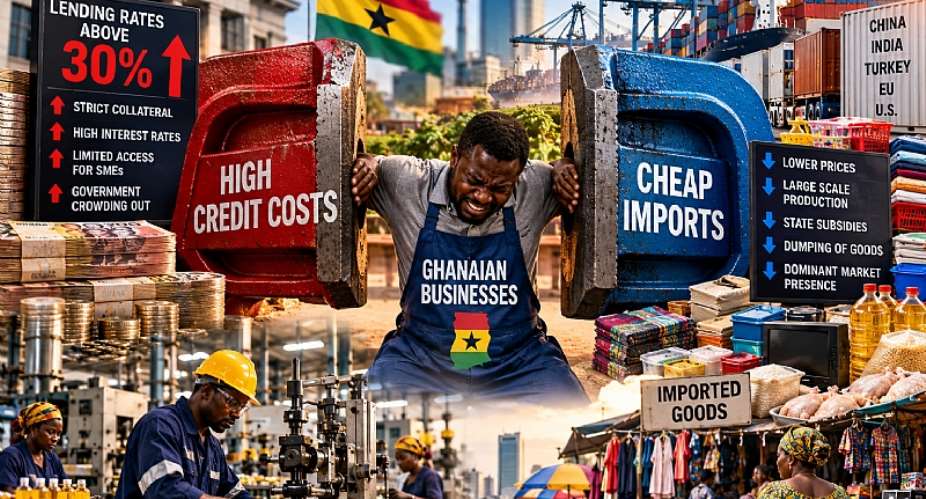
Ghana cannot build a strong economy if it becomes easier and more profitable to import finished products than to manufacture them locally.
Yet this is increasingly the uncomfortable reality confronting many Ghanaian businesses. Local manufacturers, small and medium-sized enterprises and entrepreneurs are caught between two powerful pressures: the high cost of financing their businesses and intense competition from cheaper imported goods.
The result is a dangerous squeeze on the very private sector Ghana expects to create jobs, expand the tax base, process its raw materials and drive industrialisation.
For many entrepreneurs, access to affordable credit remains one of the greatest obstacles to growth. A manufacturer who wants to purchase machinery, increase production or finance working capital often encounters lending rates that make long-term investment extremely difficult.
A business borrowing at very high interest rates must generate extraordinary returns simply to service the loan before paying workers, electricity bills, taxes, rent, transportation costs and other expenses.
The problem is even more severe for SMEs. Commercial banks frequently consider smaller businesses risky because they may lack sufficient collateral, audited accounts or predictable cash flows. Those unable to obtain conventional bank financing may turn to alternative lenders where borrowing can be even more expensive.
Under these conditions, businesses do not borrow primarily to expand. Some borrow simply to survive.
Government borrowing can add another dimension to the problem. When the state relies heavily on the domestic financial market, government securities can compete with businesses for available capital. Banks naturally have incentives to invest in relatively attractive government instruments rather than assume the greater risk of financing a small manufacturer.
Ghana therefore faces a contradiction: the country wants private businesses to create employment and increase production while the financial system can make productive investment prohibitively expensive.
But expensive credit is only half of the problem.
After struggling to finance production, Ghanaian manufacturers must compete with imported products that may come from countries where producers enjoy cheaper electricity, lower financing costs, larger markets, better infrastructure, greater economies of scale and, in some cases, substantial government support.
Walk through Ghanaian markets and shops and the evidence of the country's dependence on imports is difficult to miss. Imported food, clothing, household products, plastics, electrical products and countless other manufactured goods compete daily with domestic alternatives.
Imports are not inherently bad. Ghana needs international trade, technology, machinery, medicines and products that cannot be produced competitively at home. Competition can also force domestic companies to improve quality and efficiency.
The problem arises when Ghanaian companies are expected to compete internationally while carrying costs their foreign competitors do not face.
A Ghanaian manufacturer cannot easily compete on price if the company borrows at exceptionally high rates, pays expensive electricity tariffs, imports raw materials with a volatile currency and carries multiple taxes, levies and regulatory expenses.
The arithmetic eventually becomes impossible.
This helps explain why a Ghanaian trader may find it more profitable to import finished products than purchase them from a local factory. The trader is responding rationally to prices. But what makes sense for an individual trader can become damaging to the national economy when multiplied across thousands of businesses.
Every container of products Ghana could competitively manufacture locally represents more than an import transaction. It potentially represents production, employment, skills development, taxation and foreign exchange that could have remained within the domestic economy.
The situation becomes more serious when imports involve products Ghana already possesses the raw materials and basic capacity to produce.
Why should a country with enormous agricultural potential remain heavily dependent on imported processed foods?
Why should Ghana export agricultural commodities in relatively raw forms and subsequently import higher-value finished products?
Why should domestic factories operate below capacity while imported alternatives increasingly occupy supermarket shelves and market stalls?
These questions go to the heart of Ghana's industrialisation challenge.
High electricity costs further weaken competitiveness. Manufacturing depends heavily on reliable and affordable power. When energy costs rise, the increase eventually appears in the final price of locally manufactured goods.
Currency instability creates another burden because many Ghanaian manufacturers depend on imported machinery, packaging and intermediate inputs. A weakening cedi raises production costs even when a company has not increased its profit margin.
Taxes and regulatory costs add another layer. Businesses must comply with legitimate standards to protect consumers, workers and the environment. But regulation must be efficient, predictable and reasonably priced. When companies spend excessive amounts of time and money navigating multiple institutions, permits and charges, regulation becomes another competitive disadvantage.
The answer, however, is not to close Ghana's borders or indiscriminately ban imports.
Protection without productivity can create inefficient industries and force consumers to pay unnecessarily high prices. Ghana needs intelligent industrial policy rather than permanent protectionism.
Government should identify sectors where Ghana has genuine comparative or strategic advantages and create the conditions for those industries to become internationally competitive.
Agriculture and agro-processing should be among the priorities. Ghana has considerable potential in cocoa processing, cassava, fruits, vegetables, spices, cashew, shea, oilseeds, poultry and other value chains.
Manufacturing should similarly receive financing mechanisms designed around productive investment rather than short-term commercial lending.
Development finance institutions, credit-guarantee programmes and properly supervised concessionary funding could help viable businesses acquire machinery, adopt technology and expand production without being suffocated by conventional commercial lending costs.
Government must also exercise fiscal discipline so that excessive domestic borrowing does not undermine private-sector access to capital.
Trade rules should be enforced against genuine dumping and substandard imports, while customs administration should ensure that legitimate local producers are not disadvantaged by under-invoicing, misclassification or other forms of unfair competition.
At the same time, local manufacturers must accept their side of the responsibility.
Supporting Ghanaian industry cannot become an excuse for poor quality, unreasonable prices or inefficient production. Businesses receiving government support must innovate, improve productivity, meet standards and ultimately compete beyond Ghana's borders.
The objective should not be to produce Ghanaian companies that survive only because foreign competition has been removed. It should be to build Ghanaian companies strong enough to compete with foreign businesses at home, across Africa and eventually in global markets.
The African Continental Free Trade Area makes this particularly important. Ghana should not merely celebrate hosting the AfCFTA Secretariat. Ghanaian businesses must be positioned to manufacture and export competitively into the continental market.
The choice facing the country is therefore bigger than the debate over interest rates or imports.
It is about the type of economy Ghana wants to build.
A country cannot sustainably create prosperity by exporting raw materials, importing finished goods and borrowing heavily to finance consumption.
Ghana needs an economy that produces.
That means factories that manufacture, farms connected to processing industries, entrepreneurs with access to affordable capital and Ghanaian products capable of competing on quality and price.
If local businesses continue borrowing at high rates while competing against products manufactured under significantly cheaper financial and production conditions abroad, many will eventually stop producing.
Some will become importers. Others will downsize. Some will close.
And every factory that stops producing means more than the loss of a business. It can mean lost jobs, lost skills, lost taxes, lost exports and greater dependence on foreign production.
Ghana should welcome international trade and competition. But it must also create an environment in which Ghanaian businesses have a realistic chance of competing.
The country cannot industrialise merely by asking citizens to "buy made in Ghana."
First, Ghana must make it possible to produce competitively in Ghana.


 Mahama unveils H-Enabler platform to boost health investment and manufacturing i...
 Calm restored at Larteh Ahenase after Odwira Festival disturbances — Police
 Young woman found hanging from mango tree at Kasoa Akweley Peace Town
 Service Machinery Ghana Limited MD caged over alleged $1m fraud against employer
 Bawumia pledges support for John Boadu-led NPP leadership ahead of 2028
 Boakye Agyarko pledges support for John Boadu, calls for NPP unity after electio...
 Meet the newly elected national executives to lead NPP return to power in 2028
 'I extend my hand of friendship, partnership to contenders for ideas, experience...
 Rwandan genocide suspect 'hunter' Dafroza Gauthier dies at 72
 Brazilians begin voting in tight election between Lula and Flavio Bolsonaro


