




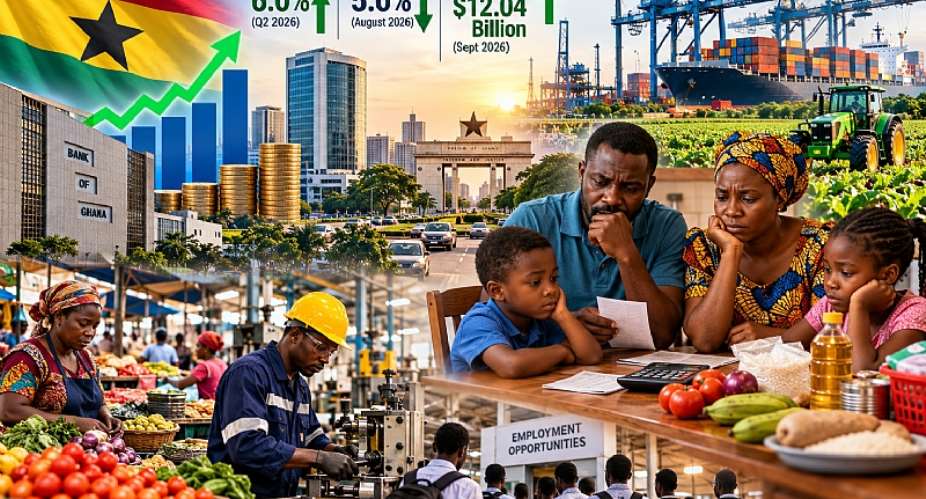
Ghana’s economy appears to be turning an important corner. Inflation has fallen sharply from the extraordinary levels experienced during the recent economic crisis, economic growth has strengthened, international reserves have improved, and the country has made significant progress in restoring macroeconomic stability.
But there is a question that statistics alone cannot answer: when will the recovery reach the kitchen table?
For the ordinary Ghanaian, economic recovery is not ultimately measured by GDP growth, reserve accumulation or improvements in debt ratios. It is measured by the price of food, electricity and transport; the availability of jobs; the cost of borrowing; the ability of businesses to survive; and whether household income can comfortably meet everyday expenses.
That is the paradox confronting Ghana. The macroeconomic indicators may be improving faster than the economic experience of many households.
Available data for 2026 point to considerable progress. Real GDP reportedly expanded by 6 percent in the second quarter, supported strongly by services and information and communication technology. Headline inflation had fallen to about 5 percent by August, a dramatic improvement from the 54.1 percent peak recorded in late 2022.
These are important achievements. Bringing inflation under control restores confidence, protects incomes and creates a better environment for investment. But lower inflation does not mean prices have returned to their previous levels. It simply means prices are increasing more slowly. A household already struggling with significantly higher food, rent, transport and utility costs may therefore hear that inflation has fallen without immediately feeling financially better off.
The same distinction applies to economic growth. A country can record impressive GDP growth without the benefits being evenly distributed.
If growth is concentrated in sectors that employ relatively few people, national output may increase without producing enough jobs or substantially improving household incomes. Ghana therefore needs to pay as much attention to the quality and employment impact of growth as it does to the headline growth rate.
This is particularly important for young people. High youth unemployment means that economic expansion must increasingly be directed towards sectors capable of absorbing large numbers of workers.
Agriculture, agro-processing, manufacturing, construction, tourism and small-scale enterprise offer significant opportunities. Ghana should deliberately connect its agricultural resources to processing industries so that cocoa, cassava, fruits, vegetables, shea, cashew, oilseeds and other commodities increasingly leave farms as inputs for Ghanaian factories rather than merely as raw materials.
Credit presents another major challenge.
The Bank of Ghana's policy rate may have declined significantly from crisis-era levels, but borrowing remains expensive for many businesses and households. For a small manufacturer, farmer or entrepreneur, macroeconomic stability means little if financing remains too expensive to purchase machinery, increase production or employ additional workers.
Government borrowing also requires careful management. Increasing dependence on domestic borrowing can reduce exposure to foreign-currency risk, but excessive government borrowing from the local financial system can compete with private businesses for available capital.
Banks naturally have incentives to lend to government when government securities provide attractive returns with comparatively lower risk. The consequence can be that the entrepreneur attempting to establish a factory or expand an agro-processing business struggles to obtain affordable financing.
This is where Ghana's next phase of economic management must concentrate.
The country needs to convert financial stability into productive investment.
Credit-guarantee programmes and other risk-sharing arrangements should be expanded to encourage lending to viable SMEs, agriculture, manufacturing and export-oriented businesses. Development finance should focus on enterprises capable of creating jobs and replacing imports rather than becoming another source of politically directed credit.
Ghana must also maintain fiscal discipline. The painful adjustments undertaken during the economic crisis should not be wasted through uncontrolled expenditure or the accumulation of new arrears.
International reserves and a relatively stable currency provide another important foundation for recovery. Ghana remains heavily dependent on imports ranging from petroleum products and machinery to pharmaceuticals, industrial inputs and consumer goods. Maintaining adequate foreign exchange reserves is therefore essential for currency stability and controlling imported inflation.
But Ghana cannot permanently defend its currency simply by accumulating reserves.
The stronger long-term solution is to produce and export more while importing less of what the country can competitively manufacture itself.
That means processing more agricultural commodities locally, expanding manufacturing, supporting export-oriented businesses and building Ghanaian companies capable of competing across the African Continental Free Trade Area.
The country's recovery must therefore move beyond stabilisation towards structural transformation.
Ghanaians should not be asked indefinitely to celebrate improving macroeconomic statistics while unemployment, expensive credit and high living costs remain major concerns. Neither should genuine progress in stabilising the economy be dismissed simply because every household has not yet experienced the benefits.
Both realities can exist at the same time.
Macroeconomic stability is essential, but it is the foundation of prosperity, not prosperity itself.
The next challenge is harder: turning stability into factories, farms, businesses, exports, affordable credit and sustainable employment.
Ultimately, ordinary citizens will judge the success of Ghana's economic recovery differently from economists and financial markets.
They will judge it at Makola and Kejetia. They will judge it at the fuel station and supermarket. They will judge it through electricity bills and school expenses. Entrepreneurs will judge it when they approach banks for loans. Young graduates will judge it when they search for work.
And families will judge it every evening when they sit around the kitchen table and calculate whether their incomes can comfortably carry them through another month.
That is where Ghana's economic recovery must ultimately be felt.
The numbers may tell us that stability is returning. The next task is to make sure prosperity follows.


 Mahama unveils H-Enabler platform to boost health investment and manufacturing i...
 Calm restored at Larteh Ahenase after Odwira Festival disturbances — Police
 Young woman found hanging from mango tree at Kasoa Akweley Peace Town
 Service Machinery Ghana Limited MD caged over alleged $1m fraud against employer
 Bawumia pledges support for John Boadu-led NPP leadership ahead of 2028
 Boakye Agyarko pledges support for John Boadu, calls for NPP unity after electio...
 Meet the newly elected national executives to lead NPP return to power in 2028
 'I extend my hand of friendship, partnership to contenders for ideas, experience...
 Rwandan genocide suspect 'hunter' Dafroza Gauthier dies at 72
 Brazilians begin voting in tight election between Lula and Flavio Bolsonaro


