




Ghana’s ambition to industrialise, modernise agriculture and create sustainable employment for its growing population is both necessary and achievable. But ambition alone will not transform the economy. The country must confront some fundamental obstacles that continue to make local production expensive and weaken the competitiveness of Ghanaian businesses.
Among the most significant challenges are the cost and reliability of electricity. Manufacturing, agro-processing, cold storage and other productive industries depend heavily on affordable and dependable energy. When electricity becomes expensive or unreliable, production costs rise, businesses lose competitiveness and investors become more cautious. The financial difficulties within the energy sector therefore represent more than an electricity problem; they are an industrialisation problem.
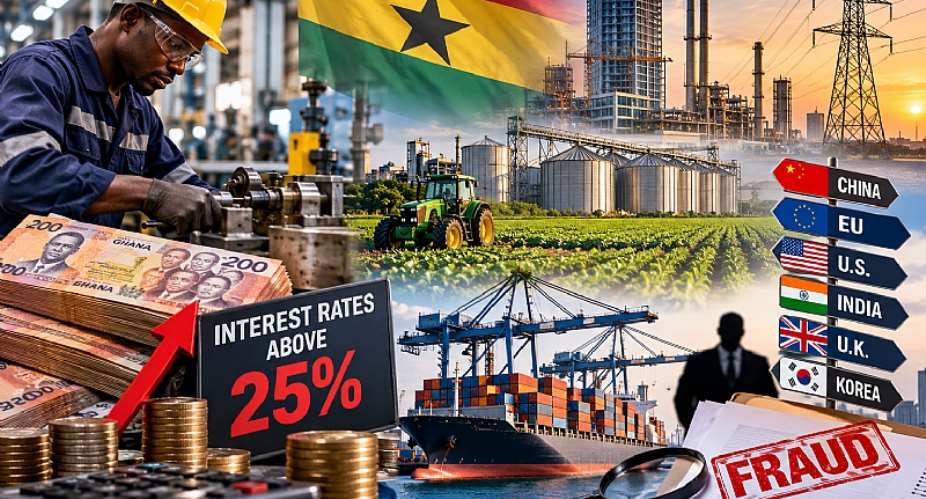
Access to affordable capital presents another major obstacle. With commercial lending rates frequently exceeding 25 percent, many Ghanaian businesses simply cannot borrow sustainably to purchase machinery, expand factories, introduce technology or finance working capital. An entrepreneur may have a viable business idea and a ready market but still find expansion impossible because the cost of borrowing destroys the economics of the investment.
This creates a serious contradiction. Ghana wants businesses to manufacture locally, add value to agricultural products and create jobs, yet the financial environment can make importing finished products easier than borrowing money to manufacture those same products locally.
Government's fiscal position also affects the business environment. High public debt constrains procurement and infrastructure investment, while payment arrears can create serious cash-flow difficulties for contractors, suppliers and investors doing business with the public sector. For companies operating on borrowed capital, delayed payments can quickly turn profitable contracts into financial liabilities.
Foreign companies entering Ghana face another reality: intense international competition. Businesses from China, India, the European Union, the United Kingdom, South Korea, Turkey, Israel, South Africa and other economies are competing aggressively for Ghanaian customers.
European and British companies benefit from longstanding commercial relationships and established distribution networks, while Chinese suppliers have become particularly competitive in price-sensitive sectors. American products, machinery and services generally enjoy a reputation for quality, durability and advanced technology, but Ghanaian purchasing decisions are frequently determined by affordability.
This explains why cheaper products can sometimes outperform technically superior alternatives. It also explains the significant market for used and reconditioned machinery, vehicles and industrial equipment. For many Ghanaian businesses, the choice is not necessarily between good and bad technology. It is between what they would prefer to buy and what their cash flow allows them to buy.
Foreign exporters that understand this reality and provide competitive credit, leasing, instalment arrangements or other financing solutions may therefore have an advantage over suppliers demanding full upfront payment.
There is also a less discussed challenge: fraud. International businesses must exercise considerable due diligence when dealing with unfamiliar organisations claiming to represent Ghanaian institutions or procurement agencies. In 2024, the U.S. Commercial Service in Ghana reportedly identified 16 fraudulent entities targeting American companies, with warnings that new schemes continue to emerge.
This is damaging not only to individual victims but also to Ghana's international business reputation. Government agencies and the private sector must therefore strengthen verification systems and make it easier for foreign companies to authenticate procurement opportunities and potential business partners.
Despite these challenges, Ghana remains an attractive destination for businesses willing to understand the market. The country has political stability, a growing consumer market, significant agricultural resources, an entrepreneurial population and strategic access to West African markets. Ghana's role in hosting the Secretariat of the African Continental Free Trade Area also strengthens its potential as a platform for companies seeking wider African opportunities.
But Ghana cannot build a competitive industrial economy simply by asking investors to establish factories or encouraging entrepreneurs to manufacture locally.
Industrialisation requires an ecosystem.
Electricity must be reliable and competitively priced. Businesses must have access to affordable long-term capital. Government must improve payment discipline. Local manufacturers must be supported to acquire modern machinery and technology. Skills development must respond to industrial requirements, while trade and tax policies should encourage domestic value addition rather than unintentionally rewarding excessive dependence on imported finished goods.
Most importantly, Ghana must recognise that local businesses cannot compete globally when they finance production at some of the highest borrowing costs faced by their international competitors.
The country's industrialisation agenda will ultimately be judged not by the number of policies announced or investment conferences organised, but by whether entrepreneurs can actually establish factories, obtain affordable financing, produce competitively and sell successfully at home and abroad.
Ghana has the resources, market opportunities and entrepreneurial talent to become a stronger manufacturing and agro-processing economy. The challenge is to create the conditions that allow productive businesses to survive and grow.
If Ghana genuinely wants to move from an import-dependent economy to a production-driven economy, then reducing the cost of doing business must become as important as attracting investment itself.
Industrialisation cannot thrive where producing locally is more expensive than importing what the country is capable of making.


 Mahama unveils H-Enabler platform to boost health investment and manufacturing i...
 Calm restored at Larteh Ahenase after Odwira Festival disturbances — Police
 Young woman found hanging from mango tree at Kasoa Akweley Peace Town
 Service Machinery Ghana Limited MD caged over alleged $1m fraud against employer
 Bawumia pledges support for John Boadu-led NPP leadership ahead of 2028
 Boakye Agyarko pledges support for John Boadu, calls for NPP unity after electio...
 Meet the newly elected national executives to lead NPP return to power in 2028
 'I extend my hand of friendship, partnership to contenders for ideas, experience...
 Rwandan genocide suspect 'hunter' Dafroza Gauthier dies at 72
 Brazilians begin voting in tight election between Lula and Flavio Bolsonaro


