




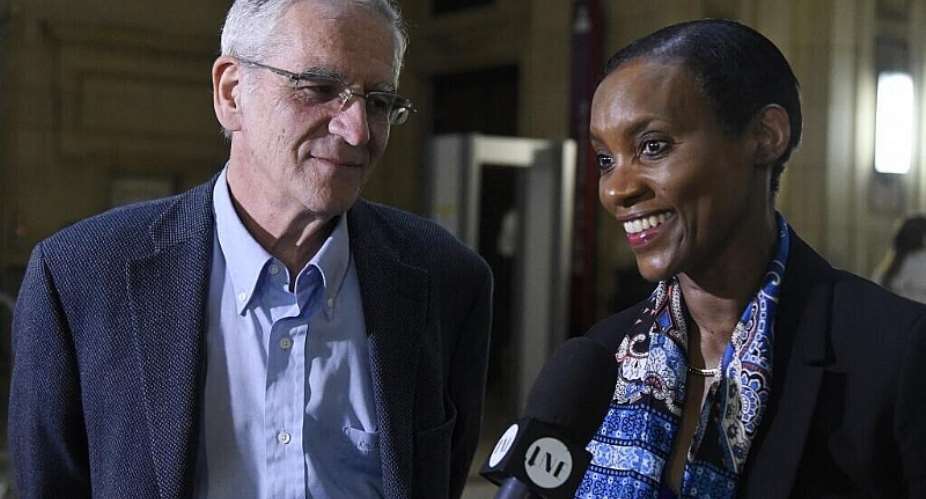
Dafroza Gauthier died on Saturday in Reims, the French city where the couple had lived since the 1980s. She is survived by her husband and three children.
The Gauthiers were often compared in France to Serge and Beate Klarsfeld, the Nazi hunters who tracked down war criminals after the Holocaust.
They founded the Collective of Civil Plaintiffs for Rwanda (CPCR), an association that filed civil suits against dozens of genocide suspects in France. In several cases, these led to criminal trials under the principal of universal jurisdiction, which allows suspects residing in France to be tried for serious crimes regardless of where they were committed.
Seven have received a final conviction and prison sentences ranging from 14 years to life.
Witness to horror
Dafroza Mukarumongi was born on 4 August 1954 in Butare, in southern Rwanda, into a Tutsi farming family.
She experienced ethnic violence from a young age, seeing her family's house burned and property looted. In 1973, her mother sent both her daughters to Burundi for safety. From there, Dafroza moved to Belgium and studied chemistry.
She had met French-born Alain Gauthier while he was working as a teacher in Rwanda, and later visited him in France. The couple married in 1977.
In February 1994, Dafroza – by then a chemical engineer – returned to Rwanda to visit family. She saw militia on the streets of Kigali and heard Hutu extremists broadcasting hate speech against Tutsis.
Her mother pushed her to leave. "I still feel an indescribable sense of guilt for having left her behind," Dafroza Gauthier told Le Monde newspaper decades later.
On 8 April 1994, two days after Rwandan President Juvénal Habyarimana's plane was shot down and the killings began, Dafroza's mother was shot dead in a Kigali church.
Back in France, "we were glued to the telephone all day", Dafroza Gauthier told the New York Times in 2014. "People would tell us, 'At X's home, they're all dead. They've been killed this morning.' It didn't mean anything anymore. I can't express it with words."
In total, she said, around 70 to 80 of her relatives died – her mother's entire family.
'Speaking helps us heal' says Rwandan survivor on genocide anniversary
A life's work
In 2001, the Gauthiers attended the trial in Belgium of four people accused of taking part in the genocide. All were convicted.
Later that year, they set up the CPCR. Their investigations unmasked several suspects living comfortably in France – including Dominique Ntawukuriryayo, who played in a role in the killing of as many of 25,000 Tutsi refugees and was subsequently convicted by the International Criminal Tribunal for Rwanda.
They secured their first criminal case in France in 2014, when former chief of intelligence Pascal Simbikangwa was tried in Paris for genocide and crimes against humanity. He was found guilty and sentenced to 25 years in prison.
France and Rwanda unite to honour genocide victims with Paris monument
Thinking about the 1994 atrocities "makes your head spin", Dafroza Gauthier told France Culture radio around the 30th anniversary of the killings. "But we can't just think – we have to act, do something about this slaughter."
She often said she was seeking not revenge, but justice.
"She was a remarkable person," Christophe Renzaho, president of the Rwandan Community in France expat group, told RFI. "The justice system has lost someone very important, a person who knew no bounds when it came to bringing those who committed genocide against the Tutsis to justice.
"It was her life's work and she carried it out until her very last breath."

 Mahama unveils H-Enabler platform to boost health investment and manufacturing i...
 Calm restored at Larteh Ahenase after Odwira Festival disturbances — Police
 Young woman found hanging from mango tree at Kasoa Akweley Peace Town
 Service Machinery Ghana Limited MD caged over alleged $1m fraud against employer
 Bawumia pledges support for John Boadu-led NPP leadership ahead of 2028
 Boakye Agyarko pledges support for John Boadu, calls for NPP unity after electio...
 Meet the newly elected national executives to lead NPP return to power in 2028
 'I extend my hand of friendship, partnership to contenders for ideas, experience...
 Rwandan genocide suspect 'hunter' Dafroza Gauthier dies at 72
 Brazilians begin voting in tight election between Lula and Flavio Bolsonaro


