




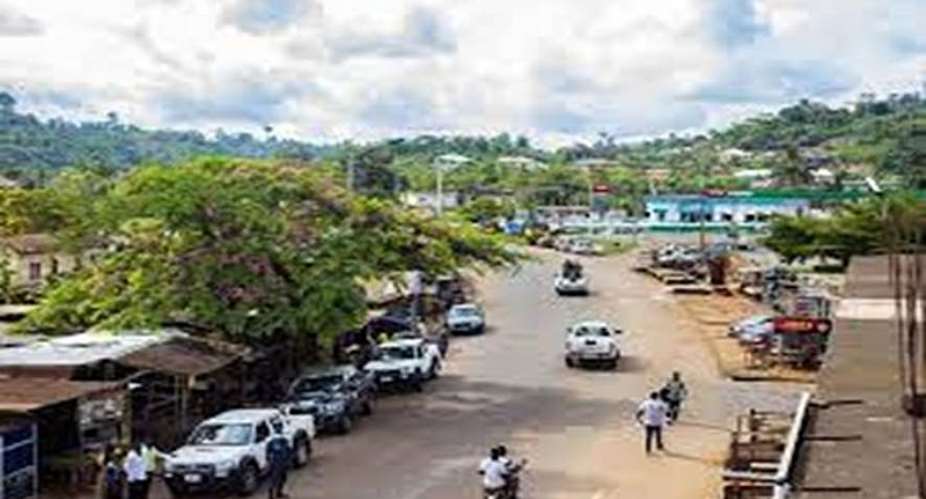
The Western North Region is a new region carved out of Ghana's former Western Region. Established in 2019, it borders the Ivory Coast (Comoé District) to the west, the Central Region to the southeast, and the Ashanti, Ahafo, Bono East, and Bono regions to the north. The region is governed under the local government system, which divides the territory into nine MMDAs, three Municipal, and six District Assemblies). Each district, municipal, or metropolitan assembly is led by a chief executive who represents the central government but is accountable to an assembly chaired by a presiding member chosen from among its members.
After the government proposed establishing a regional hospital in each new region, including the Western North Region, the traditional leaders of Sefwi Wiawso, particularly the Nananom, convened and designated a substantial plot of land in Sefwi Domeabra, a suburb of the regional capital, to facilitate construction of the proposed hospital.
Recently, various news outlets and social media platforms reported that the proposed regional hospital would be built at the Benchema barrier in the Juaboso Constituency. Nananom and most opinion leaders, who had offered land at no cost, were not informed of the proposed location, which led them to disapprove of the decision.
The Benchema Barrier, where a few government's decision-makers are attempting to construct the new regional hospital opposite Nananom, is not a town; it is a small settlement with approximately 15 houses and inadequate educational facilities. It is worth considering the origin of the idea to construct the proposed regional hospital there.
When proposing this hospital at Benchema Barrier, it is vital to realize that a regional hospital serves a geographic area larger than a single local or rural area. It often serves as a focal point for economic sustainability, creating jobs and providing the resources needed for growth. The benefits of a thriving regional hospital are felt throughout the region, starting in the regional capital and extending for miles. This boost is essential for local businesses and families.
Benefits of siting the hospital in Sefwi Wiawso, the Regional Capital.
Regional facilities provide specialized medical treatments, emergency response, and routine exams for peripheral or rural populations, cutting travel distances.
Additionally, concentrating high-volume services and complex procedures in regional hubs reduces overall hospitalization days, lowers mortality rates, and simplifies administrative costs. Centralized investment enables regional centers to acquire diagnostic and surgical equipment that would otherwise be cost-prohibitive, such as sophisticated robotic surgery.
Furthermore, large regional hospitals in regional capitals serve as primary local employers and economic multipliers, encouraging stable employment opportunities and sustaining auxiliary community business activity. They also form the foundation for nearby telehealth networks and clinics, ensuring efficient patient referrals, shared staffing resources, and standardized clinical protocols.
Opening hospitals in cities or regional capitals rather than villages or settlements like Benchema Barrier brings many operational, economic, clinical, and social benefits that affect innovation, sustainability, quality, and access.
When a hospital system is thriving and employment is strong, demand for schools, housing, transportation, and other services rises. If a company is looking to expand, whether it is a factory or distribution center, it examines the school and health care systems. It wants those services available to attract and retain employees.
If people must leave the community for health care, the local economy suffers. “Decreasing services or closing a hospital stunts the community’s economic growth. Companies are rarely attracted to relocate to a community with little or no health care. Existing businesses may be forced to close or leave the community. The rest of the community health-wise and economically can enter a downward spiral of decline.
Disadvantages of operating a regional hospital in a rural location such as Benchema Barrier
In rural areas such as Benchema Barrier, low population density often creates challenges, including lowered patient volumes and diseconomies of scale, fixed overhead expenses, high percentages of subsidized and uninsured patients, disproportionately elderly populations, physician shortages, and reduced access for low-income patients.
Those who advocate building a new hospital in Benchema Barrier should recognize that regional hospitals require many physicians, nurses, technicians, and administrators. Within areas that lack urban amenities, well-developed educational systems, and career opportunities for spouses, it is exceedingly challenging to attract and retain this highly educated workforce. Are there municipal amenities or well-established educational systems in Benchema Barrier and its surroundings that some of us are unaware of? I completed elementary school at Benchema, Anglican Middle School. Benchema Barrier, is a village just a few kilometers away from where I was born.
We must always remember that Regional Hospitals require consistent, expedited deliveries of medical gases, blood products, and specialized medications. Logistics are complicated, and remote village locations worsen delivery times.
Reliable electrical infrastructure, high-speed internet, and extensive water supplies are necessary for advanced medical equipment, such as MRI machines and life-support systems. Benchema Barrier is not an optimal location for the Western North Regional Hospital because of frequent outages and inadequate village infrastructure.
Additionally, major institutions require economies of scale. High overhead costs and a small local patient pool often lead to severe financial deficits and eventual closure.
In this regard, I would like to urge those promoting the construction of the Western North Regional Hospital at the Benchema Barrier to remember that it is generally not advisable to construct a regional hospital in a village, as rural areas lack the population density, specialized workforce, and infrastructure necessary to support large-scale healthcare facilities. A regional capital such as Sefwi Wiawso is a more suitable location for such a facility.
By Kwame Aduhene-Kwarteng PhD, MA


 Three Injured in Stampede at NPP Delegates Conference in Kumasi
 Elect Leaders Who Can Restore Public Confidence and Unite the Party - Kufuor
 Allegations Won’t Deter Me - Baffour Awuah Challenges EOCO to Prove Wrongdoing ...
 Bawumia Urges NPP Aspirants to Accept Election Results and Unite After Delegates...
 Akufo‑Addo Urges NPP Delegates to Unite Behind New Leaders and Rebuild Party for...
 Ghana Bloggers Association Condemns Alleged Assaults on Media Workers at La Plea...
 GH¢10m Bail Keeps Baffour Awuah Out of Custody as EOCO Probe Continues
 Bawumia Accuses NDC Government of Running Down Free SHS, Says Policy Is ‘Sufferi...
 MoH Announces Nationwide Mop-Up Recruitment to Fill Abandoned Postings on Octobe...
 Sammy Crabbe Says Alliance with John Boadu Is Not a Withdrawal from NPP Chairman...


