




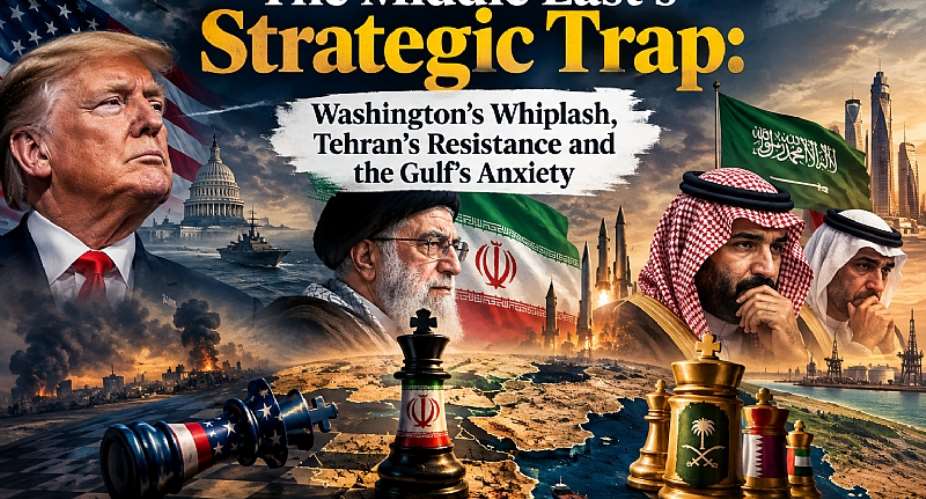
Human society, much like the individual human being, can display patterns of behaviour under prolonged stress. Medical complications can produce psychological consequences; similarly, prolonged wars, insecurity and political trauma can create repetitive patterns in states. In the current post-war discourse, several regional actors appear trapped in cycles from which they cannot easily escape. The labels used here—ADD, OCD, GAD and MPD—are political metaphors, not medical diagnoses. But what happens when a state refuses to recognise the strategic trap it has entered?
American ADD at its peak?
The latest developments in Washington suggest that the United States is confronting a widening strategic dilemma. President Donald Trump’s senior national-security team—including Vice President JD Vance, Secretary of Defense Pete Hegseth, Secretary of State Marco Rubio and special envoy Steve Witkoff—held a closed-door Camp David meeting on October 2 to discuss the Iran war and the Saudi-Houthi conflict.
The question is not simply whether Washington can strike the Houthis, but whether another military adventure would solve the problem or enlarge it? After months of confrontation with Iran, another direct American military commitment in Yemen could deepen the same strategic burden Washington is already carrying. Saudi Arabia understandably seeks security assurances, particularly as Houthi activity threatens the wider Red Sea and Bab el-Mandeb environment. But intelligence-sharing, targeting assistance and diplomatic backing are not necessarily equivalent to direct American participation.
This is where the metaphor of American “ADD” becomes relevant: is Washington moving from one crisis to another without resolving the strategic consequences of the previous one? The challenge for Trump is not merely military capability; it is deciding where American involvement should stop.
The Iranian OCD effect?
Iran presents the opposite pattern: repetition, resistance and refusal to concede under pressure. President Masoud Pezeshkian has publicly argued that Tehran does not want the war to continue and that dialogue should replace further killing, while Foreign Minister Abbas Araghchi has advanced proposals through mediators. Iran recently proposed a seven-day roadmap involving the reopening of the Strait of Hormuz and renewed negotiations.
Yet Washington and Tehran remain divided over sequencing, sanctions and security guarantees. Could both sides require a face-saving mechanism rather than another demonstration of strength? Trump needs political space to claim that American pressure produced results, while Tehran needs a formula that does not appear to be capitulation.
The RAF Fairford investigation illustrates how quickly this confrontation can spread beyond the battlefield. British counter-terrorism police have arrested a dual UK-Iranian national and are investigating possible foreign-state involvement, but the investigation remains ongoing and Iran denies involvement. Should suspicion become evidence before evidence is established? That distinction matters diplomatically.
GCC: GAD—the General Anxiety Disorder?
For the Gulf states, the central issue is strategic anxiety: how can economic transformation continue while regional security remains uncertain? Vision 2030, mega-projects, energy diversification and investment ambitions require stability, confidence and predictable trade routes. What happens when economic transformation meets an increasingly unpredictable security environment?
The GCC is not responding uniformly. Qatar continues to play a mediating role, Oman maintains channels with Iran, while Saudi Arabia and the UAE pursue their own security calculations. That divergence may explain why a single regional settlement remains difficult. Can the Gulf build a collective security architecture while maintaining different relationships with Washington, Tehran, Ankara and Beijing?
Israel and the politics of perpetual threat
Israel’s conduct and rhetoric remain central to the regional crisis, particularly because Gaza continues to generate profound humanitarian consequences. The UN Human Rights Office reported that Israeli military attacks in Gaza continued to kill Palestinians, including children, while a UN Commission of Inquiry has made grave findings concerning Israeli conduct.
The political question, however, is broader: does a permanent security narrative create security, or does it perpetuate the conflict that produces insecurity? Israeli leaders argue that their military actions are necessary for national security, while critics argue that the scale of civilian suffering and regional escalation is undermining prospects for lasting stability.
The Middle East therefore faces a choice not between strength and weakness, but between escalation and political architecture. Will Washington seek another battlefield, will Tehran seek another formula of resistance, will the Gulf seek another security umbrella, and will Israel continue defining security primarily through military power?
The region may ultimately discover that no actor can bomb its way out of a diplomatic problem. The real breakthrough may come not from another missile, but from a face-saving negotiation in which every side can step back without claiming defeat.


 Three Injured in Stampede at NPP Delegates Conference in Kumasi
 Elect Leaders Who Can Restore Public Confidence and Unite the Party - Kufuor
 Allegations Won’t Deter Me - Baffour Awuah Challenges EOCO to Prove Wrongdoing ...
 Bawumia Urges NPP Aspirants to Accept Election Results and Unite After Delegates...
 Akufo‑Addo Urges NPP Delegates to Unite Behind New Leaders and Rebuild Party for...
 Ghana Bloggers Association Condemns Alleged Assaults on Media Workers at La Plea...
 GH¢10m Bail Keeps Baffour Awuah Out of Custody as EOCO Probe Continues
 Bawumia Accuses NDC Government of Running Down Free SHS, Says Policy Is ‘Sufferi...
 MoH Announces Nationwide Mop-Up Recruitment to Fill Abandoned Postings on Octobe...
 Sammy Crabbe Says Alliance with John Boadu Is Not a Withdrawal from NPP Chairman...


