




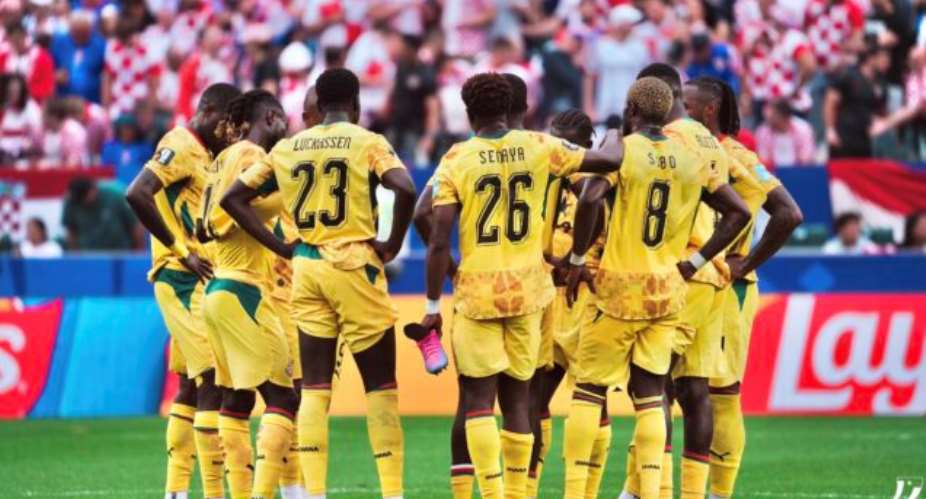
In recent years, the Black Stars, Ghana's national football team, have experienced a significant decline in performance and reputation. This has led to criticism and the perception that they have become an "easy target" or "punching bag" for other national teams. This claim is supported by their recent Africa Cup of Nations (AFCON) tournaments and World Cup qualifiers, where they have often failed to advance beyond the group stage or early knockout rounds.
The team's losses to less-established nations they previously dominated, including defeats by teams like Gambia, have fueled this perception and made the situation worrying.
In my pursuit of understanding the reason, I have come to realize that coaching has lacked stability, as frequent changes and interim appointments have disrupted the team's cohesion and strategy. The Ghana National Soccer Team changes coaches like baby diapers. Over the past 15 years (2011–2026), the Ghana National Team (Black Stars) has had 12 distinct managerial stints or appointments, including nine distinct head coaches and interim/caretaker managers. The following is a chronological list of the coaches, their nationalities, and their stints:
Past Coaches from 2011- 2026:
Goran Stevanović Serbia 2011–2012 James Kwesi Appiah Ghana 2012–2014 (1st stint) Maxwell Konadu (Caretaker) Ghana 2014 (Interim) Avram Grant Israel 2014–2017 Maxwell Konadu (Caretaker) Ghana 2017 (Interim) James Kwesi Appiah Ghana 2017–2019 (2nd stint) Charles Akonnor Ghana 2020–2021 Milovan Rajevac Serbia 2021–2022 (2nd stint) Otto Addo Ghana/ Germany 2022–2023 (1st stint) Chris Hughton Ireland/ UK 2023–2024 Otto Addo Ghana / Germany 2024–2026 (2nd stint) Carlos Queiroz Portugal 2026–Present.
These frequent changes in coaches and managers harm a team by disrupting stability, tactical continuity, and player confidence, often producing temporary motivational boosts that fade over time. Chronic underperformance is strongly associated with high managerial turnover, which often signals a deeper organizational crisis within a club.
The Ghana Black Stars lack identity because of the high rate of coach turnover. At present, the team's inconsistent and subpar performances stem from uncertainty about its playing philosophy, or "identity." Constant manager turnover forces players to learn new systems, formations, and philosophies, which hinders the automaticity of their movements. In the six weeks it takes to play a World Cup or AFCON, a team cannot secure a victory. Over the decade before it begins, you either build or lose it. National coaches have only a smattering of sessions with players who spend most of the year under various managers and in different systems.
Players' confidence and performance have been adversely affected by the constant criticism from the public and media. As a result, Ghana's once-present fear factor has diminished, giving opponents greater confidence.
Administrative challenges, including off-field issues, internal disputes, and corruption allegations within the Ghana Football Association, have impacted morale and preparation. Most Ghanaian football administrators and legislators control local football organizations. As a result, players are often imposed on the national team by their clubs. A coach unwilling to acknowledge their players may face sabotage or lack the support needed to manage the national team effectively. Many football administrators are accused of charging players before imposing them on certain managers.
Ghana has ceased participating in Colts football, a sport that has been instrumental in identifying talented individuals. Numerous individuals argue that soccer academies have replaced Colts soccer and serve the same purpose. The inquiry is, "How many talented youth, particularly those from economically or socially deprived backgrounds, can afford to attend these soccer academies?" All of this has rendered our pursuit of soccer glory a difficult challenge.
Consider a nation that has won the African Nations Championship (AFCON) four times. The Black Stars experienced a period of success from 2008 to 2017. Despite six consecutive AFCON semi-final appearances, final defeats in 2010 and 2015, and a penalty-kick loss that kept it from becoming the first African nation to reach a World Cup semi-final, the Ghana national team is now a target for soccer minnows in Africa and around the world.
Some solutions
Ghana can improve its soccer performance by shifting from short-term fixes to comprehensive institutional reform, grassroots investment, and professional governance. Administrators must first, define the national talent pipeline by restoring nationwide Colts football leagues and structured school sports competitions from basic education through universities. One way to do this is to revitalize grassroots and school sports.
It is also crucial to retain local talent by establishing professional contracts and incentives to ensure top prospects mature domestically before relocating abroad. The national team must include local players, as many foreign-born players may not have the same level of patriotism as those born and raised in the country. Anyone who is playing 3rd division football in a country with a Ghanaian-sounding name is referred to as "Ghana FA." As a result, they deprive the local league of any incentive to perform well to be considered for the national team. Our journey into the football wilderness will persist until the National team is built upon the shoulders of local players or local players who relocate abroad.
To identify late-blooming or rural prospects, Ghanaian football administrators must establish regional recruiting networks and build direct connections between local junior academies and professional domestic clubs.
Lastly, the FA must address dilapidated stadiums and poorly maintained domestic pitches while professionalizing Premier League Club management through transparent financial models.
Conclusion
Ghana's Black Stars, our national team, have become a "punching bag" because of poor results, organizational instability, leadership issues, and a failure to rebuild after their golden era. Nevertheless, Ghana can regain its status as a football powerhouse in Africa and beyond through targeted reforms in management, coaching, and talent development. At present, Ghana soccer is comparable to working under a good supervisor at a poorly performing company.
Kwame Aduhene-Kwarteng PhD, MA


 Three Injured in Stampede at NPP Delegates Conference in Kumasi
 Elect Leaders Who Can Restore Public Confidence and Unite the Party - Kufuor
 Allegations Won’t Deter Me - Baffour Awuah Challenges EOCO to Prove Wrongdoing ...
 Bawumia Urges NPP Aspirants to Accept Election Results and Unite After Delegates...
 Akufo‑Addo Urges NPP Delegates to Unite Behind New Leaders and Rebuild Party for...
 Ghana Bloggers Association Condemns Alleged Assaults on Media Workers at La Plea...
 GH¢10m Bail Keeps Baffour Awuah Out of Custody as EOCO Probe Continues
 Bawumia Accuses NDC Government of Running Down Free SHS, Says Policy Is ‘Sufferi...
 MoH Announces Nationwide Mop-Up Recruitment to Fill Abandoned Postings on Octobe...
 Sammy Crabbe Says Alliance with John Boadu Is Not a Withdrawal from NPP Chairman...


