




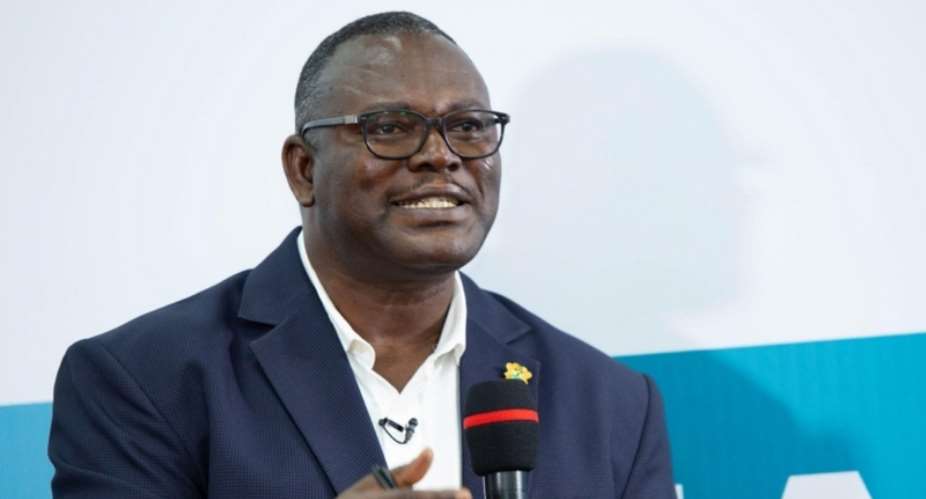
More than 70% of Ghana’s workforce operating within an estimated five million micro and small businesses remains outside the formal tax system, creating a major obstacle to the country’s efforts to achieve its 18-20% tax-to-GDP target, Professor Abdallah Ali-Nakyea, Professor of Tax Law and Policy at the University of Ghana School of Law, has said.
Prof. Ali-Nakyea, who is also Director of Ali-Nakyea & Associates PRUC, said Ghana’s existing tax framework was largely designed around formal employment and value-added tax (VAT) filing, making it difficult to capture the large number of businesses operating predominantly on a cash basis.
He described the situation as “a system built around formal payroll withholding and VAT filing that was never designed to reach a workforce this large operating in cash.”
The tax expert made the remarks at the second Transparency International Ghana (TI-Ghana) Integrity Dialogue Series, held under the theme, “Bridging Ghana’s Tax Revenue Gaps: A call for voluntary tax compliance, an accountable and fair tax system.”
The dialogue forms part of TI-Ghana’s Governance and Integrity Policy Dialogue Series (GIPDS), an initiative aimed at addressing systemic corruption and strengthening public accountability across key sectors.
Prof. Ali-Nakyea said the challenge was not unique to Ghana, citing experiences from other African countries where large informal sectors have continued to limit tax mobilisation.
He noted that Kenya, for instance, registered only 30,000 businesses under its Turnover Tax Regime and collected about US$3 million in 2023/24. Tanzania, with informal employment accounting for 45-46% of its workforce and 1.8 million small and medium-sized enterprises contributing 35% of GDP, has a tax-to-GDP ratio of 12.9%. Rwanda, where informal employment stands at about 69%, records a tax-to-GDP ratio of 15.0-16.3%.
According to Prof. Ali-Nakyea, Ghana has taken steps to address the problem through two key reforms.
One is the increase in the VAT registration threshold from GH¢200,000 to GH¢750,000. He noted that the previous threshold, introduced in 2015, had been significantly eroded by inflation.
The second is the Ghana Revenue Authority’s Modified Taxation App, which is accessible through *880# and a mobile application. The platform calculates a flat percentage tax based on turnover, replacing more complex profit-based filing requirements.
The initiative is projected to bring about two million new taxpayers into the tax system, with potential revenue exceeding GH¢10 billion under its first phase, alongside a three-year tax education programme.
Prof. Ali-Nakyea said the reforms were important because bringing informal businesses into the tax net required more than enforcement.
“Formalizing the informal sector is essential because the challenge is not only non-compliance culture but also a rational economic response to a tax system that imposes costs businesses may not absorb,” he said.
For her part, TI-Ghana Executive Director, Mary Awelana Addah, said the Governance and Integrity Policy Dialogue Series demonstrated the organisation’s commitment to promoting integrity, transparency and accountability.
She said sustained civic engagement and informed policy discussions were necessary to advance anti-corruption reforms.
“TI-Ghana recognizes the critical role of sustained civic engagement and informed policy dialogue in advancing anti-corruption reforms,” Mrs Addah said.
She noted that corruption, procurement fraud and weak enforcement continued to deprive the state of significant revenue and said the dialogue series was intended to move discussions beyond identifying problems towards developing practical solutions.
Mrs Addah said the programme would bring together governance experts and stakeholders to generate evidence-based proposals capable of strengthening TI-Ghana’s advocacy and contributing to governance reforms.
“We invite you to engage fully, share your insights, and contribute to shaping actionable proposals that will strengthen Ghana’s governance landscape.
“Together, let us make this maiden dialogue series a catalyst for reforms that uphold transparency, accountability, and integrity in public life.”
She said the year-long programme would combine regular policy roundtables with virtual meetings, with each session focusing on a high-risk sector.
The dialogue brought together TI-Ghana members, civil society organisations working against corruption, governance institutions, faith-based organisations and other stakeholders.

 EOCO drags Manhyia South MP to former law firm, residence for search
 BNI investigates Yaw Ampofo Ankrah over alleged World Cup visa facilitation sche...
 EOCO arrests three over drone flights at headquarters during arrest, probe of Ma...
 NPP’s removal of NACOC from routine checks made Ghana’s borders porous – Dr. Sam...
 Police arrest three suspected kidnappers over Yendi abduction
 Ghana’s older population projected to hit 5.7m by 2050 – Gender Ministry
 4,405 teachers to be placed on Director II rank this year – GES
 Gov’t procurement must prioritise local farmers for school feeding – Dr. Ato For...
 Prof Emmanuel Osei Sarpong appointed Acting NSA Director-General
 NSA Boss Yaw Ampofo Ankrah suspended over US$623,000 World Cup visa allegations


