




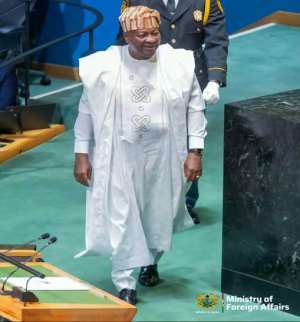
One aspect of President John Mahama’s appearance at the 81st United Nations General Assembly that fascinated me almost as much as his speech was his clothes. I have learned over the years not to treat what a president wears to an important occasion as incidental. Clothing communicates. In Mahama’s case, academic research now shows that the symbols he wears can themselves carry deliberate political meaning.
Mahama appeared at the UN in an elegant white three-piece agbada. Although the word agbada is Yoruba and the garment is particularly associated with Nigeria and Benin, the flowing prestige-robe tradition to which it belongs has circulated widely across West Africa. In Ghana, the three-piece agbada is well established in men’s formal dress and has a history in presidential fashion, especially since the Limann administration in the 1980s. Related forms are found in Togo and, under names such as boubou, grand boubou and riga, across Senegal, The Gambia, Guinea, Mali, Burkina Faso and Niger. Mahama therefore entered a diplomatic space still heavily dominated by Western business tailoring while drawing presidential formality from a recognisably West African sartorial vocabulary.
But the most interesting part of the garment, for me, is the large Adinkra symbol embroidered prominently down its front: Kramo Bɔne, from the fuller expression Kramo bɔne amma yɛanhu Kramo papa.
There is good reason to take that symbol seriously. Nyamawero Navei, Dickson Adom and Osuanyi Quaicoo Essel’s 2026 study, “Adinkra, Kente Symbolisms, Sartorial Semiotics and Political Leadership Communication of John Dramani Mahama’s 2025 Presidential Inauguration Fashion,” published in the African Identities journal, examined Mahama’s 2025 inaugural clothing alongside his inaugural speech. They found that his attire constituted a deliberate leadership narrative. Nyame Dua and Gye Nyame communicated spiritually anchored leadership, Dwennimmen combined strength with humility, Sankofa materialised his “reset” agenda, while the Ɛmmerepa da w’anim Kente communicated better days ahead.
More importantly, the researchers interviewed Mahama’s designer, who described the President as an active “co-creator” of the inaugural outfit. Mahama wanted “something Ghana with Ghana, like a touch of Ghana”, while the designer described fashion as a “universal language” requiring the deliberate selection of symbols. The study consequently treats the Adinkra and Kente elements as “active political language”. This takes us beyond simply assuming that a president’s clothes must mean something. In Mahama’s case, there is evidence from an earlier major presidential occasion that he participated actively in constructing the symbolic language of his attire.
Two other studies reinforce this interpretation. Isaac Horsu, De-Love Anobah Opare, Adwoa Sikayena Amankwah and Emmanuel Kyei’s 2025 article, “Adinkra Symbols and Political Communication: Analysing President John Mahama’s Inaugural Apparel on 7th January, 2025,” published in the International Journal of Language and Literary Studies, approaches the inaugural clothing through visual rhetoric and semiotics and interprets the Adinkra symbols as persuasive communication. Ronald Osei Mensah, Anthony Bordoh, Andrews Acquah, Eric Bruce-Amartey Jnr and Papa Kofi Nunoo’s 2025 Frontiers in Sociology article, “Sociological and Religious Interpretations of Adinkra Symbols: Qualitative Analysis of the 2025 Inaugural Outfit of Ghana’s President,” draws on 28 participants, including traditional leaders, fashion designers, museum curators and cultural preservationists. It similarly treats Adinkra as capable of communicating political philosophy, ethical leadership, national identity and cultural continuity.
There is a useful distinction here. Semiotics helps us ask what the signs mean, while visual rhetoric asks what those signs do when assembled and presented before an audience. When carried on the body of a president at a major state occasion, they also become part of political communication. As stated earlier, previous scholarship has established that Mahama has deliberately participated in this process before. As such, the prominence of Kramo Bɔne on his UNGA attire is difficult to dismiss as mere decoration.
So what does Kramo Bɔne say?
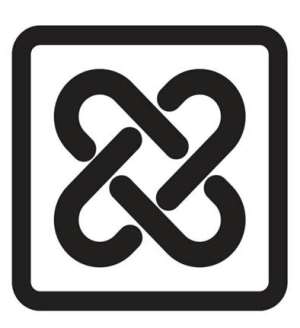 Kramo Bɔne symbol. Source: www.vecteezy.com
Adolph Hilary Agbo, in the 2006-revised edition of his book, Values of Adinkra and Agama Symbols, identifies Kramo Bɔne explicitly as a “symbol of hypocrisy”. Agbo states the underlying proverb as “Kramo bɔne amma yeanhu Kramo Papa”, which he translates into English as “The bad Muslim has made it difficult for one to recognise a good one.” In explaining the expression, Agbo states that “bɔne” means bad, “Kramo” refers to a Muslim and “papa” means good. The literal language of the proverb therefore emerges from a particular Akan encounter with Muslim identity, and that context should not be erased in interpreting the symbol.
Its moral reach, however, extends beyond that literal reference. Agbo associates the proverb with the “pretentious and hypocritical nature of some people” and, in his concluding interpretation, with the “pretence, concealment and deceptive nature of humans”. The proverb warns against taking people simply at face value because outward appearance may conceal actual character. At its heart, then, Kramo Bɔne raises a problem of discernment: how do we distinguish what someone professes to be from what their conduct reveals them to be? A bad representative can make the genuine difficult to recognise.
This makes the symbol particularly interesting in relation to Mahama’s UN address. Kramo Bɔne is not merely a general injunction against bad behaviour. It directs attention towards the gap between profession and practice, between the identity or values publicly claimed and the conduct by which those claims must ultimately be judged.
Mahama stood before an institution founded upon a Charter proclaiming sovereign equality, international cooperation, peace and human rights, and repeatedly questioned the relationship between those principles and the realities of international power. He spoke about Gaza and the application of international law. He questioned an international architecture in which Africa, with some 1.5 billion people, remains without permanent representation on the Security Council. He demanded reparatory justice for slavery. He warned that “Africa will not remain a passive arena for a new scramble for resources”. Above all, he insisted that the UN Charter must prevail over a world in which “might makes right”.
Read alongside Kramo Bɔne, a fascinating relationship emerges between the spoken and visual rhetoric. What happens when institutions profess equality but practise inequality? When international law is proclaimed as universal but appears inconsistently applied? When the language of partnership coexists with structures in which some possess considerably more power than others? Agbo’s interpretation of Kramo Bɔne gives these questions a particularly appropriate Ghanaian philosophical vocabulary: do not judge merely by what is professed; examine what conduct reveals.
Mahama did not direct that scrutiny only outwards. He told African leaders that they “must also do what is required to put our own houses in order”. If Africa questions inconsistencies, inequalities and failures of responsibility internationally, its own leadership must also withstand examination at home. Kramo Bɔne therefore meets the speech at one of its central concerns: whether conduct lives up to principle.
I would hesitate, however, to push the interpretation too far by suggesting that Kramo Bɔne somehow encodes every argument in Mahama’s speech, or assume that every passage was consciously written around the symbol. Rather, there is a narrower connection: both the clothing and the speech return us to the relationship between declared principle and actual conduct.
The white colour of the attire performs a different rhetorical function. It already has precedent in scholarly readings of Mahama’s presidential dress, with Horsu and his colleagues interpreting the white fabric of his 2025 inaugural attire in terms of purity and victory. We should not automatically transfer every meaning attributed to that earlier garment onto the UNGA outfit. Whatever additional meaning was intended at the UN, the visual effect of white is easier to establish. It gives the agbada restraint, creates an uncluttered field for Kramo Bɔne and distinguishes Mahama sharply against the darker surroundings of the General Assembly chamber. The result is commanding without being ostentatious.
The cap, on the other hand, performs a different visual function. Its brown, rust and cream tones interrupt the monochrome and introduce warmth, contrast and texture. Without knowing more about the cap’s textile and design, I would hesitate to assign it a more specific cultural meaning. Visually, however, its contribution is clear. It prevents the expansive white composition from becoming flat while allowing the central embroidery to remain dominant.
Reading the elements of the ensemble together, the three-piece agbada located Mahama within a wider West African sartorial tradition. White gave the garment restraint and allowed the embroidery to dominate. The cap introduced contrast and texture. However, the intellectual centre of the ensemble remained Kramo Bɔne. Its proposition was the most demanding of all: appearances and professions are insufficient; conduct reveals character.
That proposition also runs through some of the deepest tensions in Mahama’s address: between the ideals proclaimed by the international system and the realities of power, between political independence and economic dependence, and between Africa’s demands for justice abroad and the responsibilities of its leaders at home. Evidently, an old Ghanaian philosophy of discernment entered the same conversation as the President’s words.
Seen this way, Mahama’s appearance before the United Nations was itself part of the communication of the presidency. The speech articulated Ghana’s position in words, while the clothing located the speaker culturally and supplied a visual language through which some of the speech’s deepest concerns could also be read. At the intersection of the two was the same fundamental question: whether the principles we profess are reflected in the way we exercise power.
(The writer is an award-winning media executive, historian, educator, and leadership consultant with graduate training in business, communication, education, and African Studies)

 NPP’s removal of NACOC from routine checks made Ghana’s borders porous – Dr. Sam...
 Police arrest three suspected kidnappers over Yendi abduction
 Ghana’s older population projected to hit 5.7m by 2050 – Gender Ministry
 4,405 teachers to be placed on Director II rank this year – GES
 Contractors begin construction of 120-bed trauma hospital at Bole – Kwakye Ofosu...
 Gov’t procurement must prioritise local farmers for school feeding – Dr. Ato For...
 Vacate by October 4 or face demolition – KMA warns Abrepo Junction occupants
 Star Oil and GOIL assure no fuel price increase for new window
 Diesel will not hit GH¢22 at pumps – NPA CEO assures
 Ghana records 3,876 cybersecurity incidents in seven months – Communications Min...


