




Youth unemployment is an urgent priority for the Government of Ghana. This problem has profound effects on citizens, causing financial instability and severe psychological effects, including stress, anxiety, and a diminished sense of self-worth. These effects show why urgent solutions are needed.
In local communities, unemployment can lead to social issues such as increased rates of crime, social unrest, and higher poverty levels. These challenges strengthen the case for targeted youth employment solutions.
Economically, high unemployment reduces consumer spending, a key driver of economic growth. When fewer people earn wages, demand for goods and services decreases, which can reduce production and place a heavier burden on government resources. This economic pressure makes youth employment solutions necessary.
This article therefore focuses on one solution to unemployment in Ghana: creating employment for young people through the security services and related work.
Ghana has a youth population of about 11.78 million to 12.4 million, making up roughly 36.9% to 38% of the population. Of this number, about 1.3 million, or 21.9%, are currently without jobs.
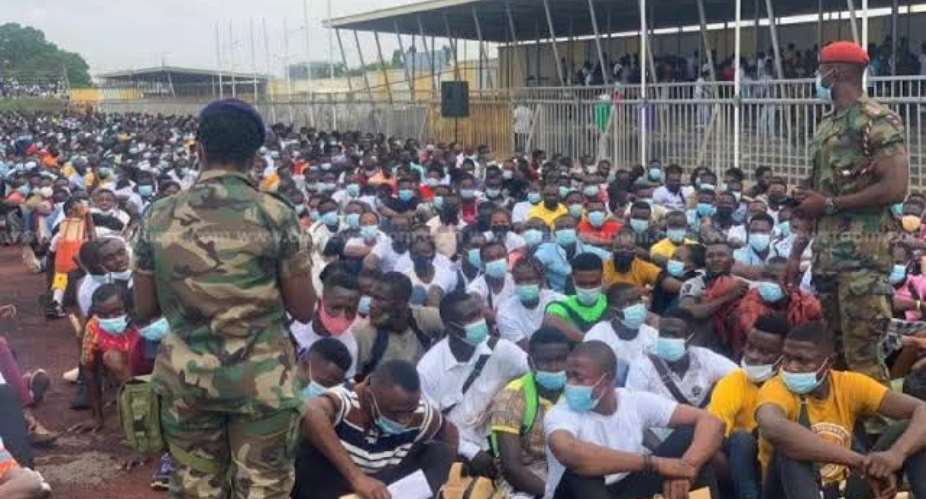
A recent Security services recruitment attracted about 506,618 young people who applied for positions across the country’s security services. Among them were 75,000 university graduates and 330,000 Senior High School certificate holders. This huge number was vying for only about 5,000 openings. This shows that hundreds of thousands of disciplined, motivated young people are eager to serve and could be absorbed into this solution; therefore, Policymakers should use this large youth population productively through targeted employment in the security services and related work.
Ghana is facing the destruction of its forestlands by illegal miners, popularly known as Galamseyers, and illegal loggers. In my view, the government can recruit these young people into the security services of their choice, let them complete their respective training, and then issue them uniforms, provide benefits, privileges, and salaries, provide machines and other inputs, set up camps in areas where illegal miners and loggers operate, and let them engage in farming to feed the country and help stop the importation of foodstuffs. This would address youth unemployment while also tackling illegal mining, illegal logging, and food supply needs.
The government of Ghana must hire these young people as security service personnel, keep some in the regular barracks, and send the remaining ones to camps structured like the defunct Workers Brigade Farms set up under Dr. Kwame Nkrumah’s government. This will serve as a direct state response to youth unemployment and rapid urbanization, providing thousands of young men and women with steady employment, accommodation, and a baseline income.
This approach will also boost agricultural production. Hiring able-bodied youth as security service personnel, stationing them where our forest reserves are under threat from galamsayers and illegal loggers, and having them engage in farming activities will make agriculture more productive and reduce unemployment pressure.
Additionally, these institutions served as an educational framework that trained technically unskilled, uneducated, and displaced individuals in civic responsibility, trades, engineering, and modern farming methods. It also allowed some youth to learn to operate heavy machinery and specialized tools, creating a pipeline of skilled labor that supports the employment solution and Ghana's industrialization goals.
Again, this system of hiring youth as security service personnel and assigning them other responsibilities would enhance infrastructure and Community Development. When the security personnel are organized into disciplined labor units, they could be deployed to address the country's severe urban housing shortages. They can help construct public buildings, build local roads, clear land for settlement, and engineer infrastructure crucial to rural community service, while also reducing youth unemployment.
Local smallholder farmers could often visit these camps or barracks, especially those engaged in them, to learn and replicate advanced agricultural practices in their own villages. This is possible because these farming camps use modern, mechanized farming methods, which would spread better practices to local communities.
I will end my submission by suggesting that policymakers and security commanders, once these youths are absorbed into the system, must ensure those working outside the traditional military structure prioritize career progression, fair pay, and modern workplace conditions. Security officers across the country want to feel their work is meaningful and that their personal development is encouraged. In this vein, they must be paid competitively with other industries to reduce turnover, and their daily activities must be linked to the broader picture of public safety. They must be permitted to engage in peacekeeping operations to improve morale and their financial situation. These measures can also help address youth unemployment in Ghana.
Kwame Aduhene-Kwarteng PhD, MA


 Three Injured in Stampede at NPP Delegates Conference in Kumasi
 Elect Leaders Who Can Restore Public Confidence and Unite the Party - Kufuor
 Allegations Won’t Deter Me - Baffour Awuah Challenges EOCO to Prove Wrongdoing ...
 Bawumia Urges NPP Aspirants to Accept Election Results and Unite After Delegates...
 Akufo‑Addo Urges NPP Delegates to Unite Behind New Leaders and Rebuild Party for...
 Ghana Bloggers Association Condemns Alleged Assaults on Media Workers at La Plea...
 GH¢10m Bail Keeps Baffour Awuah Out of Custody as EOCO Probe Continues
 Bawumia Accuses NDC Government of Running Down Free SHS, Says Policy Is ‘Sufferi...
 MoH Announces Nationwide Mop-Up Recruitment to Fill Abandoned Postings on Octobe...
 Sammy Crabbe Says Alliance with John Boadu Is Not a Withdrawal from NPP Chairman...


