




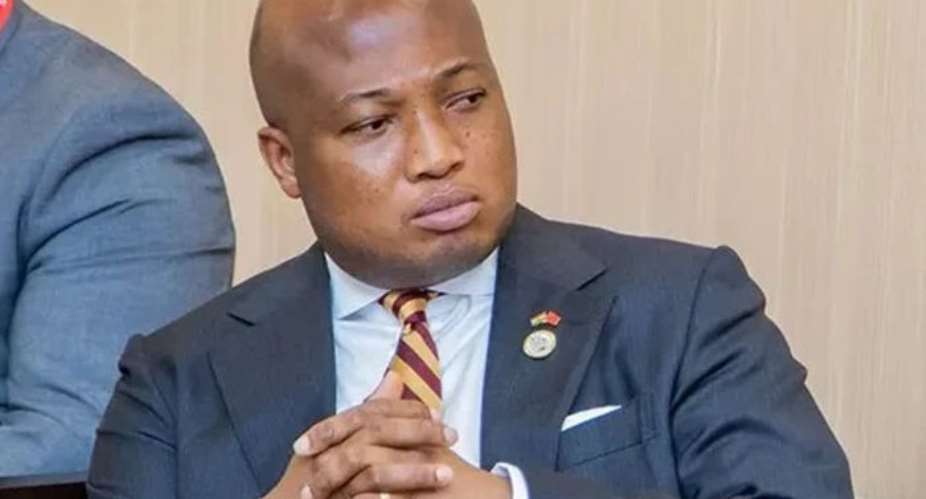
Ghana has rejected calls for the abolition of the International Criminal Court (ICC), with Foreign Affairs Minister Samuel Okudzeto Ablakwa arguing that the institution should instead be strengthened to hold perpetrators of racism, genocide and crimes against humanity accountable.
Mr Ablakwa said Ghana remained committed to the principles of the Durban Declaration and Programme of Action and believed that serious violations of those principles should attract consequences.
"Ghana takes the firm view that there must be severe consequences for those who flagrantly violate the Durban Declaration and commit crimes against humanity.”
“We, therefore, are strongly opposed to attempts to abolish the International Criminal Court. The ICC should rather be strengthened to serve as our collective bulwark. The ICC needs our protection not our condemnation," Mr Ablakwa said.
He made the remarks at a High-Level Plenary Meeting at the United Nations in New York on Monday to mark the 25th anniversary of the Durban Declaration and Programme of Action.
Mr Ablakwa said Ghana would continue to support the Declaration’s objectives, including the pursuit of reparatory justice.
He said the ultimate goal should be the creation of a world in which all people were treated equally.
Ghana calls for action on Durban commitments
The Foreign Affairs Minister commended the United Nations for organising the commemorative event and recalled the adoption, 25 years ago, of a global framework aimed at confronting racism, racial discrimination, xenophobia and related intolerance.
According to him, the Durban Declaration represented a collective commitment to confronting historical injustices and dismantling systems that perpetuate inequality.
"The Durban Declaration affirmed our shared responsibility to address historical injustices and dismantle the structures that perpetuate inequality. This solemn day must bring us to a reckoning that what our world needs is decisive action not more political declarations," he said.
Mr Ablakwa questioned why the world was still grappling with racial inequality decades after the Declaration was adopted.
"It should be of great consternation to us all that 25 years after the Durban Declaration, we still need to remind some people that all men and women are created equal; 25 years after Durban but we still have to proclaim that Black Lives Matter," the minister said.
Concerns over global conflicts
Mr Ablakwa also pointed to conflicts and humanitarian crises around the world as evidence, in his view, of the gap between international commitments and their implementation.
"25 years after Durban, we seem to watch on helplessly as a genocide unfolds in Palestine with the two-state solution adopted by this Assembly becoming elusive each passing day.
25 years after Durban, but we cannot save the people of Sudan. 25 years after Durban, but xenophobic attacks have become a recurring feature in South Africa”.
He further criticised what he described as the failure of the international system to fully reflect Africa’s place in global decision-making.
According to him, the principles of the Durban Declaration would remain incomplete if Africa, with a population of about 1.4 billion people, continued to lack a permanent seat on the UN Security Council.
"The Durban Commitments must become reality, not a mere slogan. President John Mahama spoke a timeless truth when he stated in this hallowed chamber a few days ago, that: 'No race is superior and no nation is inferior'," he said.
Ghana renews call for reparatory justice
On reparatory justice, Mr Ablakwa said the continuing relevance of the Durban Declaration was rooted in its recognition that historical injustices had contributed to inequalities that persist today.
"Reparatory justice is, therefore, essential to restoring dignity, addressing inequalities and building long-lasting trust," he said.
He referred to paragraph 13 of the Durban Declaration, which recognised slavery as a crime against humanity.
"This year, we removed the 'should have been' by resoundingly correcting that historical injustice with the emphatic adoption of the Ghana-led landmark resolution declaring the trafficking of enslaved Africans as the gravest crime against humanity," the minister said.
Mr Ablakwa said Ghana’s pursuit of reparatory justice was not limited to recognition of historical wrongdoing but also involved concrete steps to address its continuing consequences.
“Now, we ask for what justice has always required.
An apology that is sincere; return of what was looted; repair for the harm that still lives on; and a promise, a real promise, that it will never happen again,” the minister said.

 Chief Justice Baffoe-Bonnie is Mahama's surrogate to control the judiciary — Mar...
 Court gives OSP four more weeks to serve Ofori-Atta, Akore in US
 Dangote's $16bn Kenya refinery 'new chapter' for Africa
 Mahama to open national conference on housing finance
 NPP announces voter ID requirements for October 3 national conference
 Ghana rejects calls to abolish International Criminal Court , urges stronger act...
 September 30: Cedi sells at GHS12.20 on forex market, GHS11.70 on BoG interbank
 'Ghana is now training lawyers illegally' — Former Bar president
 Akyem Hemang residents demand justice for alleged military shooting of 29-year-o...
 Adenta-Accra morning travel time improves significantly in just 23 minutes under...


