




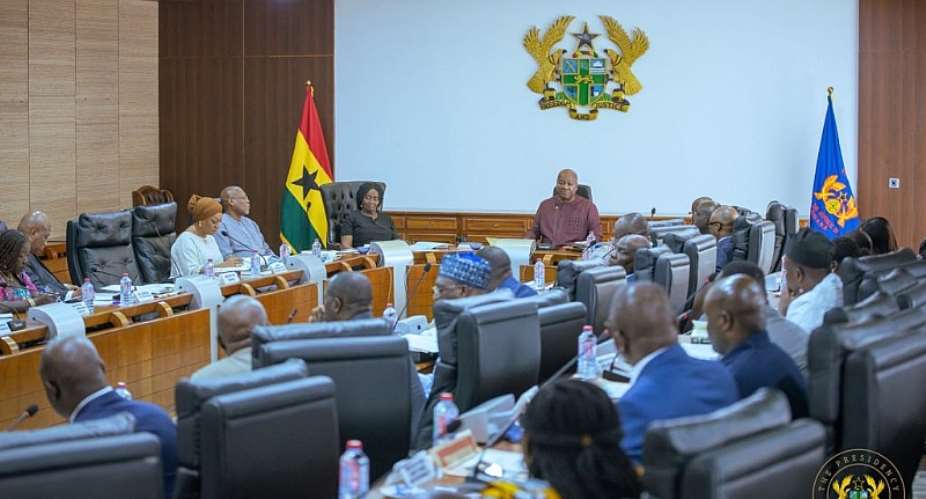
The recent debate over the introduction of Chinese Language (Mandarin) into Ghana’s education system has taken an interesting turn. President John Dramani Mahama has recently clarified that Cabinet has not approved any policy introducing Chinese or Arabic as compulsory subjects in public schools. Speaking during a citizens’ engagement in Ghana's Upper West Region, the President stressed that he chairs Cabinet and that no such curriculum had been presented for Cabinet approval. He also raised a practical concern: Ghana is already struggling to provide enough teachers for French, so where would the country find sufficient teachers to teach Chinese? This follows the Minister responsible for education's public declaration of the government's plan to introduce foreign languages, including Mandarin, in the Senior High School curriculum, alongside the National Council for Curriculum and Assessment (NaCCA) 's official launch of the Mandarin curriculum.1,2,4
That president’s remark settles an important procedural question: there is presently no Cabinet-approved nationwide policy to make Mandarin compulsory or government-institutionalized policy in Ghana's public schools. But it does not settle the more important policy question: Should Ghana seriously consider institutionalizing Chinese language as part of its foreign-language education strategy?
The evidence suggests that this question deserves a much more deliberate conversation.
Mandarin is increasingly an economic skill
Language policy should not be divorced from the economic realities confronting Ghanaian young people. China is Ghana's largest trading partner, and the two countries continue to deepen economic cooperation in areas including education, manufacturing, investment, technology and job creation. At the August 2026 Ghana-China Joint Commission on Economic, Trade and Technical Cooperation, Ghana's Finance Minister, Dr. Cassiel Ato Forson, explicitly called for deeper Chinese investment in local processing, manufacturing, technology transfer and employment.6
This economic relationship creates an obvious question for Ghana's education system: what skills should Ghanaian students acquire to participate more effectively in an increasingly interconnected Ghana-China economic relationship?
Mandarin is one such skill!
Knowing Mandarin does not automatically guarantee employment. Nor should language learning be presented as a substitute for technical or professional competence. But language has a utility that functions as an additional labor-market asset, particularly where workers interact with foreign companies, investors, institutions and clients. This is precisely where our current research project on the “Perceptions of Chinese Culture in Ghana”, with a recent publication, becomes relevant.3
In our ex-ante analysis of including foreign languages in Ghana's educational curriculum, key stakeholders identified employment prospects as one of the principal potential benefits of Mandarin education. The study found strong support for including foreign-language education, particularly Mandarin, and identified employment, student mobility, and exchange opportunities as anticipated benefits for Ghanaian students. In fact, preliminary evidence suggests that students with Mandarin proficiency in Ghana have better employment prospects in their first year after graduation than the national employment ratio (see Figure 1). The argument, therefore, is not that every Ghanaian student must become fluent in Mandarin. The argument is that Ghana's education system should give young people the opportunity to acquire a language that is increasingly relevant to one of Ghana's most important international economic relationships.
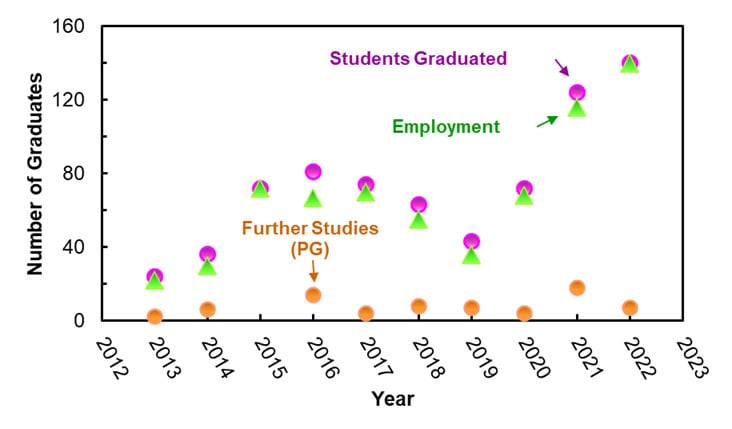
Figure 1. Students graduating from the University of Ghana Confucius Institute and their employment status within the first year of graduation (2013–2022).5
Mandarin can widen the geography of educational opportunity
The second consideration is student mobility.
For many Ghanaian students, international education is not simply about earning a foreign qualification. It is increasingly about accessing research networks, scholarships, professional training, economic empowerment, cultural exchange, and new academic environments.
An institutional pathway already exists between Ghana and China.
Traditional public universities in Ghana, including the University of Cape Coast, University of Ghana, and Kwame Nkrumah University of Science and Technology, have all developed Chinese-language and international academic partnerships. Their Confucius Institutes established in collaboration with Chinese universities have supported Chinese-language students through overseas study opportunities, while they continue to deepen collaboration.
These developments matter because student mobility is partly an infrastructure question.
If Ghana wants more young people to take part in international education opportunities involving China, language preparation should not begin only after a student has secured admission or a scholarship. Introducing Mandarin opportunities earlier in the education pipeline could allow interested students to develop language competence progressively. Our study identified precisely this potential. Mandarin was associated by stakeholders with greater student mobility and participation in exchange programs.
The question is not Chinese versus Ghanaian languages
One concern raised in the public debate is whether foreign-language education could come at the expense of Ghanaian languages. That concern deserves to be taken seriously.
Mandarin should not be conceptualized as a replacement for Ghanaian languages, English, or French. Ghana's multilingual education policy has to accommodate several legitimate objectives: strengthening foundational literacy, preserving Ghanaian languages, maintaining English proficiency, developing regional communication through French, and creating opportunities for engagement with emerging global economic partners, especially China.
The policy challenge is therefore one of addition and balance, not substitution.
A Ghanaian student should not have to choose between acquiring competence in a Ghanaian language and acquiring an additional international language. A well-designed education system should create pathways for both.
But the President has identified a genuine implementation problem
There is, however, one part of the President's argument that should not simply be brushed aside: teacher supply. Our research independently identified the shortage of qualified Mandarin teachers as one of the principal anticipated implementation challenges.
This is important.
The case for Mandarin cannot rest solely on its potential economic and educational benefits. A credible policy must answer practical questions: Who will teach it? Where will teachers be trained? What proficiency level should students attain? Which schools should participate initially? What curriculum and assessment framework should be used? How will Ghanaian cultural perspectives be incorporated into the teaching of Chinese language and culture?
These are not reasons to close the discussion. They are reasons to design the policy properly.
Indeed, Ghana already has institutional experience on which such a system could build. The public universities with the presence of Confucius Institutes can maintain stronger collaborations and partnerships to mitigate these challenges. The University of Ghana has also encouraged Chinese companies operating in Ghana to create internship opportunities for its students, linking Chinese-language learning with workplace exposure.
A phased approach may offer a practical middle ground
The debate does not have to be reduced to two extremes: immediately making Mandarin compulsory nationwide or abandoning the idea altogether. A more evidence-based approach would be to develop Mandarin through structured, voluntary and phased implementation.
Selected schools could offer Mandarin as an optional foreign language. Teacher-training capacity could be expanded simultaneously through what we called the Mandarin Bias Institutes. Colleges of Education could work with the Ghana Education Service and other relevant institutions to develop teacher-training pipelines. Partnerships with Chinese universities and enterprises could support scholarships, teaching resources, internships and exchange programs. The outcomes could then be systematically evaluated. Such a framework would allow policymakers to assess student uptake, learning outcomes, teacher availability, costs, progression to tertiary education, scholarship participation and employment-related outcomes before considering broader expansion. This would also respond directly to the implementation concern raised by the President.
The bigger question for Ghana
The current controversy risks making Mandarin appear to be merely another subject competing for space in an already crowded curriculum. That is too narrow a way to view the issue.
The more fundamental question is whether Ghana's education system is preparing young people for the international economic and educational environment in which they will compete.
Our research suggests that stakeholders see Mandarin as having potential value precisely because it connects education with employment, international mobility and exchange opportunities.3 The President's recent clarification that Cabinet has not approved a nationwide Mandarin policy is therefore best understood as a statement about the current status of government policy, not necessarily the end of the policy conversation.
Ghana can acknowledge the practical constraints while still examining the evidence.
Conclusion
The choice before policymakers is not simply whether to introduce Chinese into schools tomorrow. It is whether Ghana should build the institutional capacity that would allow its young people to acquire Mandarin where there is demonstrated demand and opportunity.
That is a question worth answering on the basis of evidence rather than headlines.
If Mandarin can expand access to scholarships, strengthen student mobility, improve intercultural competence and provide an additional skill for engagement with Chinese-linked economic activity, then the language deserves a place in Ghana's broader conversation about the future of education and employment.
The objective should not be to make every Ghanaian a Mandarin speaker. It should be to ensure that a Ghanaian young person who sees an opportunity in China-related education, trade, investment, technology, or employment is not excluded from that opportunity simply because the education system never gave them the chance to learn the language.
That is ultimately the policy question that deserves Ghana's attention.
Written by:
Dr. Gabriel Asante, Dr. Benedict Arthur and Prof. Sun Yuan
Research Fellows, Sino-Ghana Research Center for West Africa
Hubei University of Automotive Technology, Shiyan City, China
References
- Ababio, A. (2025, December 17). Chinese Language Curriculum Introduced into Ghana’s Basic and Secondary Schools as Confucius Institute at UCC Marks 10 Years. Ghanaian Watch. https://www.ghanaianwatch.com/2025/12/17/chinese-language-curriculum-introduced-into-ghanas-basic-and-secondary-schools-as-confucius-institute-at-ucc-marks-10-years/
- Aniagyei, R. (2026, September 13). President Mahama Debunks Arabic and Chinese Curriculum Rumours. Information Services Department. https://www.isd.gov.gh/president-mahama-debunks-arabic-and-chinese-curriculum-rumours/
- Asante, G., Gbologah, L., Yang, R., Hou, Y., & Marfo, C. O. (2026). Foreign language education in Ghana: Ex-ante analysis of the integration of Mandarin in senior high school curriculum. Current Issues in Language Planning, 1–25. https://doi.org/10.1080/14664208.2026.2713661
- Asiedu-Addo, S., & Kumi, J. (2025, December 19). NaCCA launches Chinese language curriculum. Graphic Online. https://www.graphic.com.gh/news/general-news/ghana-news-nacca-launches-chinese-language-curriculum.html
- Bodomo, A., Mboya, C., & Nkrumah, B. (2024). Confucius institutes and the promotion of Chinese language and culture: A case study. In J. Adeli, & L. Ammann (Eds.), New silk road narratives: Local perspectives on Chinese presence along the belt and road initiative (pp. 179–192). Heidelberg Asian Studies Publishing.
- Forson, C. A. (2026, August 24). Finance Minister Opens Fifth Session of Ghana–China Joint Commission. Ministry of Finance. https://www.mofep.gov.gh/news-and-events/2026-08-24/finance-minister-opens-fifth-session-of-ghana%E2%80%93china-joint-commission?utm_source=chatgpt.com


 'Suing me won’t gag me, what did you do for NDC to continue to keep you in offic...
 'Ghana is now training lawyers illegally' — Former Bar president
 Akyem Hemang residents demand justice for alleged military shooting of 29-year-o...
 Adenta-Accra morning travel time improves significantly in just 23 minutes under...
 US 'steals' Bawumia’s idea, launches America.gov for public services five years ...
 “Disband Black Stars, sack FA and let FIFA ban us for two years” – Sam George af...
 South Africa summons US ambassador for 'record' third time
 Dangote to launch $16bn refinery in Kenya
 Ghana, Luxembourg to explore visa waiver agreement
 Tullow loses $393m tax arbitration case against Ghana – Finance Minister


