




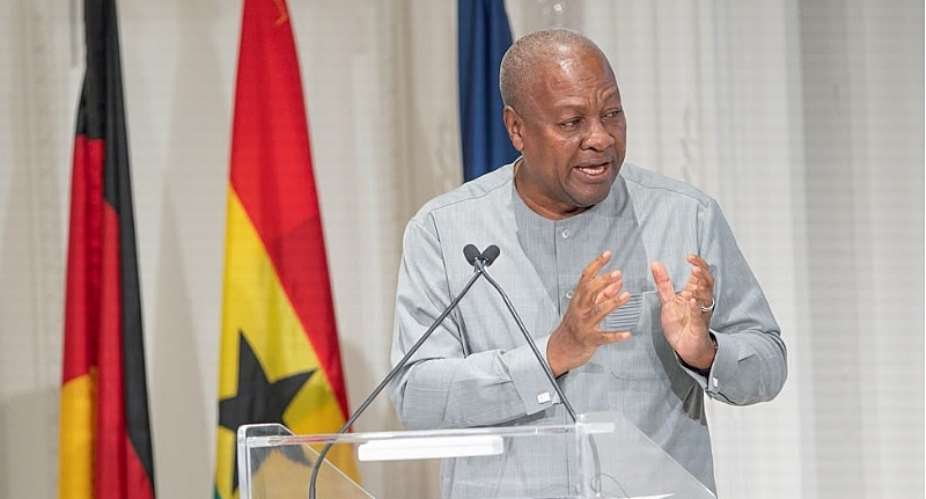
Across Africa, we continue to hear prominent leaders calling for reform of the United Nations. Ghanaian President John Dramani Mahama and many others argue that Africa deserves permanent representation on the Security Council and should have a greater say in global affairs.
On the surface, this appears to be a reasonable demand.
Africa is home to more than a billion people. It comprises fifty-four states. It possesses vast natural resources and immense human potential. Yet when the most important decisions are made within the United Nations Security Council, Africa has no permanent seat and no veto power.
Many see this as an injustice.
I do too.
But where I differ is in the solution.
I believe calls for reforming the United Nations are largely a waste of time, because they begin with a false assumption. They assume the United Nations was designed to represent Africa fairly. It was not.
To understand why Africa continues to find itself marginalised, we must first understand how the UN was created and whom it was created to serve.
The United Nations emerged from the ashes of the Second World War. It was established not by the peoples of the world acting collectively, but by the victorious powers of the war acting in their own interests.
The United States, Britain, France, the Soviet Union and China sat down to shape the post-war order. They designed institutions that would preserve stability, but they also designed institutions that would preserve their influence.
The Security Council was never intended to be a democratic body. If it were, it would not have permanent members. If it were democratic, one country would not be able to veto the wishes of the majority. If it were democratic, a continent of more than one billion people would not be permanently excluded from its highest chamber of power.
The reality is that the structure reflects the world of 1945 rather than the world of today.
When the UN was founded, most African countries were still colonies. Africans fought and died during the Second World War, but Africans had no meaningful role in designing the international system that emerged afterwards.
The world was being reorganised without Africa.
That historical reality remains embedded within the institution to this day.
Many African leaders continue to argue that Africa deserves a permanent seat on the Security Council. But I ask a different question.
Why would the existing powers voluntarily surrender their advantages?
History teaches us that power is rarely given away. It is defended.
The countries that possess veto power today are not holding it temporarily. They are holding it because the entire system was constructed around the idea that they would remain central to global decision-making.
That is not an accident.
It is the foundation of the institution itself.
This is why every major discussion about Security Council reform eventually ends in speeches rather than action.
The people who have the power to approve reform are the same people who benefit from the existing arrangement.
They have little incentive to weaken themselves.
The Libya crisis of 2011 exposed this reality in a particularly painful way.
Regardless of one's opinion of Muammar Gaddafi, the episode revealed just how limited Africa's influence could be even on matters affecting Africa directly.
The African Union sought diplomatic engagement and political mediation. The AU attempted to advance an African solution to an African problem.
Yet events ultimately unfolded according to the preferences of powerful external actors.
The result was the collapse of the Libyan state, the spread of weapons across the Sahel, growing insecurity and years of instability whose effects are still being felt.
Whether one supported or opposed the intervention is not the essential question.
The essential question is this:
What was the value of Africa's position if Africa's position could simply be ignored?
That question should trouble every African.
Because it highlights a deeper problem that exists beyond Libya.
Africa has spent decades seeking recognition from institutions over which it exercises very little control.
Rather than asking how we can become more influential within structures designed by others, perhaps we should be asking how we can strengthen the structures that belong to us.
This is where the vision of Kwame Nkrumah becomes relevant.
Nkrumah understood something that many leaders still fail to grasp. He understood that Africa's greatest weakness was not merely external domination.
It was fragmentation.
A divided Africa could be influenced.
A divided Africa could be manipulated.
A divided Africa could be economically exploited.
A divided Africa could be politically marginalised.
But a united Africa would be far more difficult to ignore.
Nkrumah's warning was simple.
Divided, we are weak.
United, we become a force.
Unfortunately, many African leaders rejected his call for deeper political integration. They preferred national sovereignty to continental unity. They feared losing authority within their own states. The result has been decades of cooperation without true integration.
Today the consequences are obvious.
Africa negotiates with the world as dozens of separate voices rather than one powerful collective voice.
Meanwhile, the African Union remains underutilised.
Too often African governments treat the AU as a ceremonial institution rather than a strategic one. Speeches about African unity remain plentiful, but implementation remains weak.
Yet if Africa is serious about changing its position in the world, this is where attention must be focused.
Strengthening the AU.
Expanding economic integration.
Deepening intra-African trade.
Developing continental infrastructure.
Building independent financial institutions.
Coordinating security policies.
Creating greater political cohesion.
These initiatives will do more to increase Africa's influence than decades of appeals for UN reform.
Because power does not come from being invited into somebody else's house.
Power comes from building your own.
Too often African political thinking remains trapped within a framework that seeks validation from outside. We continue to assume that legitimacy comes from gaining entry into institutions designed elsewhere.
But real sovereignty is not achieved by obtaining a slightly larger chair in another person's boardroom.
Real sovereignty comes from possessing the ability to shape outcomes independently.
The great powers of the world are respected not because they ask for respect.
They are respected because they possess economic strength, political influence and strategic leverage.
Africa must pursue the same path.
The future of the continent will not be determined by whether the United Nations chooses to become more generous.
It will be determined by whether Africans choose to become more united.
The challenge before us is not convincing others to give us power.
The challenge before us is organising ourselves to generate power.
And that is a very different conversation.
Closing
So let me end with this.
For generations, Africa has knocked on doors built by others.
We have requested seats at tables built by others.
We have appealed to institutions created by others.
And after decades of waiting, we are still asking for permission to be heard.
Perhaps it is time to stop asking.
Perhaps it is time to remember what Nkrumah understood all along.
No people become great by depending upon the goodwill of others.
No continent becomes powerful by waiting for invitations.
No civilisation advances by begging for inclusion.
Africa already has a table.
It is called the African Union.
The tragedy is not that Africa lacks a seat at the United Nations.
The tragedy is that Africa possesses its own table and still does not fully believe in its power.
The day Africa chooses unity over division, strategy over dependence, and confidence over approval-seeking, the world will not need to be persuaded to listen.
It will have no choice.
And when that day comes, Africa will no longer be asking for a place in the world.
Africa will be helping to shape the world itself.
Kwame Osei

 John Boadu comes nowhere near Asiedu Nketiah in terms of pedigree, gravitas, val...
 ‘If promotion arrears aren’t paid by October 30, I will have no honour’ – Haruna...
 GACL enhances screening at Accra International Airport
 Mahama to decide on permanent Ayalolo contra-flow system after Thursday review –...
 NPP elections: Kwadwo Bamba’s first vice chair victory was a big surprise – Prof...
 NPP Delta Force Commander Kojo Bamba elected First Vice Chairman
 GRA probes alleged GH¢600 extortion involving Customs officer at Accra Internati...
 “NPP has men, let us take machoism out' — Former Speaker Prof Oquaye on vigilant...
 Gov’t renames 24-hour economy markets as District Economy Markets, targets 100% ...
 BoG, Police arrest 7 in Accra over alleged use of cedi notes for money bouquets,...


