




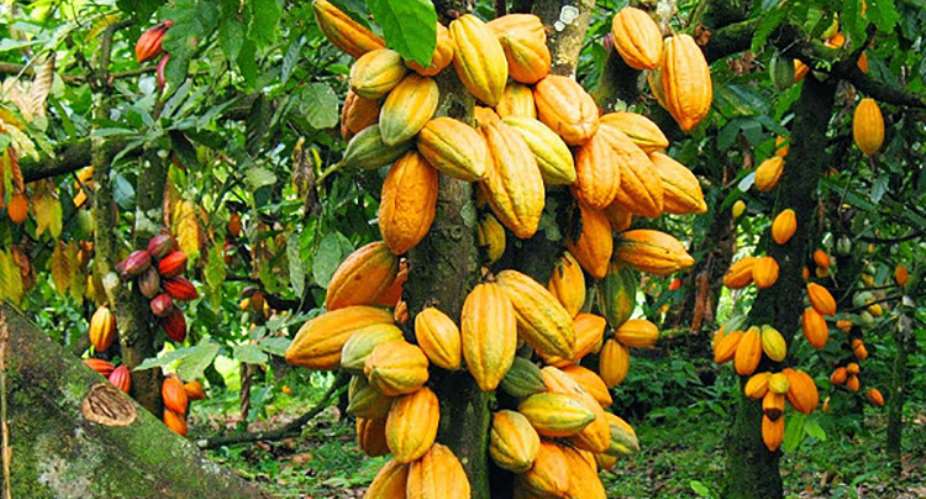
Cocoa production may be facing terrible times. At a time that reports suggest that Cote d’Ivoire is facing concerns over cocoa quality and future supply, due to below-average rainfall that hit several key growing regions, a new study has also come to give a contrary view that, heavy rainfall is the dominant climatic constraint on yields across major producing regions around the globe.
A Reuters report said, though Cote d’Ivoire is in its rainy season, which normally runs from April to mid-November, farmers in several cocoa-producing regions say recent rains have not been enough to support the crop.
Published in the PNAS Environmental Sciences journal this month, the authors of the study, “Rainfall extremes drive cocoa yield losses across the tropics”, said using newly available district-level production records from Ghana combined with daily rainfall and temperature data, they found that, “excess wet-season rainfall and dry-season drought together explain 68% of interannual yield variability.”
The International Cocoa Organization (ICCO) has confirmed this by saying, “variations in the yield of cocoa trees from year to year are affected more by rainfall than by any other climatic factor.”
“Trees are very sensitive to a soil water deficiency. Rainfall should be plentiful and well distributed through the year. An annual rainfall level of between 1,500mm and 2,000mm is generally preferred. Dry spells, where rainfall is less than 100mm per month, should not exceed three months,” the ICCO said.
The authors of the PNAS study said, “national yield data from Ecuador and Indonesia also give a consistent negative response to heavy rainfall, indicating a common mechanism across the tropics, likely linked to damage and disease risks, associated with intense precipitation during key phenological stages.”
They identified heavy rainfall during phenological stages as a recurrent source of yield loss and said their “work shifts attention from average climate trends to extreme events relevant for management and adaptation.”
To identify the dominant meteorological drivers of interannual cocoa yield variability in Ghana, they established the relevant phenological context. For Ghana, the authors defined the production year, as the cocoa season beginning in March of the calendar year and ending in February of the following year.
They said cocoa flowering and the initiation of new pods (cherelles) peak during the major rainy season, when rainfall exerts strong control on floral bud and cherelle production. This period also coincides with the main period of pollinator activity. Pods initiated during the first rainy season contribute to the main cocoa harvest, which typically spans October–March and accounts for 70 to 80% of annual production, with recent seasons frequently extending through May. Accordingly, climate windows were mapped to the production year in which the associated pods are harvested.
The authors said they applied a suite of complementary statistical learning approaches to identify dominant predictors, including least absolute shrinkage, selection operator in machine learning (LASSO), elastic net regression, and a random forest model.
Candidate climate predictors were derived from daily rainfall and daily temperature . They included mean and 95th-percentile daily rainfall from the University of Reading’s Tropical application of Meteorology using SATellite, (TAMSAT) Pan-African dataset, and indicators of cool and heat stress defined by daily minimum temperatures below 18 ◦C and daily maximum temperatures above 32 ◦C, following physiological thresholds for cocoa. To retain seasonal structure while limiting predictor dimensionality, climate variables were aggregated into two-month windows aligned to the cocoa crop year(March February, with January–February assigned to the preceding year.
Across all the modelling approaches, a consistent subset of predictors emerged as dominant. Both least lasso and elastic net, identified the 95th percentile of daily rainfall during the April–June primary wet season and mean rainfall during the November–February dry season as the most influential predictors of interannual production variability.
These variables were also ranked highly by the random forest model, despite its ability to represent nonlinear interactions, indicating that the identified relationships are robust across linear and nonlinear formulations. Consistent with the cocoa phenological cycle, these two predictors were interpreted as acting on distinct developmental stages: The April–June wet-season rainfall.
The authors found that, heavy rainfall emerged as the strongest predictor of cocoa yield losses, stating that, “during the wet season, extreme rainfall provides substantially greater explanatory power than mean or median rainfall, as well as soil moisture metrics which could be interpreted as closer proxies for persistent humidity or waterlogged conditions.”
They outlined some mechanisms that link heavy rainfall to reduced cocoa yields, and these include, cocoa flowers during the rainy season, overlapping with peak pollinator activity, as well as heavy rainfall during the main wet season which directly affects the flowers and young pods that determine the subsequent harvest.
In addition, they said exposed reproductive structures are vulnerable to mechanical damage, and intense rain and wind can induce flower and cherelle abortion (shedding of young, immature pods) before they reach maturity in addition to excessive rainfall could interfere with cocoa pollination.
They also said extreme rainfall promotes fungal disease and noted that field observations indicate a lag of approximately one week between rainfall events and the onset of black pod rot, adding that, “in West Africa, primary infections of black pod disease (Phytophthora) typically begin near the end of the first rainy peak and can persist for months.”
The study said extreme precipitation may represent an underappreciated risk for perennial tree crops under increasingly variable hydroclimate conditions, stating that, “rainfall extremes covary with El Niño and other sea surface temperature patterns, and there is a robust physical expectation of increases in rainfall extremes with warming, these results provide a physical basis for risk forecasts.”
The authors cited proposed causes for the recent production shortfalls in West Africa to include aging trees, gold mining, smuggling, reduced fertilizer access, and low pollination, but said, “the extent to which non climatic versus climatic factors drive cocoa yields, however,
remains uncertain.”
The authors used two decades of newly available district-level data from the Ghana Cocoa Board, paired with daily rainfall and temperature observations and identified the weather signals driving production fluctuations.
“We find that rainfall extremes explain the majority of interannual production variability. Short-duration rainfall extremes during vulnerable phenological stages are the dominant driver of yield losses in this tropical perennial tree crop,” the study said.
Their finding contrasts with crop–climate studies that emphasize temperature extremes or seasonal-mean water availability. “Applying the same framework to Indonesia and Ecuador indicates a consistent association between rainfall extremes and yield variability,” they added.


 'Suing me won’t gag me, what did you do for NDC to continue to keep you in offic...
 'Ghana is now training lawyers illegally' — Former Bar president
 Akyem Hemang residents demand justice for alleged military shooting of 29-year-o...
 Adenta-Accra morning travel time improves significantly in just 23 minutes under...
 US 'steals' Bawumia’s idea, launches America.gov for public services five years ...
 “Disband Black Stars, sack FA and let FIFA ban us for two years” – Sam George af...
 South Africa summons US ambassador for 'record' third time
 Dangote to launch $16bn refinery in Kenya
 Ghana, Luxembourg to explore visa waiver agreement
 Tullow loses $393m tax arbitration case against Ghana – Finance Minister


