




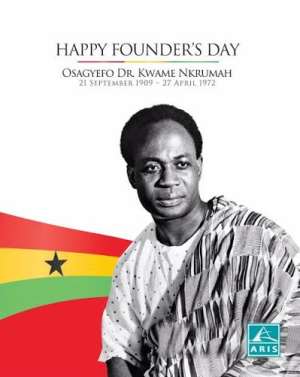
There is a particular kind of Ghanaian irony that arrives, unbidden, on a national holiday: the streets are quiet, the flags are out, somewhere a minister is quoting Nkrumah at a lectern, and somewhere else, entirely unremarked by the ceremony, a two-year-old girl has died in a house fire because a wire frayed or a stove was left burning. Both things happened this week. Both are true. And the distance between them — between the commemorative and the calamitous — is, I think, the real subject of Founder's Day in the year 2026.
Let me start with the date itself, because even that has been contested territory. For four years, under President Akufo-Addo, Ghana observed "Founders' Day" on August 4th, honoring the "Big Six" collectively and, not incidentally, diluting the singular claim of Kwame Nkrumah to the title of founder. President Mahama, on returning to office, reversed this: Parliament's Public Holidays and Commemorative Days (Amendment) Bill of 2025 struck August 4th from the calendar and restored September 21st — Nkrumah's birthday — as the nation's Founder's Day. So it is that today, Ghanaians mark the occasion under the man's own name again, with the President's office issuing a statement invoking Nkrumah's declaration that the African is capable of managing his own affairs, and calling on citizens to complete the unfinished business of nation-building. It is a fine sentiment. It is also, this year, an almost unbearably ironic one, because the unfinished business on display is not the romantic kind — continental unity, industrial self-reliance — but the mundane, damning kind: a fire service that cannot keep pace with faulty wiring, and a flagship national monument that has become a byword for the very culture of grand gesture over institutional follow-through that Nkrumah, whatever his faults, at least tried to avoid.
The Cathedral and the Confession
Consider the National Cathedral. On September 18th, President Mahama's government dissolved the project's Board of Trustees — chaired by Apostle Professor Opoku Onyinah — and ordered the handover of the stalled Accra site to the Ministry of Local Government by October 31st. This followed a 2024 finding by Ghana's Commission on Human Rights and Administrative Justice that a $312 million construction contract with Ribade Company Limited had violated the Public Procurement Act, and a forensic audit of nearly $90 million already spent, now sitting with the Attorney-General. The site itself required demolishing judges' residences and diplomatic housing to clear it. Nearly a decade after it was conceived as a monument to national gratitude, what stands there is rubble, a bill, and a Supreme Court's worth of unanswered procurement questions.
I do not raise this to relitigate the theology of state-sponsored cathedrals, on which reasonable Ghanaians disagree. I raise it because the Cathedral has become our national Rorschach test: a mirror in which every citizen sees confirmation of what they already believed about the previous administration, and in which almost nobody sees an actual reckoning. Dissolving a board is not accountability; it is the bureaucratic equivalent of clearing your throat before saying something you don't intend to say. The forensic audit has apparently been "completed" and handed to the Attorney-General — a phrase that, in Ghanaian public life, has historically meant something between "filed" and "buried," with the distinction to be determined by whichever way the political wind is blowing when someone next asks about it. If Founder's Day is meant to honor the discipline of institution-building, then the honest thing to do is admit that this project is a case study in its opposite, and that admitting so costs the current government nothing, since it inherited rather than created the mess.
A House Near Susanna Lodge
The second story is smaller, and for that reason more painful. On Sunday, a domestic fire broke out at a residence in Cantonments, near Susanna Lodge — an affluent, diplomatically dense quarter of Accra, not the kind of neighborhood where Ghanaians expect fire-safety failures. A two-year-old girl was trapped inside and could not be gotten out in time. The Ghana National Fire Service has not yet established a cause. What the Service has established, in its own data, is more troubling in aggregate: domestic fires rose from 770 cases in the first quarter of 2025 to 881 in the same period this year, now the leading category of fire outbreak nationally, with Greater Accra recording the highest regional total. Electrical faults, negligence, and appliance misuse are cited as the chief culprits.
I mention the location deliberately. Cantonments is not Old Fadama. It is not a market where extension cords run overhead like jungle vines. If domestic fire deaths are rising even in the capital's wealthiest enclaves, the explanation is not simply poverty — it is a wiring code and an inspection regime that nobody enforces, in a country building faster than it certifies. A child's death is not a metaphor, and I resist making it one. But a nation that spends a decade and ninety million dollars on an unbuilt cathedral, while its electrical inspection infrastructure remains an honor system, has misjudged where the sacred actually resides.
Ethiopia's New Arithmetic of Rebellion
Beyond our borders, the continent offered its own commentary on the fragility of the state as an idea. On Sunday, seven Ethiopian armed factions — the Amhara Fano National Movement, the Tigray People's Liberation Front, the Oromo Liberation Army, and others representing ethnic-nationalist, separatist, and even communist currents — announced a joint coalition, styling itself the Alliance for Survival, aimed at removing Prime Minister Abiy Ahmed's government and installing a transitional administration. This is a genuinely startling development: the TPLF and the OLA have historically been adversaries as often as allies, and their leaders reportedly spent roughly a year negotiating the coalition in secret. It arrives weeks after the most serious violations yet of the 2022 Pretoria peace accord that ended the Tigray war, with both federal and TPLF forces reportedly massing along their shared border, according to African Union monitoring — an eerie echo of the conditions that preceded a conflict which killed an estimated 600,000 people.
Abiy Ahmed, remember, won a Nobel Peace Prize in 2019 for reconciling with Eritrea. The distance between that laureate and the man now facing a seven-faction insurgency is the distance between the promise of federal reform and the reality of what happens when reform is not matched by genuine power-sharing. Ethiopia's crisis deserves far more attention from West African commentary than it typically receives; we treat East African conflict as geographically remote, when in fact it is a preview of what happens to any post-colonial federal experiment that mistakes centralized ambition for national cohesion.
A Vaccine Trial as an Act of Global Solidarity — and Global Delay
In the Democratic Republic of Congo, meanwhile, the WHO has pressed forward with what officials are calling the country's deadliest Ebola outbreak on record, now caused by the rare Bundibugyo strain rather than the more familiar Zaire strain for which the existing Ervebo vaccine was designed. Case counts passed 6,000 by early September, with deaths above 3,000. The DRC has already received tens of thousands of doses of Ervebo — some deployed to frontline health workers outside any formal trial, the rest folded into a ring-vaccination study designed to test whether a vaccine built for one strain offers cross-protection against another. Meanwhile, two purpose-built candidate vaccines, one from Moderna using mRNA technology and one from Oxford, are only now entering safety trials in the UK and Canada, with efficacy trials in the DRC itself not expected before October or November.
Sit with that timeline. The outbreak was likely spreading, unnoticed, from late January. It was declared in mid-May. And a vaccine matched to the actual pathogen will not begin proper efficacy testing in the affected country until at least eight months after transmission likely began. This is not incompetence; global vaccine development for a strain with no prior human trials genuinely takes time. But it is also, again, an argument for something Africa has said for decades and rarely built: continental biomanufacturing capacity that does not have to wait on Geneva's telephone tree to Cambridge and Oxford.
Digital Africa's Quiet, Unglamorous Progress
Here, at least, is a genuinely hopeful thread. The African Telecommunications Union's plenipotentiary conference in Abuja this year produced the "2026 Abuja Declaration on Meaningful Connectivity," committing member states to prioritize internet access in rural and underserved regions. The African Union's own data shows the number of member states hosting Internet Exchange Points climbing from eighteen to thirty-five, cutting continental reliance on routing African data through Europe merely to reach a neighboring country — a fact so structurally absurd it is almost a parable in itself: more than eighty percent of Africa's internet traffic still leaves the continent before returning to it. Analysts now describe 2026 as the year African digital policy moves from paper to plumbing — digital identity systems, payment rails, cross-border data infrastructure actually going live rather than merely being drafted. This is unglamorous work, the opposite of a cathedral: no ribbon-cutting, no foreign dignitaries, just fiber in the ground and exchange points switched on. It deserves more attention from columnists than it gets, myself included.
New York, and the Order That Isn't
All of this converges, this week, on New York, where the 81st UN General Assembly's high-level week has opened under the theme of restoring trust in an institution that even its own allied think tanks describe as trapped in institutional crisis, with peace diplomacy largely paralyzed and two consecutive years of budget cuts eroding its operational capacity. This is Secretary-General António Guterres's final General Assembly before his decade-long tenure ends on December 31st, with the race for his successor already quietly underway.
The backdrop to this diplomatic theater is the still-unresolved war between the United States and Iran, now in its seventh month. A June ceasefire memorandum collapsed within weeks; September brought renewed American airstrikes on Revolutionary Guard targets, an Iranian strike that reportedly killed civilians at a wedding, and Tehran's warning — issued just a day before the Assembly opened — that it possesses intelligence of an imminent major attack and will treat any Western ally that assists it as a co-belligerent. President Trump, for his part, told an interviewer this week that "very big things" may be coming, while simultaneously signaling openness to meeting Iranian President Masoud Pezeshkian on the Assembly's sidelines — a juxtaposition of menace and diplomacy that has become the signature rhetorical style of this war. Oil prices, unsurprisingly, are drifting toward the hundred-dollar mark.
Layer onto this the European political tremors of the past year — Viktor Orbán's electoral defeat in Hungary raising questions about the future cohesion of Europe's nationalist right; Marine Le Pen's reinstatement to run again in France after an appeals court overturned her ban from office; the Alternative for Germany's continued rise in the country's east — and you have the outline of a genuinely fragile world order, one in which middle powers from the Gulf to Southeast Asia are visibly hedging rather than committing, declining to fully align with Washington, Beijing, or Brussels because none of the three currently offers a stable enough bet.
What Founder's Day Is Actually For
So here is where I land, and where I expect some readers to disagree with me, which is the entire point of writing an opinion column rather than a press release. Founder's Day, properly understood, is not a celebration of a man's birthday. It is supposed to be an audit of a promise — the promise that Africans could govern themselves competently, justly, and durably, on their own terms, without waiting for anyone's permission. By that standard, this year's commemoration falls on a week that offers a mixed report card at best: a stalled cathedral finally facing a deadline it should have faced years ago; a child dead in a fire that better code enforcement might have prevented; a neighboring nation sliding toward the kind of fragmentation Nkrumah spent his career warning against; a health emergency exposing the cost of not building our own vaccine capacity; and, in the one genuinely encouraging item on the list, quiet infrastructural progress that gets a fraction of the press coverage devoted to grander, less consequential projects.
If we are diaspora Ghanaians, and diaspora Africans more broadly — in London, in Toronto, in Frankfurt, in Houston — reading this on a founder's anniversary, the honest question is not "what would Nkrumah think of us." It is whether we are prepared to fund, staff, and hold accountable the unglamorous institutions — fire codes, procurement boards, vaccine manufacturing, internet exchange points — that actually determine whether the next generation inherits a functioning state or another half-built monument. Cathedrals we can commission. Institutions we have to build, brick by unglamorous brick, and then defend when someone tries to skip a step. That, and not a lecture at the Kwame Nkrumah Mausoleum, is what founding actually requires.


 Ghana, Panama sign MoU to deepen bilateral political consultations
 Founder’s Day: NAPO urges Ghanaians to uphold Kwame Nkrumah’s legacy
 Founder’s Day: Mahama urges Ghanaians to draw inspiration from Nkrumah’s vision
 Mahama to build 400-bed Mother and Child Block at Korle Bu – Kwakye Ofosu
 GES threatens sanctions against SHS heads imposing unauthorised charges
 Betting could destroy future of Ghana’s youth in 3–5 years – Akim Swedru MP
 Zimbabwe Suspends Journalist for One Year Over ‘Unethical’ Reporting on Chinese ...
 Third Drug Mule in 3 Weeks: R2m Heroin Found in SA Man’s Luggage at OR Tambo
 NACOC Debunks MP’s Claim as France’s €225m Cocaine Case Deepens
 Putin party retains majority in first vote since 2022 invasion of Ukraine


