




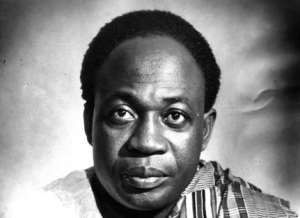
In September 1945, Kwame Nkrumah was not yet the man in bronze. Even the name by which history would come to know him was still taking shape. In contemporary records of the Fifth Pan-African Congress, he still appeared as "Francis Nkrumah." He was thirty-six, recently arrived in Britain from the United States, and immersed in the ordinary labour from which political movements are built: meetings, correspondence, organisation, and argument. He was preparing to play a key role in that historic October gathering in Manchester that year and subsequently became Secretary-General of the West African National Secretariat.
By February 1946, he was corresponding with Kobina Sekyi (ARPS), J. B. Danquah (Gold Coast Youth League), Ashie-Nikoi (Gold Coast Farmers Committee), John Tsiboe (Ashanti Pioneer), and other nationalists in the Gold Coast at the time (and the wider sub-region), about the struggle for complete West African independence.
Indeed, Nkrumah did not create Gold Coast nationalism, nor did he meet an empty terrain. He entered a politically active society with an argumentative African press, older nationalist organisations, educated elites, organised labour, and established traditions of African political thought. What distinguished him was his remarkable capacity to help transform this inheritance into mass mobilisation. Returning to the Gold Coast in December 1947 as General Secretary of the United Gold Coast Convention, he broke with the organisation, formed the Convention People's Party in June 1949, led Positive Action, went to prison, won election while incarcerated, and emerged as Leader of Government Business in 1951. He became Prime Minister in 1952. On 6 March 1957, barely twelve years after Manchester, he stood at the head of an independent Ghana.
The scale of what followed explains much of Nkrumah's enduring appeal. His government did not regard political independence as the completion of nationalism. Tema, Akosombo, educational expansion, and industrialisation reflected a larger belief that the inherited colonial economy could be remade. Beyond Ghana, Nkrumah invested heavily in African liberation and continental unity and gave powerful expression to the idea of an African personality, an older intellectual tradition that he associated with African emancipation, dignity, and confidence in the world. Whatever judgement history makes about individual policies, there was an unmistakable audacity to the enterprise.
That record, however, cannot be divided conveniently between an early visionary and a later authoritarian who somehow lost his way. The Preventive Detention Act came in 1958, barely a year after independence. Opposition violence, assassination attempts, and bitter conflict created genuine security problems, but the government's response increasingly narrowed political freedom. Power became more concentrated, opponents were detained, and Ghana formally became a one-party state in 1964. Mounting economic difficulties, produced by both domestic choices and an increasingly difficult external environment, added to the pressures on his government. Developmental ambition, centralisation, and intolerance of opposition increasingly inhabited the same state.
The coup of 24 February 1966 therefore overthrew a government with real political and economic problems. But what followed was more than a change of regime, as the National Liberation Council attempted to dismantle Nkrumah's place in Ghana's official national story. The CPP was proscribed, institutions associated with him were renamed, his image was publicly repudiated, and his statue was toppled. Nkrumah, who was outside the country when the coup occurred, would never return alive. He spent his remaining years principally in Guinea and died in Bucharest on 27 April 1972.
His return to Ghana's public life was neither immediate nor universally accepted. It came through a gradual accumulation of political, institutional, and cultural acts. His remains came home in 1972 and were buried at Nkroful. By 1979, the People's National Party, which claimed the Nkrumaist inheritance, had won a parliamentary majority and the presidency under Hilla Limann. In 1992, Nkrumah's remains were transferred to the purpose-built memorial park in Accra, where a new statue restored him physically and symbolically to the national landscape. In 1998, Parliament restored his name to the Kwame Nkrumah University of Science and Technology, from which it had been removed after the 1966 coup. Roads, institutions, books, lectures, monuments, and eventually even an offshore oil-production vessel (FPSO) carried his name.
This rehabilitation was never politically neutral. Ghana's Nkrumaist and Danquah-Dombo-Busia traditions have continued to differ over the relative place of Nkrumah and other nationalists in the achievement of independence. The national calendar eventually became another arena for that older contest. President John Evans Atta Mills's government established 21 September as Founder's Day in 2009. Under President Nana Addo Dankwa Akufo-Addo, 4 August became Founders' Day and 21 September Kwame Nkrumah Memorial Day. In 2025, Parliament reversed that arrangement, removed 4 August from the commemorative calendar, and restored 21 September as Founder's Day. Thus, six decades after Nkrumah ceased to govern Ghana, the country is still debating how he should inhabit its founding story.
While these arguments have continued, another transformation has occurred more quietly. The generation that knew Nkrumah as a living political actor is disappearing. An eighteen-year-old on Independence Day would now be eighty-seven. Most Ghanaians alive today never experienced Nkrumah as president, political opponent, liberator, or authoritarian ruler. They inherited him. Their Nkrumah comes through family recollections, textbooks, political traditions, documentaries, photographs, monuments, speeches, and commemorations. The passage from living to inherited memory places a different responsibility upon historians, schools, museums, universities, and the state.
It also raises a question that deserves greater attention on this Founder's Day, and that is: what is all this remembering for?
Ghana has accumulated enormous symbolic capital around Kwame Nkrumah. His name carries recognition far beyond the country. His life evokes emotional attachment and fierce disagreement. He occupies physical, educational, and political space while remaining one of the most recognisable symbols of Pan-African aspiration across Africa and its diaspora. Successive generations have invested public money, scholarship, argument, institutional attention, and political energy in constructing, destroying, recovering, and defending his place in Ghanaian history.
For much of the past sixty years, Ghana's public commemorative culture has therefore been preoccupied with whether Nkrumah deserves remembrance and what position he should occupy within the national story. Ghanaian historians and scholars have, of course, long subjected his record to critical examination, and serious scholarship has never been reducible to ceremonial praise. The question here, therefore, is different. It concerns the larger public culture through which Nkrumah is commemorated, taught, invoked, and inherited. What civic and intellectual return does Ghana obtain from this extraordinary accumulation of symbolic capital?
I would argue that what Ghana's public commemoration of Nkrumah now needs is a stronger culture of critical inheritance.
Critical inheritance asks more of us than either veneration or repudiation. It requires a willingness to inherit the whole historical figure, to recognise achievement without manufacturing perfection, and to confront failure without using it to erase achievement. Its practical expression would be what we might call a "usable Nkrumah": a Nkrumah whose ideas, decisions, ambitions, methods, successes, and mistakes become resources through which the present can interrogate itself.
By a usable Nkrumah, I do not mean selecting convenient portions of his life to serve present purposes. Ghana has had enough of that. Neither should the objective be to manufacture another officially approved Nkrumah. Rather, it should be to cultivate a public culture confident enough to encounter the whole historical figure and to ask what his life illuminates about the problems of our own time.
We might begin by recovering the organiser behind the monument. Before the presidential office came years of reading, writing, correspondence, travel, persuasion, and institution-building. The Nkrumah of Manchester did not possess state power. He possessed ideas, networks, and an extraordinary willingness to work. In an age when successful people are often encountered first at the point of visibility, there is something valuable in studying the preparation that preceded Nkrumah's triumphs. History rarely changes because people admire ideas. Somebody has to organise around them.
His scale of ambition deserves equal attention. Ghana does not need to reproduce Nkrumah's economic programme. The world of the 2020s is not the world of the 1960s. But Tema and Akosombo should provoke a larger question than whether one supports Nkrumah politically. Are we still capable of imagining national projects whose benefits may mature beyond the government that begins them? One danger of democratic politics is the temptation to compress national ambition into electoral cycles. Nkrumah's record, including the economic difficulties that eventually confronted his government, should encourage a more demanding conversation about how bold vision must be joined to sound financing, institutional capacity, and disciplined implementation.
The African personality offers another inheritance worth interrogating. The idea had an intellectual history before Nkrumah, but he gave it particular political force in the age of African independence. For his generation, colonialism had shaped not merely who governed Africans but assumptions about whose knowledge, institutions, and standards possessed authority. What might African personality demand of us today, when our universities, governments, and societies still consume so many technologies, theories, cultural products, and developmental prescriptions produced elsewhere? It cannot mean intellectual isolation. Obviously not. Instead, it should mean possessing enough confidence to learn from the world without assuming that Africa must always approach it as a pupil.
Most importantly, critical inheritance requires us to recover Nkrumah's mistakes.
The Preventive Detention Act should lead us into serious conversations about civil liberty and the ease with which governments can persuade themselves that opponents obstruct national progress. The one-party state should remind us that national unity is not political conformity. The concentration of authority around a charismatic leader should teach why institutions must remain larger than those who temporarily occupy them. The economic strains of his later government should remind us that the nobility of an ambition does not exempt it from questions of cost, capacity, and execution.
Indeed, a mistake from which a nation learns is also an inheritance.
Founder's Day itself could, therefore, acquire greater civic purpose. Schools should not merely tell children that Nkrumah was a great man. Let them read him. Let university students examine a policy that succeeded alongside one that failed. Let citizens ask what African personality means in the age of artificial intelligence, what economic independence means for a country still heavily dependent on imported goods, and what Pan-Africanism demands in the age of the African Continental Free Trade Area. Let us also ask why governments born from struggles for freedom can become intolerant of dissent.
None of this diminishes Nkrumah. It takes him seriously.
The larger issue, then, is how a nation chooses to inherit its history. Nkrumah's continuing value lies partly in the difficulty he presents us: his life resists the comfort of simple judgement. To inherit him seriously is to accept that the same historical figure can enlarge a nation's political imagination while also warning it about the dangers that accompany power, certainty, and ambition. That tension should not be resolved for succeeding generations. It should be handed to them as a question.
So, let 21 September be heralded with speeches, wreaths, recalled quotations, shared memories, and renewed arguments about Nkrumah and Ghana's independence. All have their place. The deeper value of commemoration, however, should lie in what remains after the ceremonies are over: whether successive generations can draw upon the ambitions he pursued, the institutions he built, the ideas he advanced, and the errors he made to think more intelligently about their own responsibilities. Such an endeavour should move us beyond the decades-old debate over where Nkrumah belongs in Ghana's past towards the more consequential question of what that past can contribute to the Ghana we are still trying to build.
(The writer is an award-winning media executive, historian, educator, and leadership consultant with graduate training in business, communication, education, and African Studies)

 Ghana, Panama sign MoU to deepen bilateral political consultations
 Founder’s Day: NAPO urges Ghanaians to uphold Kwame Nkrumah’s legacy
 Founder’s Day: Mahama urges Ghanaians to draw inspiration from Nkrumah’s vision
 Mahama to build 400-bed Mother and Child Block at Korle Bu – Kwakye Ofosu
 GES threatens sanctions against SHS heads imposing unauthorised charges
 Betting could destroy future of Ghana’s youth in 3–5 years – Akim Swedru MP
 Zimbabwe Suspends Journalist for One Year Over ‘Unethical’ Reporting on Chinese ...
 Third Drug Mule in 3 Weeks: R2m Heroin Found in SA Man’s Luggage at OR Tambo
 NACOC Debunks MP’s Claim as France’s €225m Cocaine Case Deepens
 Putin party retains majority in first vote since 2022 invasion of Ukraine


