




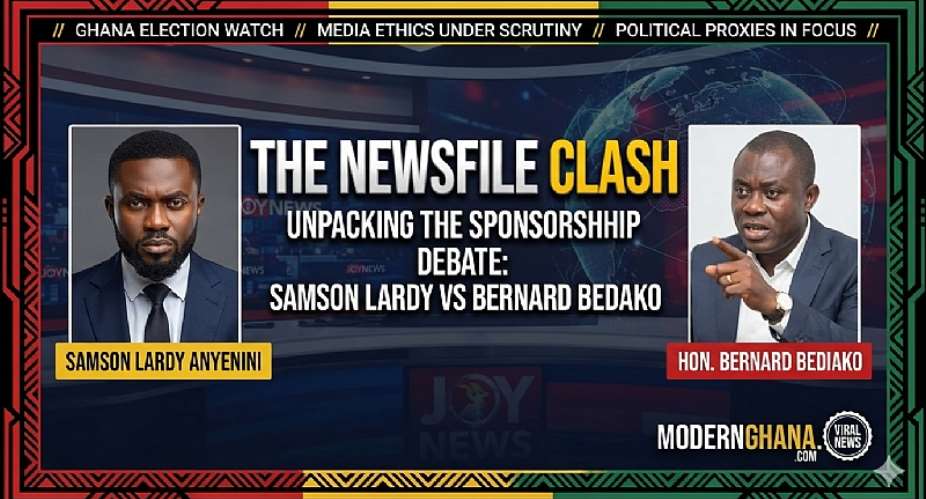
In a vibrant democracy like Ghana's, the relationship between political parties and media practitioners is constantly under the microscope. This scrutiny reached a boiling point on August 19, 2026, during an episode of JoyNews' flagship current affairs program, NewsFile. What began as a standard panel discussion erupted into a fierce clash between the host, renowned legal practitioner and broadcast journalist Samson Lardy Anyenini, and the National Democratic Congress (NDC) Member of Parliament for Akwatia, Bernard Bediako Baidoo. The confrontation centered on explosive, long-standing public perceptions that political entities secretly bankroll fierce external commentators like Kevin Taylor. This incident highlights a growing national concern: the delicate balance between robust political communication, media neutrality, and the active discouragement of dangerous rhetoric.
THE CRUX OF THE CLASH: THE "WHYs" BEHIND THE CONFRONTATION
To understand why this exchange became an instant viral sensation, we must dissect the underlying triggers that brought these two legal minds to an impasse:
- The Attempted Distinction: The clash ignited when MP Bernard Bediako Baidoo tried to separate the harsh political commentary of US-based media personality Kevin Taylor from that of "Ghana Jollot"—a commentator declared wanted by the Ghana Police Service for allegedly inciting public violence.
- The Backlash on Alleged Sponsorship: Samson Lardy Anyenini firmly pushed back against any attempts to rationalize aggressive media outputs. The exchange tapped directly into a prominent public narrative: allegations that the opposition NDC sponsors Kevin Taylor’s aggressive, pro-NDC media campaigns.
- Professional Accountability: As a former Journalist of the Year, Anyenini sought to maintain a strict standard on NewsFile, enforcing the principle that the media must not be used to shield or justify entities that skirt the edge of unlawful incitement.
- Defending Party Integrity: On the other side, Bediako, serving as an NDC lawmaker and lawyer, was perceived as attempting to salvage the political image of the party by decoupling mainstream party leanings from loose-cannon commentators, sparking an intense back-and-forth on air.
EDUCATING GHANA: KEY TAKEAWAYS FROM THE INCIDENT
This viral clash is not just entertainment; it serves as a crucial case study for the Ghanaian electorate on how political communication operates today:
- The Rise of Proxy Communicators: Political parties increasingly rely on unaffiliated digital broadcasters to drive aggressive narratives that mainstream politicians cannot explicitly state on the record.
- The Legal Limits of Free Speech: There is a stark constitutional difference between severe political criticism and comments that actively border on cross-border incitement or public disturbance.
- The Role of Host Neutrality: Media hosts carry the burden of acting as gatekeepers, ensuring that public platforms do not inadvertently validate toxic rhetoric or unverified allegations of political backing.
RECOMMENDATIONS AND SUGGESTIONS FOR THE WAY FORWARD
To preserve the integrity of Ghana’s media landscape ahead of future political cycles, the following structural steps are recommended:
- Clear Party Disclaimers: Political parties, including the NDC and the NPP, must issue explicit, formal disclaimers distancing themselves from independent commentators who use violent or deeply divisive language.
- Enhanced National Media Commission (NMC) Vigilance: The NMC must step up its monitoring of digital feeds and cross-border broadcasts that affect local peace, collaborating with internet service providers to flags clear incitement.
- Audience Decoupling: Ghanaian citizens should learn to decouple official party positions from the sensationalized content created by online political influencers whose primary metric is digital engagement rather than factual accuracy.
- Standardized Gatekeeping: Media houses must follow the precedent set during this NewsFile episode—swiftly checking panellists whenever they attempt to normalize or validate rogue actors.
The fiery exchange between Samson Lardy Anyenini and Hon. Bernard Bediako Baidoo is a symptom of a much larger systemic challenge in Ghanaian politics. Whether the allegations regarding the NDC’s sponsorship of fringe external commentators are rooted in reality or are merely clever political folklore, the lesson remains clear. Ghana's democratic stability relies on maintaining a clean media space. As the nation moves forward, politicians must recognize that defending toxicity for short-term partisan gain damages the wider democratic framework, and the media must remain fearless in calling it out.
✍️ Submitted by:
Retired Senior Citizen
For and on behalf of all Senior Citizens of the Republic of Ghana 🇬🇭
Teshie-Nungua, Accra
📧 [email protected]

 Ghana, Panama sign MoU to deepen bilateral political consultations
 Founder’s Day: NAPO urges Ghanaians to uphold Kwame Nkrumah’s legacy
 Founder’s Day: Mahama urges Ghanaians to draw inspiration from Nkrumah’s vision
 Mahama to build 400-bed Mother and Child Block at Korle Bu – Kwakye Ofosu
 GES threatens sanctions against SHS heads imposing unauthorised charges
 Betting could destroy future of Ghana’s youth in 3–5 years – Akim Swedru MP
 Zimbabwe Suspends Journalist for One Year Over ‘Unethical’ Reporting on Chinese ...
 Third Drug Mule in 3 Weeks: R2m Heroin Found in SA Man’s Luggage at OR Tambo
 NACOC Debunks MP’s Claim as France’s €225m Cocaine Case Deepens
 Putin party retains majority in first vote since 2022 invasion of Ukraine


