




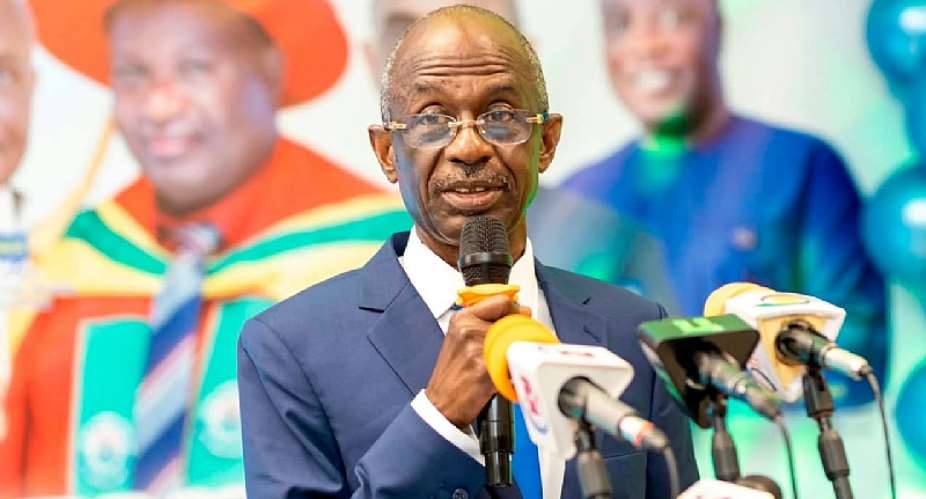
National Chairman of the National Democratic Congress (NDC), Johnson Asiedu Nketiah, has urged journalists in the Bono Region to intensify their monitoring of public projects and create a credible record of government development commitments.
He said journalists should go beyond reporting the commissioning of projects to regularly track their implementation, cost, timelines and impact on communities.
Mr Asiedu Nketiah was speaking as the Special Guest of Honour at the 4th Bono Regional Ghana Journalists Association (GJA) Awards, held in Sunyani on Saturday, September 19, 2026.
The awards were held under the theme: “Ethics, Integrity and Impactful Journalism – Essential Ingredients for Societal Transformation.”
He challenged journalists to document major development projects in the region by finding out what had been awarded, the contractors responsible, the value and terms of contracts, and the scheduled completion dates.
“When the date arrives, go back. Find out whether the work was completed and whether the public received what it paid for,” he said.
Mr Asiedu Nketiah said where projects were successfully implemented, journalists should report the achievement to the public, while problems encountered should also be investigated to establish what happened and who was responsible.
He said such consistent monitoring would ensure that years later, the media archives could provide an independent account of what happened to major development commitments made in the region.
“Five years from now, it should be possible for somebody to go into the archives of the media in Bono and reconstruct what happened to the major development commitments being made today,” he said.
According to him, such documentation was one of the important ways journalism could hold political authorities and public institutions accountable.
Regional journalism
Mr Asiedu Nketiah also emphasised the importance of regional journalism, saying too much of Ghana’s national conversation remained concentrated in Accra.
He noted that developments affecting farmers, businesses, young people, schools, hospitals, roads and district assemblies formed an important part of the national story and deserved sustained media attention.
He urged journalists to move beyond press conferences and seek stories in communities, markets, farms, hospitals, district budgets and procurement records.
“Some of the stories that matter most to people's lives will never begin at a press conference,” he said.
The NDC National Chairman, who is also a former Speaker of Parliament, said the media had an important role in helping the country make better decisions by providing citizens with accurate information on development and public expenditure.
Government must accept scrutiny
Mr Asiedu Nketiah, while acknowledging his position as National Chairman of the governing NDC, said the government should expect scrutiny from the media.
He said ministers should be prepared to answer legitimate questions, while public expenditure and government promises should be subjected to proper examination.
“This government should expect scrutiny. Ministers should answer legitimate questions. Public expenditure should be examined. The promises we made to Ghanaians should be checked against what we deliver,” he said.
He stressed that journalists should report both achievements and shortcomings based on verified facts, irrespective of which political party benefited from the coverage.
“Journalism serves the citizen best when the facts are established properly and reported without regard to which political party finds them convenient,” he added.
Mr Asiedu Nketiah also called on politicians and public officials to provide journalists with the information required for accurate reporting and to avoid treating difficult questions as hostility.
He said uncomfortable questions could sometimes draw the attention of public officials to issues that people around them might be unwilling to raise.
Call for sustainable journalism
The NDC National Chairman further expressed concern about the conditions under which journalists operate, saying media organisations needed adequate resources to employ and retain competent professionals, investigate stories and maintain strong regional newsrooms.
He said journalists should be able to build sustainable careers without becoming financially dependent on politicians, businesses or institutions they were expected to cover.
“If we want high professional standards, the sustainability of serious journalism deserves attention as well,” he said.
Mr Asiedu Nketiah also advised award winners to value the professional reputation they build over time, saying credibility was more important than the immediate recognition associated with an award.
He urged journalists to maintain their commitment to fact-checking, thorough interviews and responsible reporting, particularly when covering politically sensitive issues.
Economic recovery
Touching on the national economy, Mr Asiedu Nketiah said Ghana was emerging from a difficult period characterised by economic instability, high public debt and rising prices.
He said the economy had begun to improve, citing growth of six per cent in the second quarter of 2026 and inflation of five per cent in August.
He, however, said the significance of those improvements would ultimately depend on whether they translated into better incomes, stronger businesses and improved living conditions for citizens.
Mr Asiedu Nketiah also said Ghana needed to avoid abandoning useful programmes whenever there was a change of government, arguing that projects and policies that were working should be improved rather than discarded because of their political origins.
He called for greater long-term planning in areas such as agriculture, industrial development, energy, transportation, housing and public services.
Congratulating the award winners, Mr Asiedu Nketiah commended the Bono Regional branch of the GJA for sustaining the awards and recognised the contribution of journalists and media practitioners to public life in the region.
He urged journalists to continue keeping an accurate record of the country’s development journey, including government promises, public expenditure, projects, results and the conditions of the people.
Award winners
Lawrence Yeboah Gyan of Wisdom FM, a campus radio of the Catholic University of Ghana, Fiapre, won the 2025 overall Best Bono Region GJA Award alongside two other awards.
Biiya Mukusah Ali of the Daily Graphic grabbed two awards - the Best Tourism report (print category) and Best Agroecology and Agri-business award.
Ghanaian Times’ Bono Regional Correspondent, Daniel Bruce Dzirasah went home with the Best report on mining as well as the Best Development-focused report.
Other award winners were Claude Kumi Abisa (TV3) - Tourism (Electronic); Emmanuel Kwadwo Gyan, Sky FM - Best Radio (electronic) documentary; Precious Semevoh of Joy News - Climate Change and Green Transition; Edward Adjei-Frimpong, a freelancer - Business & Finance category; Michael Sarpong-Mfum (Channel One TV) Education; Samuel Kumi, Service Radio - Best Morning Show Host and Osei Kwadwo Laar (Sun City Radio) - Best Newscaster in Akan.

 The 'Ghana Jollof' Backlash — Why the Arrest of Nurse Salomey Must Wake Up Every...
 Ghana, Panama sign MoU to deepen bilateral political consultations
 Founder’s Day: NAPO urges Ghanaians to uphold Kwame Nkrumah’s legacy
 Founder’s Day: Mahama urges Ghanaians to draw inspiration from Nkrumah’s vision
 Mahama to build 400-bed Mother and Child Block at Korle Bu – Kwakye Ofosu
 GES threatens sanctions against SHS heads imposing unauthorised charges
 Betting could destroy future of Ghana’s youth in 3–5 years – Akim Swedru MP
 Zimbabwe Suspends Journalist for One Year Over ‘Unethical’ Reporting on Chinese ...
 Third Drug Mule in 3 Weeks: R2m Heroin Found in SA Man’s Luggage at OR Tambo
 NACOC Debunks MP’s Claim as France’s €225m Cocaine Case Deepens


