




On Monday, 14 September 2026, His Excellency President John Dramani Mahama presided over the formal handover of the cleared right-of-way for the proposed Accra-Kumasi Expressway at Kwaso, near Ejisu in the Ashanti Region. Engineers of the Ghana Armed Forces had cleared 175.6 kilometres of the corridor in 19 weeks, one week ahead of schedule. The proposed expressway itself will cover approximately 198.7 kilometres, including about 176 kilometres of new six-lane expressway and roughly 23 kilometres of upgraded connector roads, linking Ablekuma in Greater Accra to Sewua in the Ashanti Region.
The project deserves recognition for its ambition. The existing Accra-Kumasi highway is approximately 270 kilometres, and the new alignment is intended to shorten the journey considerably and reduce travel time between Ghana's two largest economic centers. The government has also announced substantial domestic financing for the project.
“But one statement made during the ceremony deserves a much deeper national conversation”
President John Dramani Mahama disclosed that "space had deliberately been reserved within the expressway corridor to accommodate a future railway between Accra and Kumasi". He also indicated that the Finance Minister would develop a financing plan for railway revitalisation. The intention is understandable and, at first glance, attractive. Reserving land today could avoid the enormous future costs of land acquisition, compensation, and encroachment when Ghana eventually decides to construct the railway.
However, I believe Ghana must be extremely careful.
A railway should not automatically follow a road simply because the road has already created a convenient corridor. The more important question is: where should the railway go if its purpose is to transform Ghana?
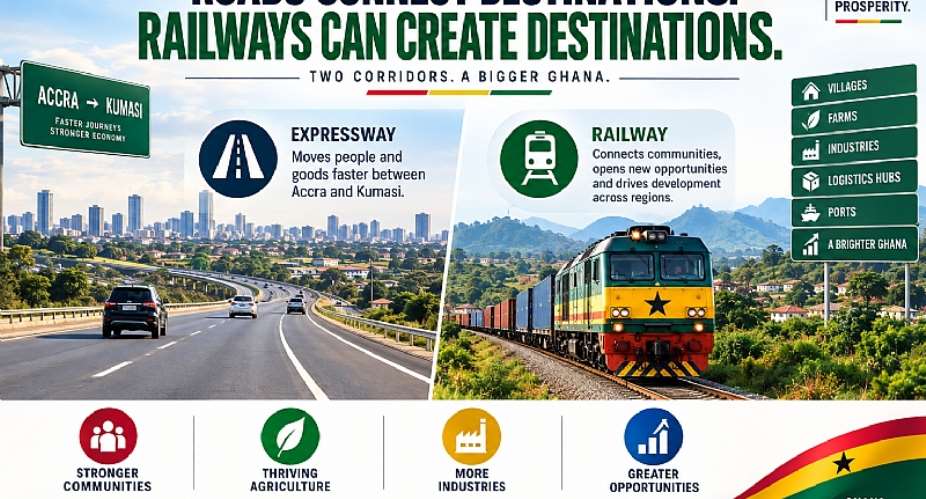
This distinction could determine whether Ghana builds a railway merely connecting Accra and Kumasi or creates a railway corridor capable of opening entirely new areas of the country to development. Ghana should resist the temptation to think of railway development as simply putting tracks beside highways. Roads and railways perform overlapping but fundamentally different spatial-development functions. An expressway is primarily designed to move road vehicles quickly between major destinations. A railway, particularly in a developing economy, can do something much more transformative: it can create economic nodes. A railway station can change the economic geography of a community. It can become a collection point for agricultural produce. It can support warehouses and logistics centers. It can encourage residential and commercial development. It can attract processing industries. It can connect workers with employment centers and students with educational institutions. It can give previously peripheral communities direct access to national markets.
That means the alignment of a railway should be determined not simply by the shortest distance between two large cities but by a combination of freight demand, population distribution, industrial potential, agricultural production, settlement patterns, future urban growth and multimodal connectivity. If the future Accra-Kumasi railway simply runs beside a high-speed expressway from Ablekuma to Sewua, Ghana risks placing two major transport investments inside essentially the same development corridor. That may be efficient from the perspective of land acquisition. It may not necessarily be optimal from the perspective of national development.
Roads mainly connect existing destinations, but railways can help create new ones. This distinction matters greatly for Ghana’s future transport planning. The Accra-Kumasi Expressway is intended to improve movement between the country’s two major economic centers, but railway planning should go further by asking which towns, agricultural zones, industrial areas, and logistics hubs could be transformed through rail access. Ghana’s existing Eastern Railway concept already demonstrates this broader role by linking Accra, Kumasi, and Tema Port while supporting hinterland development and regional trade. Rather than automatically placing a future railway beside the new expressway, Ghana should undertake a comparative corridor study to identify the alignment that delivers the greatest long-term economic, social and spatial benefits.
A well-designed railway can stimulate new settlements, industrial clusters, agricultural markets and inland logistics centers, thereby reducing excessive economic concentration in Accra and Kumasi. Multimodal transport should also be understood as integration rather than simple physical proximity. Railways, roads, ports and inland waterways do not need to follow the same route; they need efficient interchange points. This is especially important for connecting rail with Tema and Takoradi ports, Boankra, and the Volta Lake system. Reserving land for future rail is therefore sensible, but the reserved corridor should not automatically determine the final railway alignment. Ghana is making a decision that could shape national development for generations. The central question should be whether the railway merely follows the road or strategically opens new parts of Ghana to trade, industry, investment and opportunity.
God Bless Our Homeland Ghana!
Author: Joseph Fuseini: ([email protected])


 Ghana, Panama sign MoU to deepen bilateral political consultations
 Founder’s Day: NAPO urges Ghanaians to uphold Kwame Nkrumah’s legacy
 Founder’s Day: Mahama urges Ghanaians to draw inspiration from Nkrumah’s vision
 Mahama to build 400-bed Mother and Child Block at Korle Bu – Kwakye Ofosu
 GES threatens sanctions against SHS heads imposing unauthorised charges
 Betting could destroy future of Ghana’s youth in 3–5 years – Akim Swedru MP
 Zimbabwe Suspends Journalist for One Year Over ‘Unethical’ Reporting on Chinese ...
 Third Drug Mule in 3 Weeks: R2m Heroin Found in SA Man’s Luggage at OR Tambo
 NACOC Debunks MP’s Claim as France’s €225m Cocaine Case Deepens
 Putin party retains majority in first vote since 2022 invasion of Ukraine


