




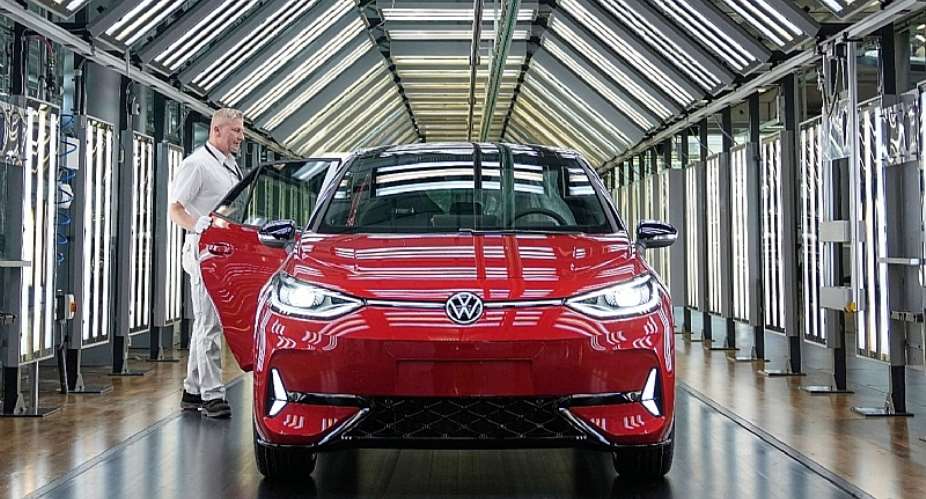
The Germany finance minister demanded tougher EU tariffs on Chinese carmakers as Volkswagen's (VW) crisis hit headquarters, and Chinese car brands head toward selling more than a million cars on the continent in 2026.
When the Germany finance minister visited Volkswagen's (VW) headquarters to deliver a warning about China, the symbolism wasn't subtle. Standing in the shadow of the carmaker's flagship plant, Lars Klingbeil told Brussels it was time to stop pulling punches with Beijing, a message aimed less at EU trade officials than at the tens of thousands of German autoworkers watching their jobs about to disappear.
"We cannot be naive in our dealings with China", Klingbeil said, When he met the VW staff representatives and local politicians. Germany, he added, needs "a different, more robust approach toward countries that threaten our industry."
It's a striking shift in tone from Europe's largest economy, one that reflects just how existential the crisis at its iconic industry has become. Volkswagen (VW), the Europe's biggest carmaker and long a symbol of German industrial might, is in the middle of what it has itself called, the deepest restructuring in its 89-year history, with cumulative job cuts now approaching 100,000.
Mercedes-Benz and BMW are trimming their own workforces too, as all three grapple with a common enemy: Chinese manufacturers that are outproducing, outpricing, and increasingly outselling them, especially in electric vehicles.
A crisis Brussels can no longer ignore
Klingbeil's visit, landed at a delicate moment for the EU's trade relationship with Beijing. The bloc has imposed elevated tariffs on Chinese built Electro-Vehicles, arguing that, they're propped up by state subsidies that give them an artificial cost advantage. But those tariffs stop short of hybrid vehicles which have become one of the fastest growing categories for Chinese exporters looking to sidestep the existing barriers.
That loophole is now squarely in Berlin's sights. Klingbeil said Germany would push Brussels for "concrete measures" covering both plug-in hybrids and local content requirements, rules that would force manufacturers selling into Europe to source a greater share of parts from European suppliers.
He wasn't alone in making the case. Daniela Cavallo, who chairs Volkswagen's supervisory board and has long been one of the company's most influential labor voices, appeared alongside the minister to back an extension of tariffs to Chinese hybrids. "We find ourselves in enormously tough, difficult and unfair competition with China," she said.
Chinese manufacturers now regularly outselling established names like Ford, Audi and Mercedes-Benz in individual months.
Chinese brands are on track to sell more than 1 million cars in Europe in 2026 for the first time, a threshold that would have seemed implausible just three years ago, when sales were smaller than what a single mid-size European manufacturer might convert in a good quarter.
The scale of the shift explains why a finance minister is now weighing in on car tariffs. Five years ago, Chinese-brand vehicles barely registered in Europe selling 66,000 units out of a market of more than 11 million new cars. By 2023 that share had climbed to roughly 3%. Then it kept climbing: 6.1% in 2025, and 9.2% in the first half of 2026 alone, with Chinese manufacturers now regularly outselling established names like Ford, Audi and Mercedes-Benz in individual months.
Much of that growth has come through a route the existing tariffs don't cover. The EU's elevated duties on Chinese EVs, in place since 2024, briefly slowed the pace that year, but manufacturers pivoted hard into plug-in hybrids, a category exempt from the levies. Chinese brands' share of European sales jumped from 2.5% to 13.7% in just twelve months.
The workers are not just waiting quietly
The politics here are inseparable from the shop floor. IG Metall, Germany's largest industrial union and a powerful presence on VW's supervisory board, has spent much of the past year locked in an increasingly bitter standoff with management over the pace and scale of job losses.
The union has organized repeated walkouts and protests at VW plants from Zwickau to Hanover, and it's planning another round of nationwide demonstrations at car plants and suppliers, a pointed reminder to the German Government in Berlin that patience is running out.
Francis Tawiah (Duisburg, Germany)


 Foreign Affairs Ministry requests special audit of emergency evacuations since 2...
 Germany cuts energy tax to lower petrol prices as Merz faces state key elections
 Trump says son repaid Russian oligarch who funded wedding festivities
 France calls on Moscow to reverse takeover of European assets
 Highly influential people sponsoring Ghana Jollof TikTok activities – CID
 'Ghana Jollof' case: Bawumia's condemnation of nurse's arrest is hypocritical – ...
 Ahafo Ano South West MP involved in road accident
 Constitutional Review alone will not solve Ghana’s problems – Kwesi Pratt Jnr.
 East Legon Football Academy applauds NPA Boss for supporting youth football
 Lawyer challenges two-week remand of Salomey over connection to wanted 'Ghana Jo...


