




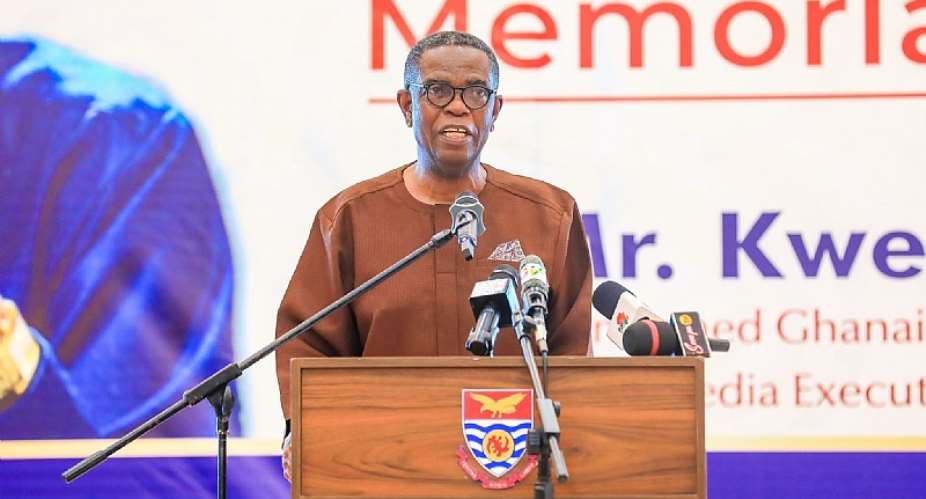
Veteran journalist and Managing Editor of the Insight newspaper, Kwesi Pratt Jnr., has argued that Ghana’s persistent constitutional challenges cannot be resolved solely through amendments to the 1992 Constitution, stressing that the real problem lies in the conduct of political leaders and state institutions.
Delivering the first lecture in the 15th Kwame Nkrumah Memorial Lectures at the University of Cape Coast (UCC), Mr Pratt said that although certain flaws in the Constitution require correction, no constitutional document can, by itself, protect ordinary citizens from exploitation by powerful interests.
Speaking on the theme, “Kwame Nkrumah, Yesterday, Today and Tomorrow: Perspectives on Constitutionalism, Development and Pan-Africanism,” he noted that a constant tension exists between Ghana’s economic realities and the ideals enshrined in the Constitution.
“In that tension, the poor and the marginalised always lose out,” he said.
According to him, constitutional provisions alone cannot guarantee justice or accountability.
“No formulation of words on a piece of paper will protect the poor against rapacious elites. No constitution enforces itself. No constitution in the world enforces itself,” he stated.
Mr Pratt cautioned that calls for constitutional review sometimes distract attention from the actions of those entrusted with political power. While acknowledging shortcomings in the constitutional framework, he maintained that recurring constitutional crises stem more from how leaders and institutions operate than from defects in the document itself.
“Continual constitutional crisis cannot be explained by poor drafting and review, although defects in the text are real and must be corrected,” he said.
He criticised the political class for what he described as repeated abuses of power since the advent of the Fourth Republic. He accused successive administrations of overreach, mismanagement of national resources and disregard for citizens’ rights.
Mr Pratt also expressed concern about the performance of key state institutions. He argued that Parliament has frequently failed to hold the Executive accountable, while the Supreme Court has not always interpreted constitutional law in ways that empower ordinary citizens to challenge abuses by those in authority.
Reflecting on the legacy of Ghana’s first President, Dr Kwame Nkrumah, Mr Pratt said constitutional reform during the independence struggle was inseparable from broader political and economic transformation.
He explained that Nkrumah viewed constitutional change as a strategic tool for moving the Gold Coast from colonial rule to self-government and eventually to full independence.
According to him, Nkrumah transformed the nationalist movement from an elite-led campaign into a mass movement that mobilised workers, farmers, market women, students and other segments of society.
Mr Pratt noted that after the formation of the Convention People’s Party (CPP) in 1949, the party organised rallies, political campaigns and grassroots structures that intensified pressure for immediate self-government.
He described Nkrumah’s Positive Action campaign as a disciplined non-violent resistance movement involving strikes, boycotts, press activism and non-cooperation with colonial authorities.
“Nonviolence was not a weakness. It required courage, organisation and restraint. It was not passive. It was active resistance,” he said.
While Nkrumah supported constitutional reforms, Mr Pratt explained that he opposed arrangements that preserved colonial domination and delayed self-rule. He noted that constitutional developments in 1951, 1954 and 1956, combined with consistent electoral victories by the CPP, paved the way for Ghana’s independence on March 6, 1957.
He described Nkrumah’s constitutional strategy as a gradual process in which mass mobilisation compelled constitutional reforms, which were then used to advance the nation toward complete sovereignty.
A significant portion of the lecture focused on Nkrumah’s economic vision. Mr Pratt rejected what he called the simplistic narrative that Nkrumah destroyed Ghana’s economy.
He argued that Ghana inherited a colonial economy heavily dependent on the export of raw materials such as cocoa, gold and timber, while relying on imports for manufactured goods.
According to him, Nkrumah understood that political independence would remain incomplete without fundamentally transforming that economic structure.
Mr Pratt said the Seven-Year Development Plan sought to achieve industrialisation, economic diversification, agricultural modernisation, infrastructure expansion, human capital development and greater African economic integration.
He highlighted investments made during the period in factories, electricity generation, roads, schools, universities, hospitals, ports and housing projects, saying these were intended to create a productive foundation for national development.
Although he acknowledged serious challenges, including falling cocoa prices, rising external debt, inflation, shortages and administrative constraints, he argued that these difficulties do not justify reducing Nkrumah’s legacy to economic failure.
“The claim, repeated by Nkrumah’s ideological opponents, that he simply destroyed Ghana’s economy, is too crude to survive any serious examination,” he said.
Instead, he urged a more nuanced assessment focused on whether state investments built productive capacity, were effectively managed and generated sufficient returns to meet the country’s financial obligations.
Mr Pratt added that Ghana’s continuing dependence on raw material exports, limited industrialisation, debt burdens, foreign exchange pressures and unemployment indicate that many of the structural weaknesses Nkrumah sought to address still remain.
Addressing one of the most controversial aspects of Nkrumah’s administration, Mr Pratt discussed the Preventive Detention Act, which empowered the government to detain individuals without trial.
He noted that the Nkrumah administration justified the law on grounds of national security, citing bomb attacks, assassination attempts, violent conspiracies and threats to the stability of the newly independent state.
At the same time, he acknowledged the significant implications of granting governments the power to detain citizens without ordinary criminal proceedings.
According to him, any administration that employs such powers must accept responsibility for their human consequences.
Mr Pratt further emphasised that discussions about Nkrumah’s government should also recognise the violent opposition and assassination attempts the former President faced during his time in office.
Source: UCC
 Ahafo Ano South West MP involved in road accident
 Constitutional Review alone will not solve Ghana’s problems – Kwesi Pratt Jnr.
 East Legon Football Academy applauds NPA Boss for supporting youth football
 Gov't didn't show NPP enough respect in constitutional review process – Martin K...
 September 18: Cedi sells at GHS12.15 on forex market, GHS11.53 on BoG interbank
 Lawyer challenges two-week remand of Salomey over connection to wanted 'Ghana Jo...
 Minority calls for NSA boss Ampofo Ankrah, others to be dismissed over alleged 2...
 ‘You gave us GH¢60,000 to run 66 offices nationwide and expect us to function?’ ...
 Russia seizes assets of Swiss food giant Nestle and three French firms
 Russia votes in parliamentary election as war in Ukraine drags on


