




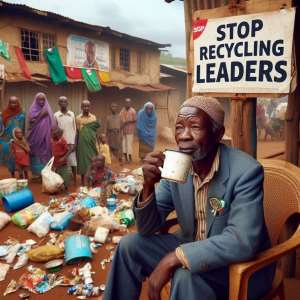
There is a peculiar kind of week that only Ghana seems able to produce — the kind where the President is standing on a reclaimed dumpsite in Agbogbloshie shaking hands with soldiers in the morning, while by evening a TikTok account with a food-based alias has the whole country arguing about free speech, incitement, and how far the state should go to silence a voice it does not like. Add to that a Japanese astronaut touring Accra talking about space debris while ordinary Ghanaians still struggle with debris of a much more terrestrial kind, a freshly minted public holiday honouring the birth of the man who gave us our flag, and a string of arrests spanning cybercriminals, drug mules, and a nurse from Techiman — and you begin to understand why writing an honest column about Ghana in September 2026 requires more patience than writing about most other places on Earth. This is not a country short on drama. It is a country long on contradictions, and this week gave us a full buffet of them.
Let me walk you through it, plainly, fairly, and without pretending that any single actor in these stories — government, police, activist, or TikToker — has a monopoly on virtue.
The Mountain Finally Moves
For as long as most young Ghanaians can remember, the Agbogbloshie waste heap has sat in the middle of Accra like an open wound the city learned to live with. On Friday, September 18, President John Dramani Mahama personally commissioned what has been billed as a National Emergency Waste Evacuation Exercise, aimed squarely at that mountain of refuse choking the Korle Lagoon corridor. The operation is expected to remove roughly one million tonnes of accumulated waste over ninety days, based on a drone-assisted artificial intelligence assessment of the heap. The waste will travel a punishing forty-two kilometres from the heart of Accra to the Adepa Engineered Landfill Site near Nsawam in the Eastern Region, a joint effort of the Ministry of Local Government, the Ghana Armed Forces, and the District Road Improvement Programme.
What struck me most was not the scale but the financing logic. Finance Minister Cassiel Ato Forson revealed that the exercise will be funded through the District Assemblies Common Fund, built around a cost-saving proposal to reuse machines the DRIP programme had already paid for, with fresh money going only toward fuel and allowances. That is the kind of budgeting Ghanaians say they want from their government — practical, and mercifully free of another expensive foreign consultancy. To spare Accra's already suffocating traffic, much of the haulage will happen at night, with movement restricted during the day. Mahama did not stop at the trucks either; he directed the Accra Metropolitan Assembly and the Ablekuma Central Municipal Assembly to tighten enforcement of sanitation bylaws, warning that clearing the heap counts for nothing if residents simply return to dump on the reclaimed land.
Now, the fair-minded columnist in me must ask the uncomfortable question the government would rather I skip: why does it take an "emergency" declaration and a presidential photo-op to move waste that has been accumulating for decades? Agbogbloshie did not appear overnight. Successive administrations — NDC and NPP alike — walked past that heap for years, and it is worth noting that this "emergency" comes conveniently timed with heightened public scrutiny of urban sanitation ahead of local government elections. A ninety-day clean-up is commendable. A ninety-day clean-up followed by five years of silence, as has happened before with sanitation pledges in this country, would be a betrayal dressed up as an achievement. The true test is not the commissioning ceremony; it is whether Adepa's landfill, and the promised network of "modern transfer stations" and "recycling infrastructure," actually materialise once the cameras leave Jamestown.
When the Sky Comes Calling
While bulldozers prepared to move mountains of earthly waste, Ghana was also looking upward. Between September 15 and 19, the Ministry of Foreign Affairs hosted Dr Koichi Wakata — a five-time space flyer and Axiom Space's Chief Technology Officer for the Asia-Pacific — for a series of engagements exploring deeper Ghana-Japan cooperation in space science. Foreign Minister Samuel Okudzeto Ablakwa hosted Wakata for dinner at the Ministry on September 15, pledging the Ministry's readiness to coordinate international partnerships that advance Ghana's strategic interests. This is not a new friendship; it builds on GhanaSat-1, developed by three Ghanaian engineers at All Nations University in partnership with Japan's Kyushu Institute of Technology, and deployed from Japan's Kibo module aboard the International Space Station back in 2017.
There was a genuinely moving moment buried in the diplomatic formality: students of Presbyterian Boys' Secondary School, fresh off winning the National Science and Maths Quiz for a record ninth time, sat with Wakata and heard him speak about the realities of human spaceflight. If you want to know why Ghana keeps producing quiz champions with nowhere near enough laboratories to match their talent, that image says it all — brilliance without infrastructure. Ablakwa reportedly framed the longer ambition as nothing less than producing Ghana's first astronaut, and with Ghana and Japan set to mark seventy years of diplomatic ties in 2027, there is real institutional weight behind the rhetoric.
Here is where I must be the fair broker rather than the cheerleader. Space cooperation sounds glamorous, and Ghanaians are entitled to dream big. But when a nation cannot yet reliably evacuate its own waste without declaring a national emergency, some will rightly ask whether satellite ambitions are premature theatre. I would gently push back on that cynicism, though, because the two are not actually in competition. The same earth-observation technology this partnership promises — used for agriculture, disaster response, and environmental monitoring — could, in a properly funded future, be exactly the tool that helps track illegal dumping sites like Agbogbloshie before they become emergencies. Space technology and sanitation trucks are not rivals for the same coin; they are, if managed honestly, two arms of the same modernisation effort.
A Birthday Ghana Keeps Renegotiating
Amid all this, Ghanaians got official confirmation of something many had already circled on their calendars: Monday, September 21, 2026, has been declared Founder's Day, a statutory public holiday, under a declaration signed by Interior Minister Muntaka Mohammed-Mubarak. The day commemorates the birthday of Dr Kwame Nkrumah, Ghana's first President, and follows Parliament's passage of the Public Holidays and Commemorative Days Amendment Bill last year, which restored July 1 as Republic Day, dropped August 4 from the calendar entirely, and reinstated September 21 as Founder's Day.
If that sentence made your head spin, you are not alone. This is now at least the third time in a decade that Ghana's political class has rearranged which date honours Nkrumah, which date honours the "Big Six," and which date is simply Republic Day. I will say this plainly: constantly shuffling the commemorative calendar every time political winds shift cheapens the very history these holidays are meant to preserve. Whether you view Nkrumah as the singular father of the nation or insist, as some historians and descendants of the other five independence leaders do, that his outsized commemoration erases equally vital contributions, the flip-flopping itself does a disservice to both camps. Ghanaians deserve a settled, bipartisan national holiday calendar that does not get rewritten with every change of government. That said, there is something to be said for correcting historical imbalance — for decades, August 4 as "Founder's Day" was seen by Nkrumahists as a deliberate diminishment of his legacy, engineered to spread credit thin. Reasonable people can disagree on where the balance sits; what is not reasonable is treating national memory as a political football to be repositioned every election cycle.
The Long Arm of the Law, Reaching in Many Directions
Ghana's security apparatus has had a genuinely busy fortnight, and the range of cases tells its own story about the country's evolving threat landscape. On the international crime front, Ghana's Narcotics Control Commission announced the arrest of three individuals accused of representing and facilitating the local activities of Dutch fugitive drug lord Jos "Bolle Jos" Leijdekkers, tied to a 3.9-metric-tonne cocaine shipment intercepted by French customs in Dunkirk. One of the three, identified as Desmond Curiel, a 34-year-old Dutch-Ghanaian, is described as one of Leijdekkers's key accomplices. That Ghana is now visibly entangled in European narco-trafficking networks, rather than simply serving as a transit rumour, should worry every citizen who remembers how quickly cocaine money corrupted institutions elsewhere in West Africa.
Closer to home, the Police Service also had to clean its own house: seven police officers were interdicted over an alleged extortion incident in Accra, a reminder that accountability must cut both ways — toward citizens and toward the uniform itself. Meanwhile, in Ashaiman, an ex-convict was arrested for impersonating a soldier and extorting residents, caught with a full set of military camouflage in his possession — a small case, but one that speaks to a worrying pattern of civilians weaponising the mere symbolism of the security services for personal gain. And earlier this month, Parliament's Defence and Interior Committee chair disclosed a sobering statistic for a country that prides itself on stability: more than 300 people were arrested along Ghana's northern border between 2023 and 2025 over suspected recruitment attempts by extremist groups, alongside 47 cross-border security incursions. Ghana is not an island. The Sahel's instability is knocking, gently but persistently, on our northern door, and it deserves more sustained national attention than a single conference disclosure.
Jollof, Justice, and the Limits of Free Speech
And then there is the story that has consumed timelines more than any policy announcement this week: the Ghana Police Service's decision to publicly declare a TikTok personality known as "Ghana Jollof" a wanted person. In a notice issued on September 17, police identified the account's operator as 40-year-old Barbara Asantewaa Kodua, describing her as fair in complexion, last seen at Accra's international airport in August 2022, and suspected of currently hiding in the United Kingdom, in connection with an alleged case of inciting violence. The declaration followed the arrest, days earlier, of a Techiman-based nurse; Salomey Awiti Bafoh, a Senior Nursing Officer, was remanded for two weeks by the Adenta Circuit Court on charges of abetting the publication of false news, accused of acting as Kodua's liaison in producing and circulating the TikTok content.
This is precisely the kind of story where a columnist must resist the temptation to pick a side simply because one side shouts louder online. On one hand, if the allegations of incitement to violence are substantiated by evidence, the Police Service has both the right and the responsibility to investigate and, where warranted, prosecute — no online persona, however popular or partisan, is above the law, and inciting violence is a real and prosecutable offence in any functioning democracy, not merely in Ghana. On the other hand, the manner of the declaration has drawn serious and legitimate pushback. Lawyer and human rights activist Oliver Barker-Vormawor publicly criticised the Police Service for what he called an unnecessary public stunt, and that criticism deserves to be weighed carefully rather than dismissed as mere partisan noise, given Ghana Jollof's known association with the opposition NPP. A wanted notice, especially one broadcast this visibly on social media against a figure openly critical of the sitting government, inevitably invites questions about whether due process is being observed or whether public shaming is being used as a substitute for it. Ghana's own history — including past controversies over the use of "false news" and cybercrime statutes against government critics — means this scepticism cannot simply be waved away as sympathy for wrongdoing.
The honest position, the only one I can defend without fear or favour, is this: the public has not been shown the underlying evidence of incitement, so no one — least of all a columnist writing from Accra — is in a position to declare Kodua guilty or innocent in the court of public opinion. What can be said fairly is that both extremes are dangerous. A police service that treats every viral government critic as a security threat corrodes public trust and free expression. A public that treats every police action against a controversial figure as automatically political corrodes the rule of law just as surely. Ghana Jollof's own reported response — a defiant video mocking President Mahama, the First Lady, and the presiding Adenta Court judge — will do nothing to cool this down, and inflammatory responses from either side rarely serve the truth. This case deserves due process, transparency about the specific evidence of incitement, and a resolution through the courts rather than through hashtags. Anything less risks setting a precedent that could just as easily be turned against critics of a different political stripe tomorrow.
Steelmanning the Other Side
Because I insist on fairness even when it is uncomfortable, let me steelman the positions I have just questioned. The government's defenders would rightly note that emergency declarations, whether for waste or for security matters, often require exactly the kind of political urgency and presidential visibility that critics dismiss as theatre — sometimes a spectacle is precisely what breaks years of bureaucratic paralysis, and Agbogbloshie's residents, who have lived beside that heap for a generation, are unlikely to complain about the optics if the waste is genuinely gone in ninety days. The Police Service's defenders would argue that incitement to violence is a serious matter regardless of the accused's political affiliation, and that failing to act against any citizen — TikToker or otherwise — because of fear of a "politicisation" narrative would itself be a dereliction of duty; the police cannot be expected to ignore credible threats simply because doing something about them will be unpopular in certain circles. And defenders of the shifting holiday calendar would point out that correcting historical injustice sometimes requires more than one attempt, and that Nkrumah's global stature as a Pan-Africanist icon arguably justifies a permanent, unambiguous national day in his honour, separate from the broader independence commemoration.
These are not frivolous arguments. They deserve a hearing, even from those of us inclined to be sceptical of power.
The Ghanaian Way of Holding Two Truths at Once
There is something quintessentially Ghanaian about all of this happening in the same week. We are a people who can mourn a national embarrassment and celebrate a national milestone in the same breath, who can queue for waakye at dawn while debating constitutional law by lunchtime, who treat both an astronaut's visit and a TikTok scandal with the same electric seriousness. Perhaps that is our national gift: the refusal to let any single story — triumphant or troubling — define us completely. Agbogbloshie's mountain of waste and Wakata's talk of the stars above both belong to the same Accra sky. A Founder's Day holiday and a police wanted notice both belong to the same national conversation about who gets to define Ghana's story, and on whose terms.
Author's Note
I write this column not as a defender of any political party, nor as an apologist for any institution — not the Presidency, not the Police Service, not the activists who oppose them. My commitment, as always, is to hold up a mirror that is honest even when the reflection is unflattering to power. Ghana in September 2026 is a nation evacuating literal mountains of trash while still negotiating figurative mountains of political and legal ambiguity. Both efforts matter. Both deserve scrutiny. And both, I believe, will ultimately be judged not by this week's headlines, but by what Ghana looks like ninety days, or ninety months, from now.
About the Author
Chief Tutu Baffour Asare Brownsy Williams is an opinion columnist, author, and filmmaker based in Accra, Ghana, and the founder of Brownsy Silva Company, a multi-disciplinary creative platform spanning fiction, film, and current affairs commentary. He writes on Modern Ghana for a diaspora readership spanning the United Kingdom, the United States, Canada, and Germany, and is currently pursuing engineering studies at Accra Technical University.

 Foreign Affairs Ministry requests special audit of emergency evacuations since 2...
 Germany cuts energy tax to lower petrol prices as Merz faces state key elections
 Trump says son repaid Russian oligarch who funded wedding festivities
 France calls on Moscow to reverse takeover of European assets
 Highly influential people sponsoring Ghana Jollof TikTok activities – CID
 'Ghana Jollof' case: Bawumia's condemnation of nurse's arrest is hypocritical – ...
 Ahafo Ano South West MP involved in road accident
 Constitutional Review alone will not solve Ghana’s problems – Kwesi Pratt Jnr.
 East Legon Football Academy applauds NPA Boss for supporting youth football
 Lawyer challenges two-week remand of Salomey over connection to wanted 'Ghana Jo...


